3D structure opens new avenue for drug discovery
Apr 02, 2012
3D structure opens new avenue for drug discovery
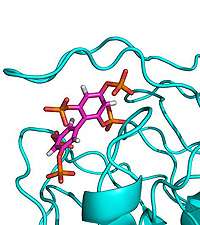
The 3D structure of SHIP2 (cyan) with the Bath-designed inhibitor molecule bound (pink and orange)

(PhysOrg.com) -- An international consortium has determined the structure of an important new drug target in complex with a synthetic molecule designed by our researchers, opening up new avenues for drug discovery.

The enzyme SHIP2, which plays a major role in cell signalling, has attracted particular attention due to its role in the negative regulation of insulin signalling and is thought to be involved in type-2 diabetes, obesity and cancer. Previous attempts to crystallise the enzyme with its natural substrate were unsuccessful, so scientists at Bath designed a new synthetic inhibitor as a mimic and with their European colleagues solved the X-ray of a key fragment of SHIP2 bound to this compound.

The research, recently published in the leading international journal ACS , was a collaborative project carried out by an international group of scientists based at the Karolinska Institutet in Stockholm Sweden, Nanyang University Singapore, the Université Libre de Bruxelles in Belgium and the University of Bath.

The scientists also undertook computational molecular dynamics on the complex, and discovered a flexible loop region of the protein that may close over the compound during binding. The researchers hope that targeting such a closed complex could provide a new strategy for the design of small-molecule drugs against SHIP2.

Professor Barry Potter, who led the enterprise together with his Wellcome Trust–funded Bath colleagues Drs Steve Mills, Andrew Riley, Gyles Cozier and Mark Thomas, said: “Such interdisciplinary collaboration represents a real route to early progress in at a time when the global pharmaceutical industry is restructuring and looking more than ever towards academic-industry partnerships for early stage drug discovery, rather than in-house R&D.

“These data further reinforce use of a new class of that we have pioneered at Bath for several years, for co-crystallisation studies.

“This work emphasises the strength of Medicinal Chemistry at the University of Bath and demonstrates that academic scientists can play a key role in drug discovery, particularly at early and innovative stages.”

The next step will be to design in silico related, but more drug-like, compounds that might bind to the closed complex of the SHIP2 enzyme. The researchers hope that others will use their work as a starting point to design such novel drug candidates.

Explore further: Protein study suggests drug side effects are inevitable

More information: pubs.acs.org/doi/pdf/10.1021/cb200494d

Related Stories

Research paper on cancer drug accorded 'VIP' status

Oct 27, 2011

A paper on the anti-cancer drug Irosustat, designed by researchers at the University of Bath, has been awarded 'Very Important Paper' status by the medicinal chemistry journal ChemMedChem, including a spec ...

Novel approach to cancer drug given major boost

Jan 15, 2007

Scientists at the ProXara Biotechnology Limited have identified a way of switching off one of the key mechanisms that leads to the development and growth of a tumour. Under the Wellcome Trust's Seeding Drug Discovery initiative, ...

Spotlight on dynamic operation of enzymes

Jun 15, 2011

Our world is unique in that living organisms can undergo complex chemical reactions quickly and precisely, and sequence them together. But how can proteins integral to life effectively hasten these reactions? ...

Recommended for you

New method for producing clean hydrogen

12 hours ago

Duke University engineers have developed a novel method for producing clean hydrogen, which could prove essential to weaning society off of fossil fuels and their environmental implications.

Making ice-cream more nutritious with meat left-overs

19 hours ago

Food industries are now turning meat left-over into high-protein content ingredients for food supplements, or to be added to processed food. But a EU-wide regulation covering them is still lacking.

Non-wetting fabric drains sweat

May 20, 2013

(Phys.org) —Waterproof fabrics that whisk away sweat could be the latest application of microfluidic technology developed by bioengineers at the University of California, Davis.

Protein study suggests drug side effects are inevitable

May 20, 2013

A new study of both computer-created and natural proteins suggests that the number of unique pockets – sites where small molecule pharmaceutical compounds can bind to proteins – is surprisingly small, meaning drug side ...

Attacking MRSA with metals from antibacterial clays

May 17, 2013

In the race to protect society from infectious microbes, the bugs are outrunning us. The need for new therapeutic agents is acute, given the emergence of novel pathogens as well as old foes bearing heightened antibiotic resistance.

User comments : 0

More news stories

New method for producing clean hydrogen

Duke University engineers have developed a novel method for producing clean hydrogen, which could prove essential to weaning society off of fossil fuels and their environmental implications.

Protein study suggests drug side effects are inevitable

A new study of both computer-created and natural proteins suggests that the number of unique pockets – sites where small molecule pharmaceutical compounds can bind to proteins – is surprisingly small, meaning drug side ...

Beautiful 'flowers' self-assemble in a beaker

By simply manipulating chemical gradients in a beaker of fluid, materials scientists at Harvard have found that they can control the growth behavior of crystals to create precisely tailored structures—such ...

Attacking MRSA with metals from antibacterial clays

In the race to protect society from infectious microbes, the bugs are outrunning us. The need for new therapeutic agents is acute, given the emergence of novel pathogens as well as old foes bearing heightened antibiotic resistance.

If you can remember it, you can remember it wrong

(Medical Xpress)—Native peoples in regions where cameras are uncommon sometimes react with caution when their picture is taken. The fear that something must have been stolen from them to create the photo ...

B vitamins could delay dementia

(Medical Xpress)—Despite spending billions of dollars on research and development, drug companies have been unable to come up with effective treatments for dementia and Alzheimer's Disease (AD). Now, A. ...

Encouraging signs for bee biodiversity

Declines in the biodiversity of pollinating insects and wild plants have slowed in recent years, according to a new study. Researchers led by the University of Leeds and the Naturalis Biodiversity Centre in the Netherlands ...