U-M architecture student builds a tent for the ultimate test: survival
February 16, 2012 By William Foreman
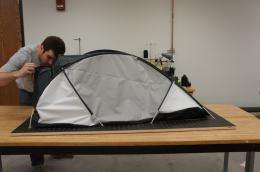
Andrew McCarthy puts the finishing touches on a half-scale model of a tent he designed for his climbing expedition. Credit: Andrew McCarthy
Andrew McCarthy didn't know how to sew five weeks ago. But that didn't stop the University of Michigan graduate student in architecture from stitching up his own tent for a thesis project.
Now, McCarthy is planning to put the tent to the ultimate test. He's going to sleep in it as he climbs Aconcaguathe highest mountain in the Western Hemisphere.
His tent project won't just be about getting a good grade. It will be about survival. Violent winds could rip the shelter to shreds in the middle of the night if it's not made right. Climbers die on the mountain every year.
But McCarthy is confident about his creation: "I think it has a good shot. It's a strong tent."
He flew to South America on Sunday and planned to spend a couple days trekking to the mountain in western Argentina. If the expedition goes as planned, McCarthy said he will reach the top of Aconcagua which means "Stone Sentinel" - on one of the last three days of February.
The second-year graduate student from Grand Rapids, Mich., said he has long been interested in nomadic dwellings and architecture for extreme environments.
"I wanted to make a tent specifically from the dimensions of my body, something I can design, build and live in," he said.
One of the most remarkable things about McCarthy's tent is how quickly he was able to design and construct it. The project began in January, during the first week of the semester, when he told one of his advisers, Prof. Shaun Jackson, that he wanted to build a tent for extreme climates.
Jackson said, "He set up such an incredibly tight timeline that I didn't think that it would be possible for him to complete the tent before his scheduled departure date.
"But he worked nonstop, stayed up night after night. He has done a brilliant job managing his time," said Jackson, who has his own design firm with a client list that includes L.L. Bean, Patagonia and Eddie Bauer.
McCarthy documented his project on his blog and he hopes to provide updates during his expedition if it's possible.
His tight schedule didn't allow his enough time to invent a new type of tent or introduce new materials. Just building a tent for the first time was a huge challenge. The geometry is complex and the rip-stop nylon material must have the right amount of uniform tension as it stretches around the poles that make up the frame.
"The vents and the doors were really difficult," he said. "It took me a couple days to figure out how to do it."
If the panels and other pieces aren't precisely cut, the tent just drapes over the poles like a loose bag. When the freezing, howling winds on the mountain kick up, the tent will just flap itself into oblivion.
McCarthy tested a half-scale model tent in a wind tunnel, and the structure was able to withstand winds of 60 mph to 80 mph before small tears started to form. The tent completely broke down when the wind was cranked up to 122 mph.
If winds rip apart the tent on Aconcagua, McCarthy hopes to be able to take refuge in another shelter with his expedition, which will include nine other climbers and two guides.
McCarthy has summited Mt. Kilimanjaro in Africa as well as mountains in the Andes and glaciers in Iceland.
Although he had to put in long hours in his studio constructing his tent, he always found time for a rigorous fitness regime.
"I started training last October," he said. "Then it became more intense in December."
He would lace up his boots and strap on his 60-pound pack for grueling sessions on a StairMaster machine. He also cycled, ran uphill on a treadmill and did core-strengthening exercises.
Now he hopes his tent will be as strong as his body.
Provided by
University of Michigan
-
From lemons to lemonade: Reaction uses carbon dioxide to make carbon-based semiconductor,
33 comments
-
Thioridazine kills cancer stem cells in human while avoiding toxic side-effects of conventional cancer treatments,
3 comments
-
SpaceX private rocket blasts off for space station (Update),
42 comments
-
Landmark calculation clears the way to answering how matter is formed,
55 comments
-
Research team claims to have found evidence Lake Cheko is impact crater for Tunguska Event,
18 comments
-
Need a rigid insulation material???
May 26, 2012
-
magnets or EMF in car bumpers to protect from fender bender
May 26, 2012
-
length of wire in a coil of known dimensions?
May 25, 2012
-
India Engineering Powerhouse
May 25, 2012
-
electromagnet core dereference between hard and soft iron
May 25, 2012
-
Measuring water pressure in an open tank
May 24, 2012
- More from Physics Forums - General Engineering
More news stories
Browser wars flare in mobile space
The browser wars are heating up again, but this time the fight is for dominance of the mobile Internet.
20 hours ago |
4 / 5 (4) |
3
Probability of contamination from severe nuclear reactor accidents is higher than expected: study
Catastrophic nuclear accidents such as the core meltdowns in Chernobyl and Fukushima are more likely to happen than previously assumed. Based on the operating hours of all civil nuclear reactors and the number ...
Technology / Energy & Green Tech
May 22, 2012 |
3.6 / 5 (25) |
57
|
HyperSolar shows dirty water no barrier to power world
(Phys.org) -- The Santa Barbara, California, company, HyperSolar, is set to transparently share the ups and downs of its research experiences toward the companys ultimate vision, successfully producing ...
Tesla to launch electric sedan in US on June 22
Tesla Motors said Tuesday it would begin deliveries of "the world's first premium electric sedan" on June 22, slightly ahead of schedule.
Technology / Energy & Green Tech
May 22, 2012 |
4.5 / 5 (12) |
18
SpotterRF debuts Radar Backpack Kit (w/ Video)
(Phys.org) -- SpotterRF has announced a special radar backpack kit designed to enhance situational awareness for soldiers on the ground. The company says its special radar is designed for warfighters as part ...
Stunning image of smallest possible five-ringed structure
Scientists have created and imaged the smallest possible five-ringed structure about 100,000 times thinner than a human hair and you'll probably recognise its shape.
'Unzipped' carbon nanotubes could help energize fuel cells, batteries
Multi-walled carbon nanotubes riddled with defects and impurities on the outside could replace some of the expensive platinum catalysts used in fuel cells and metal-air batteries, according to scientists at ...
Change in developmental timing was crucial in the evolutionary shift from dinosaurs to birds: study
At first glance, it's hard to see how a common house sparrow and a Tyrannosaurus Rex might have anything in common. After all, one is a bird that weighs less than an ounce, and the other is a dinosaur that ...
Computer model used to pinpoint prime materials for efficient carbon capture
When power plants begin capturing their carbon emissions to reduce greenhouse gases and to most in the electric power industry, it's a question of when, not if it will be an expensive undertaking.
T cells 'hunt' parasites like animal predators seek prey, study shows
By pairing an intimate knowledge of immune-system function with a deep understanding of statistical physics, a cross-disciplinary team at the University of Pennsylvania has arrived at a surprising finding: T cells use a movement ...
Yale study concludes public apathy over climate change unrelated to science literacy
Are members of the public divided about climate change because they don't understand the science behind it? If Americans knew more basic science and were more proficient in technical reasoning, would public consensus match ...
Feb 16, 2012
Rank: 3 / 5 (1)
Feb 16, 2012
Rank: not rated yet
Feb 16, 2012
Rank: 5 / 5 (1)
Feb 16, 2012
Rank: not rated yet