Quantum biology and Ockham's razor
February 6, 2012

Quantum biology and Ockham's razor

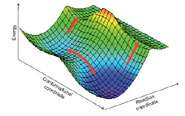
Simple schematic of a two-dimensional energy landscape

(PhysOrg.com) -- In a paper just published in Nature Chemistry, a team of University of Bristol scientists explores whether new models or concepts are needed to tackle one of the 'grand challenges' of chemical biology: understanding enzyme catalysis.

On a , nearly all the machinery that keeps our working involves chemical reactions of some sort and these reactions wouldn’t happen without enzymes – natural catalysts which make reactions happen very quickly, fast enough for life to be possible.

How do they do this?  Understanding is a fundamental problem in biology.  Billions of years of evolution have made enzymes superb catalysts, but the underlying physical principles are hotly debated.  If we could design catalysts like them, they could transform areas such as ‘green’ energy generation and would make it possible to make new molecules in environmentally friendly ways.  Engineered enzymes and designed protein catalysts are far less efficient than their natural counterparts, however.  Chemists have yet to achieve the dream of making catalysts as powerful as natural enzymes.

This has led many researchers to propose that current theoretical models and concepts may not be adequate for understanding enzymes, and that new paradigms are required.  This is particularly true for enzyme reactions that involve a particular quantum mechanical phenomenon known as tunnelling.

In quantum tunnelling, a particle passes through a barrier that, according to the laws of classical mechanics, it should not be able to get over.  Scientists have known for some time that a whole host of reactions across chemistry and biology involve quantum tunnelling (in particular, the many reactions that involve transfer of particles as small as hydrogen atoms) and they have developed accurate models to describe its effects for chemical reactions.

However, some experimental observations for enzymes have led to recent suggestions that quantum tunnelling models for are inadequate when enzymes are involved.  These ideas propose that enzymes somehow force tunnelling to happen in some special way – and that we therefore require new models for understanding how enzymes work.  So: do we have the theoretical tools to understand enzymes, or are new models and concepts needed?

In a paper published in Nature Chemistry, Dr David Glowacki, Professor Jeremy Harvey and Professor Adrian Mulholland of Bristol’s School of took Ockham’s razor to the enzyme tunnelling problem.

They used some simple maths to show that standard models for describing quantum tunnelling can explain the experimental enzyme data, so long as one accounts for the fact that enzymes have many possible different structures.  Enzymes, like all proteins, are constantly fluctuating between many subtly different structures, which can have significantly different catalytic properties.

This dynamic nature of proteins has also been highlighted by scientists who study protein folding (the process by which a protein structure assumes its functional shape or conformation, the other ‘grand challenge’ of ).  The Bristol researchers' paper indicates that structural fluctuations are significant, and by including them in modelling, scientists have the theoretical tools needed to understand these amazing natural catalysts.  This should make it possible in future to design new catalysts using these principles.

More information: ‘Taking Ockham’s razor to enzyme dynamics and catalysis’ by David R. Glowacki, Jeremy N. Harvey and Adrian J. Mulholland in Nature Chemistry

Provided by University of Bristol search and more info website

4.6 /5 (12 votes)  

Filter


Move the slider to adjust rank threshold, so that you can hide some of the comments.


Display comments: newest first

ChrisKeturakis
Feb 06, 2012

Rank: not rated yet
It's just a matter of the correct characterization. Work by the group of Prof. Israel Wachs is uncovering the mechanisms behind oxidation reactions and enzyme mimics: see older physorg article - http://www.physor...yst.html

They've already moved into actual enzyme territory and will probably publish results this year. They've given many presentations on their work.
Rank 4.6 /5 (12 votes)
Relevant PhysicsForums posts

More news stories

Computer model used to pinpoint prime materials for efficient carbon capture

When power plants begin capturing their carbon emissions to reduce greenhouse gases – and to most in the electric power industry, it's a question of when, not if – it will be an expensive undertaking.

Chemistry / Materials Science

created 12 hours ago | popularity not rated yet | comments 0 | with audio podcast

Scientists develop ultra-sensitive test that detects diseases in their earliest stages

Scientists have developed an ultra-sensitive test that should enable them to detect signs of a disease in its earliest stages, in research published today in the journal Nature Materials.

Chemistry / Analytical Chemistry

created 12 hours ago | popularity 5 / 5 (1) | comments 0 | with audio podcast

New CO2-removing catalyst can take the heat

(Phys.org) -- The current method of removing the greenhouse gas carbon dioxide (CO2) from the flues of coal-fired power plants uses so much energy that no one bothers to use it. So says Roger Aines, principal ...

Chemistry / Materials Science

created May 24, 2012 | popularity 5 / 5 (9) | comments 11 | with audio podcast

High-speed method to aid search for solar energy storage catalysts

Eons ago, nature solved the problem of converting solar energy to fuels by inventing the process of photosynthesis.

Chemistry / Materials Science

created May 25, 2012 | popularity 5 / 5 (3) | comments 4 | with audio podcast

Researchers demonstrate possible primitive mechanism of chemical info self-replication

(Phys.org) -- When scientists think about the replication of information in chemistry, they usually have in mind something akin to what happens in living organisms when DNA gets copied: a double-stranded molecule ...

Chemistry / Materials Science

created May 25, 2012 | popularity 5 / 5 (4) | comments 2 | with audio podcast


Stunning image of smallest possible five-ringed structure

Scientists have created and imaged the smallest possible five-ringed structure – about 100,000 times thinner than a human hair – and you'll probably recognise its shape.

'Unzipped' carbon nanotubes could help energize fuel cells, batteries

Multi-walled carbon nanotubes riddled with defects and impurities on the outside could replace some of the expensive platinum catalysts used in fuel cells and metal-air batteries, according to scientists at ...

Change in developmental timing was crucial in the evolutionary shift from dinosaurs to birds: study

At first glance, it's hard to see how a common house sparrow and a Tyrannosaurus Rex might have anything in common. After all, one is a bird that weighs less than an ounce, and the other is a dinosaur that ...

T cells 'hunt' parasites like animal predators seek prey, study shows

By pairing an intimate knowledge of immune-system function with a deep understanding of statistical physics, a cross-disciplinary team at the University of Pennsylvania has arrived at a surprising finding: T cells use a movement ...

Yale study concludes public apathy over climate change unrelated to science literacy

Are members of the public divided about climate change because they don't understand the science behind it? If Americans knew more basic science and were more proficient in technical reasoning, would public consensus match ...

Land and sea species differ in climate change response: study

(Phys.org) -- Marine and terrestrial species will likely differ in their responses to climate warming, new research by Simon Fraser University and Australia’s University of Tasmania has found.