Researchers find molybdenite may be better suited for integrated logic circuits than graphene
February 1, 2012 by Bob Yirka
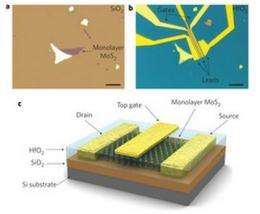
Fabrication of MoS2 monolayer transistors. Image from Nature Nanotechnology, 6, 147-150 (2011) doi:10.1038/nnano.2010.279
(PhysOrg.com) -- Because of its physical limitations, silicon use in tiny integrated logic circuits will have to one day soon be replaced by something that can work in a smaller state. That is, if we want to see miniaturization of computer components to continue. For several years, graphene has been seen as the most likely heir to the throne because it’s only one atom thick, which seems to be the physical limit for non-quamtum based computers. The problem with graphene though, is that it’s not a semiconductor in its natural state; it has to be put through special processes to make it so. Molybdenite (MoS2), on the other hand is a true semiconductor and it, like graphene can be produced in atom thick sizes, perhaps making it the ideal material to replace silicon once it reaches its size limits. Andras Kis and his colleagues at the Swiss Federal Institute of Technology in Lausanne, seem to believe so, their research into a way to create an actual integrated logic circuit from this material has been published in Nature Nanotechnology.
Molybdenite is a mineral that is found in nature but can also be made in the lab. Like silicon it can sometimes conduct electricity and sometimes not depending on the level of voltage (the bandgap). The problem with using molybdenite to create atom thick integrated logic circuits though, has been in figuring out how to connect a metal to them to convey the electricity. This is where the Swiss team has made a breakthrough, they’ve found they can attach an incredibly small bit of gold electrode to the molybdenite using hafnium oxide when it’s sitting on top of a base of silicon. The result is an integrated logic circuit that is thinner (just 0.65nm) than one that can be made from silicon. And, it’s much cheaper to produce than one of comparable size made of graphene.
Kis and his team don’t expect the computer industry to drop silicon and take up with molybdenite any time soon though, or maybe even at all. There’s still too much to learn about the material, they write and it’s also possible that other materials such as carbon nanotubes could be a better solution in the long run. But regardless, the fact that molybdenite has been shown to be a viable alternative for silicon is likely to take a little of the pressure off of chip makers as the limits of silicon eventually force manufactures to turn to something else.
More information: Single-layer MoS2 transistors, Nature Nanotechnology, 6, 147150 (2011) doi:10.1038/nnano.2010.279
Abstract
Two-dimensional materials are attractive for use in next-generation nanoelectronic devices because, compared to one-dimensional materials, it is relatively easy to fabricate complex structures from them. The most widely studied two-dimensional material is graphene, both because of its rich physics and its high mobility. However, pristine graphene does not have a bandgap, a property that is essential for many applications, including transistors. Engineering a graphene bandgap increases fabrication complexity and either reduces mobilities to the level of strained silicon films or requires high voltages. Although single layers of MoS2 have a large intrinsic bandgap of 1.8 eV (ref. 16), previously reported mobilities in the 0.53 cm2 V−1 s−1 range are too low for practical devices. Here, we use a halfnium oxide gate dielectric to demonstrate a room-temperature single-layer MoS2 mobility of at least 200 cm2 V−1 s−1, similar to that of graphene nanoribbons, and demonstrate transistors with room-temperature current on/off ratios of 1 × 10⁸ and ultralow standby power dissipation. Because monolayer MoS2 has a direct bandgap16, 18, it can be used to construct interband tunnel FETs, which offer lower power consumption than classical transistors. Monolayer MoS2 could also complement graphene in applications that require thin transparent semiconductors, such as optoelectronics and energy harvesting.
Journal reference:
Nature Nanotechnology
© 2011 PhysOrg.com
-
From lemons to lemonade: Reaction uses carbon dioxide to make carbon-based semiconductor,
33 comments
-
Thioridazine kills cancer stem cells in human while avoiding toxic side-effects of conventional cancer treatments,
3 comments
-
SpaceX private rocket blasts off for space station (Update),
42 comments
-
Landmark calculation clears the way to answering how matter is formed,
55 comments
-
Research team claims to have found evidence Lake Cheko is impact crater for Tunguska Event,
18 comments
-
How to determine the flexural rigidity of a composite
9 hours ago
-
microstructure of titanium
May 26, 2012
-
Steam in My Espresso Machine
May 26, 2012
-
Density question
May 24, 2012
-
Mass transport originating from a point source at a solid gas interface
May 22, 2012
-
Ammonia dispersion in Air
May 22, 2012
- More from Physics Forums - Materials & Chemical Engineering
More news stories
Stunning image of smallest possible five-ringed structure
Scientists have created and imaged the smallest possible five-ringed structure about 100,000 times thinner than a human hair and you'll probably recognise its shape.
6 hours ago |
4.5 / 5 (6) |
1
|
'Unzipped' carbon nanotubes could help energize fuel cells, batteries
Multi-walled carbon nanotubes riddled with defects and impurities on the outside could replace some of the expensive platinum catalysts used in fuel cells and metal-air batteries, according to scientists at ...
Nanotechnology / Nanomaterials
12 hours ago |
3 / 5 (2) |
0
|
Dopant gives graphene solar cells highest efficiency yet
(Phys.org) -- By taking advantage of graphenes favorable electrical and optical properties, and then adding an organic dopant, researchers have achieved the highest power conversion efficiency yet for ...
In nanorod crystal growth, nanoparticles seen as artificial atoms
In the growth of crystals, do nanoparticles act as "artificial atoms" forming molecular-type building blocks that can assemble into complex structures? This is the contention of a major but controversial theory ...
May 24, 2012 |
4.8 / 5 (6) |
0
|
First direct observation of oriented attachment in nanocrystal growth
Berkeley Lab researchers have reported the first direct observation of nanoparticles undergoing oriented attachment, the critical step in biomineralization and the growth of nanocrystals. A better understanding ...
May 24, 2012 |
4.7 / 5 (3) |
0
|
Change in developmental timing was crucial in the evolutionary shift from dinosaurs to birds: study
At first glance, it's hard to see how a common house sparrow and a Tyrannosaurus Rex might have anything in common. After all, one is a bird that weighs less than an ounce, and the other is a dinosaur that ...
Computer model used to pinpoint prime materials for efficient carbon capture
When power plants begin capturing their carbon emissions to reduce greenhouse gases and to most in the electric power industry, it's a question of when, not if it will be an expensive undertaking.
T cells 'hunt' parasites like animal predators seek prey, study shows
By pairing an intimate knowledge of immune-system function with a deep understanding of statistical physics, a cross-disciplinary team at the University of Pennsylvania has arrived at a surprising finding: T cells use a movement ...
Yale study concludes public apathy over climate change unrelated to science literacy
Are members of the public divided about climate change because they don't understand the science behind it? If Americans knew more basic science and were more proficient in technical reasoning, would public consensus match ...
Land and sea species differ in climate change response: study
(Phys.org) -- Marine and terrestrial species will likely differ in their responses to climate warming, new research by Simon Fraser University and Australia’s University of Tasmania has found.
10 million years needed to recover from mass extinction
It took some 10 million years for Earth to recover from the greatest mass extinction of all time, latest research has revealed.