Measurements from high-energy collisions lead to better understanding of why meson particles disappear
For several years, physicists at the Relativistic Heavy Ion Collider (RHIC) at Brookhaven National Laboratory (BNL), USA, have studied an unusual state of matter called the quark–gluon plasma, which they believe mimics the hot, dense particle soup that existed immediately after the big bang. Now, the PHENIX collaboration at RHIC reports findings about a particle called the J/ψ meson that will help physicists distinguish the properties of the quark–gluon plasma (QGP) from those of normal matter.
To create a QGP, physicists crash gold nuclei together at close to the speed of light. This provides enough energy to break apart the protons and neutrons in the nuclei into their constituent quarks and gluons, which mediate the force between quarks. In this energetic mash up, a host of short-lived particles can form, including mesons, which are made up of a quark and an anti-quark.
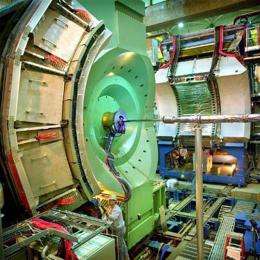
When collisions of gold nuclei yield fewer J/ψ mesons than expected from theoretical predictions, it indicates that a QGP has formed. Suppressed meson production can occur because the QGP weakens the binding force between the two quarks in the J/ψ particle. The PHENIX collaboration’s detector (Fig. 1) counts the number of J/ψ mesons created in collisions by detecting the electrons and muons—particles with the same charge, but more mass, than electrons—produced from J/ψ decays.
Effects other than the formation of the QGP, however, can also suppress the yield of J/ψ particles, which makes interpreting gold–gold collisions “ambiguous”, says Yasuyuki Akiba, a scientist at the RIKEN BNL Research Center and a member of the PHENIX collaboration.
To isolate these other effects, the PHENIX team analyzed data taken in 2003 and 2008 from collisions between deuterium—a proton and neutron—and gold, since these collisions cannot form a QGP. Even in the absence of a QGP, the team found the production of J/ψ particles was more suppressed than expected at the highest relative velocities between the deuterium and the gold collisions. “Conventional models cannot describe the data,” says Akiba.
The team thinks the unexplained suppression may be related to how the apparent density of gluons in the gold nuclei, which determines the rate of J/ψ production, varies with the speed of the deuterium.
More analysis is needed to determine whether this explanation is correct, but this work “gives a precise baseline that will be very useful for separating the quark–gluon plasma effects in gold–gold collisions,” says Akiba.
More information: Adare, A.,, et al. Cold nuclear matter effects on J/ψ yields as a function of rapidity and nuclear geometry in d + A collisions at √sNN = 200 GeV. Physical Review Letters 107, 142301 (2011).
Provided by RIKEN


