Study: Arctic sea ice decline may be driving snowy winters seen in recent years
These maps show the differences in snow cover relative to the long-term average for the winters of (left) 2009-2010 and (right) 2010-2011. During these two winters, the Northern Hemisphere measured its second and third largest snow cover levels on record. Credit: Georgia Tech/Jiping Liu
A new study led by the Georgia Institute of Technology provides further evidence of a relationship between melting ice in the Arctic regions and widespread cold outbreaks in the Northern Hemisphere. The study's findings could be used to improve seasonal forecasting of snow and temperature anomalies across northern continents.
Since the level of Arctic sea ice set a new record low in 2007, significantly above-normal winter snow cover has been seen in large parts of the northern United States, northwestern and central Europe, and northern and central China. During the winters of 2009-2010 and 2010-2011, the Northern Hemisphere measured its second and third largest snow cover levels on record.
"Our study demonstrates that the decrease in Arctic sea ice area is linked to changes in the winter Northern Hemisphere atmospheric circulation," said Judith Curry, chair of the School of Earth and Atmospheric Sciences at Georgia Tech. "The circulation changes result in more frequent episodes of atmospheric blocking patterns, which lead to increased cold surges and snow over large parts of the northern continents."
The study was published on Feb. 27, 2012 in the online early edition of the journal Proceedings of the National Academy of Sciences. The research was supported by NASA and the National Science Foundation.
In this study, scientists from Georgia Tech, the Chinese Academy of Sciences and Columbia University expanded on previous research by combining observational data and model simulations to explore the link between unusually large snowfall amounts in the Northern Hemisphere in recent winters and diminishing Arctic sea ice.
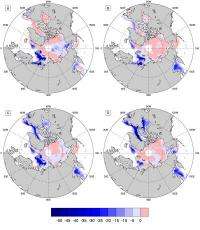
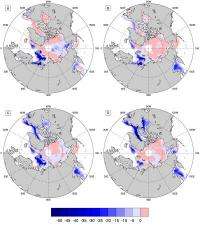
These maps show the differences in Arctic sea ice concentration relative to the long-term average for the winters of (A) 2007-2008, (B) 2008-2009, (C) 2010-2011 and (D) 2010-2011. The lowest levels of Arctic sea ice have been measured between 2007 and 2011, with the record low occurring in 2007. Credit: Georgia Tech/Jiping Liu
The researchers analyzed observational data collected between 1979 and 2010 and found that a decrease in autumn Arctic sea ice of 1 million square kilometers -- the size of the surface area of Egypt -- corresponded to significantly above-normal winter snow cover in large parts of the northern United States, northwestern and central Europe, and northern and central China.
The analysis revealed two major factors that could be contributing to the unusually large snowfall in recent winters -- changes in atmospheric circulation and changes in atmospheric water vapor content -- which are both linked to diminishing Arctic sea ice. Strong warming in the Arctic through the late summer and autumn appears to be enhancing the melting of sea ice.
"We think the recent snowy winters could be caused by the retreating Arctic ice altering atmospheric circulation patterns by weakening westerly winds, increasing the amplitude of the jet stream and increasing the amount of moisture in the atmosphere," explained Jiping Liu, a senior research scientist in the School of Earth and Atmospheric Sciences at Georgia Tech. "These pattern changes enhance blocking patterns that favor more frequent movement of cold air masses to middle and lower latitudes, leading to increased heavy snowfall in Europe and the Northeast and Midwest regions of the United States."
Diminishing Arctic sea ice can cause changes in atmospheric circulation that lead to a circulation pattern that is different than the "negative phase" of the Arctic Oscillation.
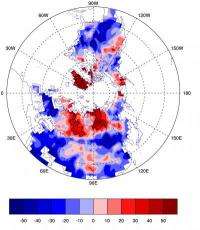
This map shows the percent change in winter blockings relative to the long-term average. Blocking patterns favor more frequent movement of cold air masses to middle and lower latitudes, leading to increased heavy snowfall in Europe and the Northeast and Midwest regions of the United States. Credit: Georgia Tech/Jiping Liu
In addition to analyzing observational data, the researchers also assessed the impact of the diminishing Arctic sea ice on atmospheric circulation by comparing the results of model simulations run with different sea ice distribution. They ran one experiment that assumed seasonally varying Arctic sea ice and utilized sea ice concentration data collected between 1979 and 2010. Another simulation incorporated prescribed sea ice loss in autumn and winter based on satellite-derived Arctic sea ice concentrations.The simulations showed that diminishing Arctic sea ice induced a significant surface warming in the Arctic Ocean and Greenland/northeastern Canada, and cooling over northern North America, Europe, Siberia and eastern Asia. The models also showed above-normal winter snowfall in large parts of the northern United States, central Europe, and northern and central China.
The consistent relationships seen in the model simulations and observational data illustrate that the rapid loss of sea ice in summer and delayed recovery of sea ice in autumn modulates snow cover, winter temperature and the frequency of cold air outbreaks in northern mid-latitudes.
Huijun Wang and Mirong Song of the Chinese Academy of Sciences Institute of Atmospheric Physics and Radley Horton from the Columbia University Center for Climate Systems Research also contributed to this work.
More information: The paper will be available here: http://www.pnas.or … s.1114910109
Provided by
Georgia Institute of Technology
-
From lemons to lemonade: Reaction uses carbon dioxide to make carbon-based semiconductor,
32 comments
-
Thioridazine kills cancer stem cells in human while avoiding toxic side-effects of conventional cancer treatments,
3 comments
-
SpaceX private rocket blasts off for space station (Update),
42 comments
-
Climate scientists say they have solved riddle of rising sea,
31 comments
-
Landmark calculation clears the way to answering how matter is formed,
55 comments
-
Hypothetical desert earth
May 26, 2012
-
More human population = greater mass?
May 25, 2012
-
Conversion from aircraft bearing to normal degrees
May 23, 2012
-
Interpretation/Analysis of the Lab results(HEPA filter)
May 22, 2012
-
Has anyone here attended the The Urbino Summer School in Paleoclimatology?
May 22, 2012
-
Earthquakes: Mag 6 N. Italy and Mag 5.6 W. Bulgaria
May 21, 2012
- More from Physics Forums - Earth
More news stories
Yale study concludes public apathy over climate change unrelated to science literacy
Are members of the public divided about climate change because they don't understand the science behind it? If Americans knew more basic science and were more proficient in technical reasoning, would public consensus match ...
11 hours ago |
4.8 / 5 (6) |
27
|
Land and sea species differ in climate change response: study
(Phys.org) -- Marine and terrestrial species will likely differ in their responses to climate warming, new research by Simon Fraser University and Australia’s University of Tasmania has found.
9 hours ago |
4 / 5 (5) |
6
|
10 million years needed to recover from mass extinction
It took some 10 million years for Earth to recover from the greatest mass extinction of all time, latest research has revealed.
Space & Earth / Earth Sciences
11 hours ago |
4.2 / 5 (5) |
2
|
Sophisticated simulations predict future warming
The chances of our planet being hit by a global warming of 3 degrees Celsius by 2050 is as likely as it being hit by an increase of 1.4 degrees, new research shows. Presented in the journal Nature Geoscience, the British study ...
Space & Earth / Earth Sciences
May 22, 2012 |
3.8 / 5 (11) |
51
Kyoto Protocol architect 'frustrated' by climate dialogue
UN climate talks are going nowhere, as politicians dither or bicker while the pace of warming dangerously speeds up, one of the architects of the Kyoto Protocol told AFP.
May 23, 2012 |
3.4 / 5 (8) |
42
'Unzipped' carbon nanotubes could help energize fuel cells, batteries
Multi-walled carbon nanotubes riddled with defects and impurities on the outside could replace some of the expensive platinum catalysts used in fuel cells and metal-air batteries, according to scientists at ...
Change in developmental timing was crucial in the evolutionary shift from dinosaurs to birds: study
At first glance, it's hard to see how a common house sparrow and a Tyrannosaurus Rex might have anything in common. After all, one is a bird that weighs less than an ounce, and the other is a dinosaur that ...
Computer model used to pinpoint prime materials for efficient carbon capture
When power plants begin capturing their carbon emissions to reduce greenhouse gases and to most in the electric power industry, it's a question of when, not if it will be an expensive undertaking.
T cells 'hunt' parasites like animal predators seek prey, study shows
By pairing an intimate knowledge of immune-system function with a deep understanding of statistical physics, a cross-disciplinary team at the University of Pennsylvania has arrived at a surprising finding: T cells use a movement ...
Stunning image of smallest possible five-ringed structure
Scientists have created and imaged the smallest possible five-ringed structure about 100,000 times thinner than a human hair and you'll probably recognise its shape.
Browser wars flare in mobile space
The browser wars are heating up again, but this time the fight is for dominance of the mobile Internet.


Feb 27, 2012
Rank: 2.2 / 5 (13)
Feb 27, 2012
Rank: 3.9 / 5 (15)
Obviously, you haven't looked at a recent photo of the Arctic.
In the past several years, the decline of extent and thickness has exposed warmer and warmer water directly to the air, aiding convection.
In early February, Svalbard hit something like 12 or 13 record daily highs in a 15 day period, breaking previous records by several degrees in celsius.
Remove the ice, you have heat transport and convection from the surface to the atmosphere to enhance storms.
The water in this region is several degrees C above normal, and probably at least 1C above the previous records.
Feb 27, 2012
Rank: 4.1 / 5 (13)
However, since this is only temporary and seasonal from cloud cover or snow packs, it is not big enough to offset the CO2 feed-backs, nor the positive feedback from loss of albedo in glaciers or sea ice.
This effect will only grow to certain limits before positive feed-backs completely overwhelm it due to continental melting day anomalies eventually becoming so high that snow can't form, or at least can't survive on the surface long enough to matter.
So if we quit pumping CO2 and other crap in the air, then it will come to an equilibrium.
If we keep polluting indefinitely, it would seem to eventually get over this "hump".
Feb 27, 2012
Rank: 2.3 / 5 (15)
Did it snow less in the past? Nope.
Feb 27, 2012
Rank: 4.3 / 5 (12)
It's extremely complicated. Real world systems don't follow perfect pen and paper models.
Just last year, Oklahoma broke both the record high and the record low on the same day at the same location.
Nobody would expect that in any weather model, be it warming, cooling, or staying the same. that's just not something anyone would think to happen, but it did.
It snowed more in the past, at least 120 to 200 years ago, and beyond, but it was for different reasons, i.e. it was just colder, so a higher percentage of precipitation was snow.
What's happening now is the convection is much higher, which means there is more water available to produce storms, and then when jet stream lines up correctly, the snows are much heavier.
However, they immediately melt as fast or faster than before, due to increased average surface temperatures, even if record daily lows are set once in a while...
Feb 27, 2012
Rank: 4.2 / 5 (10)
Low Temp: 25
Low Max Temp: 22
High Min Temp: 267
http://wx.hamweat.../us.html
there have only been 2 or 3 weeks in the last half-year where there were more cold records than hot records.
The current running week total has 11 to 1 for hot to cold ratio, and is actually down some from several days ago.
Feb 28, 2012
Rank: not rated yet
Map. "(C) 2010-2011 and (D) 2010-2011"
I guess C is 2009-2010 or ?
Feb 28, 2012
Rank: 2.1 / 5 (14)
That is the reason it snows. Its colder. The US is getting colder for about 13 years or more. Winters especially.
Warmth does not cause snow.
Feb 28, 2012
Rank: 4 / 5 (9)
Feb 28, 2012
Rank: 3.7 / 5 (9)
That's absolutely false.
13 of the 15 hottest years on record occurred in the past 15 years.
the temperature has roughly plateaued near the 1998 record, but that should not be interpreted as a down trend. 1998 was way hotter than any previous year on record.
You are cherry picking one year, 1998, and noticing that most of the years since then were slightly cooler, while ignoring the fact that all but 2 of the years since then are well above the previous records.
Some plateau effect in temperature rise is expected due to various stages of negative feedback mechanisms, as well as energy required to overcome phase changes of water.
Feb 28, 2012
Rank: 3.7 / 5 (9)
Feb 28, 2012
Rank: 4.6 / 5 (9)
1983: 14,820
1998: 12,640
2011: 5,780
total loss: 14,820 - 5,780 = 9,040
loss since 1998: 12,640 - 5,780 = 6,860
Percent of total lost since 1998: 75.88%.
that is to say, 75.88% of all ice lost in 5 year running averages volume, of the 32 year record, was lost since 1998.
44.69% of the total ice loss, in 5 year running averages, since 1983, actually happened in the past 5 years...
This is roughly consistent with a rate of net melting doubling every 5 or 6 years.
Feb 28, 2012
Rank: 2.3 / 5 (12)
http://www.real-s...1.24.gif
The web page used for this graphic is the NOAA/NASA known for exaggerating how warm it is.
Please don't quote the x warmest of y years crap. It makes you look dumb.
But go ahead, which webpage shows you US winter temperatures for the last decade other than the NOAA?
Feb 28, 2012
Rank: 2 / 5 (12)
"Two researchers here spent months scouring through old expedition logs and reports, and reviewing 70-year-old maps and photos before making a surprising discovery: They found that the effects of the current warming and melting of Greenland's glaciers that has alarmed the world's climate scientists occurred in the decades following an abrupt warming in the 1920s."
http://www.scienc...4332.htm
This station was warmer in 1940 than it was in 2010.
http://data.giss....ghbors=1
This one has 1929 almost as warm:
http://data.giss....ghbors=1
Nuuk 30s and 40s were warmest period
http://data.giss....ghbors=1
Feb 28, 2012
Rank: 3.2 / 5 (9)
"So snow is caused by less ice in the arctic." - ParkerTard
To anyone with more than 2 neurons to rub together, the article neither stated or implied what you have just said.
You low IQ muchlie?
Feb 28, 2012
Rank: 3.2 / 5 (9)
"That is the reason it snows. Its colder." - ParkerTard
You see Tard Boy. Here on planet earth, you need water vapor to produce snow, and water vapor comes from evaporation.
So when it is very cold and there is little evaporation you get little snow.
But when it is just about the freezing point, which means relatively warm, you generally have lots of evaporation, and hence ample water vapor for snow.
If you don't understand the basics of science Tard Boy... What makes you think that you have anything of consequence to say about science?
You Idiot Muchlie?
Feb 28, 2012
Rank: 2.8 / 5 (9)
"The US is getting colder for about 13 years or more." - Parker Tard
And now the truth...
http://www.ncdc.n...ag3.html
What a shame for Parker Tard that the U.S. only constitutes only 2% of the globe.
Parker Tard... You Liar Muchlie?
Feb 28, 2012
Rank: 3.7 / 5 (6)
Feb 28, 2012
Rank: 3.2 / 5 (9)
Statistics confuse him completely.
"Please don't quote the x warmest of y years crap. It makes you look dumb." - Parker Tard
Parker Tard. You Fail Stats Muchlie?
Feb 28, 2012
Rank: 3 / 5 (10)
"The USA is cooling at a rate -4.2F per decade." - Parker Tard
But back here in the real world, 10 years represents weather.
Climate is defined over periods of 30 years or more.
And on that climate time scale, the U.S. Region is warming at a rate of 0.39'C per decade.
Do you intend to be a liar for the rest of your life Parker Tard?
Feb 28, 2012
Rank: 2.8 / 5 (9)
"This station was warmer in 1940 than it was in 2010." - Parker Tard
Even on your home planet of Conservadopia.
You dumber than stone Muchlie?
Feb 28, 2012
Rank: 2.8 / 5 (9)
Are you so stupid that you even keep your lies consistent?
"30s and 40s were warmest period" - Parker Tard
Do you intend to be a liar for the rest of your life Parker Tard?
Feb 28, 2012
Rank: 2.5 / 5 (11)
The article claims "significantly above-normal winter snow cover has been seen in large parts of the northern United States".
The US is colder and getting more snow.
No surprise. Logical even.
Blaming ice in the artic is downright stupid if the US is colder by 4.2F in the last 10 years.
More snow has occurred because it is COLDER.
VD is an idiot.
Feb 28, 2012
Rank: 2.5 / 5 (11)
This article: " During the winters of 2009-2010 and 2010-2011, the Northern Hemisphere measured its second and third largest snow cover levels on record."
Wikipedia: "The winter of 20092010 in Europe was unusually cold."
http://en.wikiped...n_Europe
Wow. Unusually COLD Europe = MORE SNOW.
Does VD and his fellow STD's ever read anything?
Feb 28, 2012
Rank: 3.2 / 5 (9)
No proof followed. Just childish Claptrap from planet Conservadopia.
Meanwhile back here in the real world, 10 years represents weather.
Climate is defined over periods of 30 years or more.
And on that climate time scale, the U.S. Region is warming at a rate of 0.39'C per decade.
Do you intend to be a liar for the rest of your life Parker Tard?
Feb 28, 2012
Rank: 3 / 5 (10)
"Wow. Unusually COLD Europe = MORE SNOW." - Parker Tard
No science muchlie? Parker Tard
Feb 28, 2012
Rank: 2.3 / 5 (9)
Feb 29, 2012
Rank: 1.9 / 5 (9)
http://www.real-s...1.24.gif
VD's teensy tiny little brain can't quite grasp the obvious.
Cold winters results in more snow.
Feb 29, 2012
Rank: 3 / 5 (10)
"-4.2F per decade if you can read." - Parker Tard
Perhaps Parker Tard would like to yammer about the temperature trend inside his refrigerator crisper today as it is equally applicable to global climate trends.
No science muchlie? Parker Tard
Feb 29, 2012
Rank: 3 / 5 (10)
Meanwhile the interior of the Antarctic - the coldest place on earth - is a desert which receives less than 2 inches of precipitation per year.
Parker Tard... Poor... Ignorant... Conservative...
Feb 29, 2012
Rank: 3.8 / 5 (8)
Feb 29, 2012
Rank: 3.9 / 5 (9)
The obvious is again sailing over your head NP. Winter temperature data for the contigous US, not overall yearly, not Alaska, just winter and only according to this one graph that is posted and labeled, but has no commentary attached. The overall yearly is a plateau between 1998 and 2011, a plateau higher than every year preceding it except for one. Your graph is not useful as it is for a season in a specific area. I could link summer temperature data for texas and oklahoma and show an average rise of over 7 degrees for the same time frame, but from that I wouldn't be idiotic enough to make the statement that "IT" (being earth) has warmed by over 7 degrees....but at least you attempted to find something different than the usual rhetoric....
Feb 29, 2012
Rank: 2.2 / 5 (10)
I posted evidence that parts of the northern hemisphere (USA) in the winter is cooling at an amazing rate.
I posted evidence recent winters are very cold in Europe -- also part of the northern hemisphere.
That cooling is obviously causing more snow.
I have no idea why you want to talk about snow and summer temperatures. It doesn't snow in the summer much (sometimes at higher altitude it does).
And VD, yes Antarctica is dry ... but what moisture exists turns to snow and ice because it is cold, not because of some mythological warming.
But: "Average precipitation on the coast is 20 to 50 inches of snow"
http://www.antarc...ce.shtml
Feb 29, 2012
Rank: 2.2 / 5 (10)
18th coldest out of 115. 97 winters were warmer.
http://www.iceage...ears.htm
Feb 29, 2012
Rank: 4.4 / 5 (7)
Yes you did, however your statement in a previous post on this thread-
" The US is getting colder for about 13 years or more. Winters especially. "
Is a complete fallacy which is actually proved, once again by the link you posted to support it. If the average temperature dropped 4.2 degrees in the winter over the timeline of the graph, then for the statement that the US is cooling to be true, overall temperature measurements would have to reflect this drop. Since there hasn't been a drop in year round temperatures, the other seasons would have to offset this with warmer than usual temperatures. The winters (according to your link) are colder but the average year round isn't, hence the statement that the US is cooling is not true. This is why I mentioned the plateau bookended by 1998 and 2011.
Feb 29, 2012
Rank: 2.2 / 5 (10)
Yes.
RSS Land
http://www.woodfo...rom:2005
"Every day since February 15 has been the coldest in at least the last decade"
http://www.real-s...ontinues
Feb 29, 2012
Rank: 3.2 / 5 (9)
You might as well rant about the temperature inside your refrigerator.
Fool.
"I posted evidence that parts of the northern hemisphere (USA) in the winter is cooling at an amazing rate." - Parker Tard
Feb 29, 2012
Rank: 3.2 / 5 (9)
"And VD, yes Antarctica is dry ... but what moisture exists turns to snow and ice because it is cold" - ParkerTard
Do you intend to remain ignorant of science for the rest of your life Parker Tard?
Feb 29, 2012
Rank: 3.2 / 5 (9)
"RSS Land http://www.woodfo...rom:2005" - Parker Tard
If we look at the last 10 years from your own data source we see a positive trend of about 2.5'C per century.
http://www.woodfo...rom:2000
But that is still weather.
Going back 30 years we get to a period long enough to be considered climate..
http://www.woodfo...rom:1980
And there we see a temperature increase of about 0.6'C
Poor Parker Tard. He just can't ain't bright enough to figure out that the temperature in his refrigerator over the last 6 days doesn't reflect global climate trends.
Feb 29, 2012
Rank: 3.2 / 5 (9)
"12 Mar 10 - The United States just experienced its coldest winter in 25 years" - Parker Tard
You do realize don't you Parker Tard, that you are mentally ill.
From your own reference...
http://www.woodfo...rom:1980
Feb 29, 2012
Rank: 3.2 / 5 (9)
You poor Tard you.
"But: "Average precipitation on the coast is 20 to 50 inches of snow"" - Parker Tard
Feb 29, 2012
Rank: 2.2 / 5 (10)
Feb 29, 2012
Rank: 2.2 / 5 (10)
Actually, 2011 was quite chilly.
There were 21 years warmer including 5 years from the 1930s.
http://i39.tinypi...9rt2.jpg
Feb 29, 2012
Rank: 3.5 / 5 (8)
You poor Tard you.
"But: "Average precipitation on the coast is 20 to 50 inches of snow"" - Parker Tard
Feb 29, 2012
Rank: 1.8 / 5 (10)
The coast is warmer! Average -28C in the dead of Antarctic Winter.
"Monthly means at McMurdo Station range from -28C (-18.4F) in August to -3C (-26.6F) in January."
http://en.wikiped...tarctica
Poor VD. Dumber than a stump.
Feb 29, 2012
Rank: 2.7 / 5 (7)
First Parker Tard makes the claim about the winter temperatures in the U.S. region...
"12 Mar 10 - The United States just experienced its coldest winter in 25 years" - Parker Tard
Then in a dishonest attempt to support his claim he refers to global average yearly temperaturs.
"Actually, 2011 was quite chilly.
There were 21 years warmer including 5 years from the 1930s.
http://i39.tinypi...9rt2.jpg"
Parker Tard is clearly not capable of commenting rationally or honestly.
Globally there have been only 9 years warmer than 2011 since 1880
http://data.giss....B.Ts.txt
Feb 29, 2012
Rank: 3.2 / 5 (9)
January 2012 (Winter 2011) the fourth warmest for the contiguous United States
"The first two months of the winter season, December and January, have been much warmer than average for the contiguous United States. The two-month period was the fourth warmest on record with an average temperature 3.8 degrees F above average."
http://www.noaa.g...ats.html
Poor Parker Tard. Exposed as a perpetual liar with every comment he makes.
You would think he would have enough brains to learn.
But Conservatives never do.
Feb 29, 2012
Rank: 3.2 / 5 (9)
Yup. Pretty close to freezing - and lots of water vapour from the warm ocean near by. Hence the snow. But temps in the interior are much colder and hence the lack of snow.
You poor Tard you.
Feb 29, 2012
Rank: 2.1 / 5 (11)
"The major story of January 2012 was the lack of snow, which is in great contrast to the past two Januarys (2011 and 2010) when much-above-average snow"
http://www.ncdc.n...tc/snow/
No. There was actually way less snow in the US BECAUSE IT WAS WARMER.
VD. Dumber than a sack of hammers.
Feb 29, 2012
Rank: 2.2 / 5 (10)
-28C is 28C below freezing.
On the coast.
In winter.
August is winter in the southern hemisphere.
VD: Dumber than dirt.
Feb 29, 2012
Rank: 3.5 / 5 (8)
It is self evident that when temperatures are above freezing there is no snow.
It is also self evident that when temperatures grow increasingly colder there is less snow all else being equal.
Poor clueless Parker Tard.
Feb 29, 2012
Rank: 4.2 / 5 (5)
Feb 29, 2012
Rank: 3.5 / 5 (8)
Average temperatures in the Antarctic interior get down to -70 degrees Celsius during the winter months and -35 degrees Celsius in the warmer months.
Poor mentally ill Parker Tard.
Feb 29, 2012
Rank: 3.7 / 5 (6)
What makes them prone to this psychosis?
Feb 29, 2012
Rank: 2.3 / 5 (3)
Feb 29, 2012
Rank: 2.1 / 5 (7)
VD claims the coast of Antarctica is warm because it is only -28C. Only the mentally or dishonest claim -28C is warm.
VD thanks for the amusement. People who believe in the CO2 cult are dumber than rocks.
Feb 29, 2012
Rank: 3.7 / 5 (6)
I almost never use the word proof outside of mathematics.
Since you have used it here and ascribed it to me, you are of course lying.
"VD claims this winter was warmer and therefore proves it snows more in warm winter." - ParkerTard
"VD claims the coast of Antarctica is warm because it is only -28C." - Parker Tard
Nope. I never said that either.
But it does nicely illustrate the nature of your mental illness.
Poor Parker Tard. Just making up childish nonsense as he goes along.
Mar 04, 2012
Rank: not rated yet
Mar 04, 2012
Rank: 1 / 5 (5)
VD said both. Easy to find and read.
Mar 04, 2012
Rank: 5 / 5 (4)
Parker Tard, who has proven himself to be a congenital liar, can't support his lies so he provides no links.
"VD said both. Easy to find and read." - ParkerTard
Mar 04, 2012
Rank: 4.2 / 5 (5)
http://gizmo.geot...2011.pdf