Twin Grail spacecraft reunite in lunar orbit
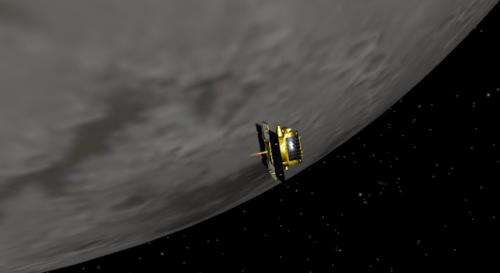
(PhysOrg.com) -- The second of NASA's two Gravity Recovery And Interior Laboratory (GRAIL) spacecraft has successfully completed its planned main engine burn and is now in lunar orbit. Working together, GRAIL-A and GRAIL-B will study the moon as never before.
"NASA greets the new year with a new mission of exploration," said NASA Administrator Charles Bolden. "The twin GRAIL spacecraft will vastly expand our knowledge of our moon and the evolution of our own planet. We begin this year reminding people around the world that NASA does big, bold things in order to reach for new heights and reveal the unknown."
GRAIL-B achieved lunar orbit at 2:43 p.m. PST (5:43 p.m. EST) today. GRAIL-A successfully completed its burn yesterday at 2 p.m. PST (5 p.m. EST). The insertion maneuvers placed the spacecraft into a near-polar, elliptical orbit with an orbital period of approximately 11.5 hours. Over the coming weeks, the GRAIL team will execute a series of burns with each spacecraft to reduce their orbital period to just under two hours. At the start of the science phase in March 2012, the two GRAILs will be in a near-polar, near-circular orbit with an altitude of about 34 miles (55 kilometers).
During GRAIL's science mission, the two spacecraft will transmit radio signals precisely defining the distance between them. As they fly over areas of greater and lesser gravity caused by visible features such as mountains and craters, and masses hidden beneath the lunar surface, the distance between the two spacecraft will change slightly.
Scientists will translate this information into a high-resolution map of the moon's gravitational field. The data will allow scientists to understand what goes on below the lunar surface. This information will increase knowledge of how Earth and its rocky neighbors in the inner solar system developed into the diverse worlds we see today.
Each spacecraft carries a small camera called GRAIL MoonKAM (Moon Knowledge Acquired by Middle school students) with the sole purpose of education and public outreach. The MoonKAM program is led by Sally Ride, America's first woman in space, and her team at Sally Ride Science in collaboration with undergraduate students at the University of California in San Diego.
GRAIL MoonKAM will engage middle schools across the country in the GRAIL mission and lunar exploration. Thousands of fifth- to eighth-grade students will select target areas on the lunar surface and send requests to the GRAIL MoonKAM Mission Operations Center in San Diego. Photos of the target areas will be sent back by the GRAIL satellites for students to study.
A student contest that began in October 2011 also will choose new names for the spacecraft. The new names are scheduled to be announced in January 2012. Ride and Maria Zuber, the mission's principal investigator at the Massachusetts Institute of Technology in Cambridge, chaired the final round of judging.
Provided by JPL/NASA


