Time recording up one's sleeve
January 3, 2012

Time recording up one's sleeve

Enlarge

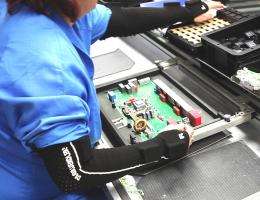
Inertial sensors are small and lightweight. Employees wear them in specially made, breathable sleeves that do not impede their movements.  © Lintje GbR

Optimized operations are essential to globally competitive companies. Until now, inspectors have timed procedures, usually manually, in order to organize manual assembly operations efficiently – a method prone to error. A new system records times automatically and cuts costs for companies.

Handling tools, assembling , inserting, joining and bolting parts, painting components, operating equipment – innumerable procedures must be executed before a product can be packaged and shipped. How much time do employees need for individual procedures? How long does manual assembly take? Industrial manufacturers have to analyze and optimize their employees’ operations continually in order to remain competitive. They must record the times of operations if they wish to analyze the individual procedures. This enables them to identify long handling distances, impractically located components, overly frequent tool changes or irregular and superfluous movements, which waste time and make production processes inefficient.

Until now, every individual movement has usually been timed by someone with a stopwatch or with digital time boards manned by employees. This approach is not really objective, however. It is replete with errors and disadvantageous for everyone involved: The stress factor for employees is extremely high and they might not execute their jobs at their usual speed. For companies, this requires quite a lot of work from staff and thus incurs high costs. There is therefore great need for more precise, automated and cost effective solutions. Contracted by the engineering firm DR. GRUENDLER in Magdeburg, researchers at the Fraunhofer Institute for Factory Operation and Automation IFF have developed such a system.

Three matchbox-sized sensors integrated in a sleeve record hand and arm movements precisely and measure the start and end of individual actions, e.g. reaching, grasping, setting up, joining, checking or releasing. The interlinked sensor modules are positioned on the upper and lower arm and the hand. Employees merely have to put on the two sleeves. They are snug like a second skin yet comfortable and do not impede the wearer. “The present stopwatch method only allows a process organizer to time five individuals simultaneously, depending on the situation. Our solution makes it possible to record time simultaneously, even at several workplaces, without requiring additional labor. The system’s greater precision and objectivity is crucial,” says Martin Woitag, research manager at the Fraunhofer IFF. Woitag and his team relied on inertial sensors for their solution. They measure the acceleration and angular velocities of arms and hands in the X, Y and Z axes. Unlike other motion tracking systems, such as GPS, the inertial measurement system functions without any other infrastructure. The inertial sensors independently detect objects’ positions in space. “What is more, our solution doesn’t require complex calibration. A tool that teaches in the measuring points directly at the assembly workplace one time is all that is needed,” according to Woitag. A PC application completes the system. The software calculates and reconstructs the motion sequences based on the sensor data. It breaks processes down into motion segments and ascertains the related times.

At present, the sleeves can be used for assembly jobs at sitting workplaces in logistics and manufacturing. In the next stage, the researchers in Magdeburg intend to configure the system to also analyze assembly operations during which workers stand or move around. They additionally plan to use the sensors to detect posture and thus analyze workplace ergonomics.

Provided by Fraunhofer-Gesellschaft search and more info website

Filter


Move the slider to adjust rank threshold, so that you can hide some of the comments.


Display comments: newest first

finitesolutions
Jan 03, 2012

Rank: not rated yet
There is the Frida robot. The sooner they automatized each and every operation the better. People will manage and find something else to do.
Shifty0x88
Jan 04, 2012

Rank: not rated yet
I like the idea, I wish I could see their software though. How do they make it work for any individual, and how accurately are the movements per each individual. I'm assuming the 1-time configuration sets up some sort of neural network or measures offsets or something like that.

I can see this being abused by saying: "Look he/she isn't moving fast enough, they could assemble 4 more items per hour if we increased the speed of the belt by X ft/sec."

It could still save people money and may find a way to reduce stress/strain(physical) on people, as a way to reduce health care costs or something like that.

Very interesting indeed though.
Rank 5 /5 (1 vote)
Relevant PhysicsForums posts

More news stories

Browser wars flare in mobile space

The browser wars are heating up again, but this time the fight is for dominance of the mobile Internet.

Technology / Software

created 16 hours ago | popularity 3.7 / 5 (3) | comments 3

Probability of contamination from severe nuclear reactor accidents is higher than expected: study

Catastrophic nuclear accidents such as the core meltdowns in Chernobyl and Fukushima are more likely to happen than previously assumed. Based on the operating hours of all civil nuclear reactors and the number ...

Technology / Energy & Green Tech

created May 22, 2012 | popularity 3.6 / 5 (25) | comments 56 | with audio podcast

HyperSolar shows dirty water no barrier to power world

(Phys.org) -- The Santa Barbara, California, company, HyperSolar, is set to transparently share the ups and downs of its research experiences toward the company’s ultimate vision, successfully producing ...

Technology / Energy & Green Tech

created May 24, 2012 | popularity 4.8 / 5 (16) | comments 17 | with audio podcast report

SpotterRF debuts Radar Backpack Kit (w/ Video)

(Phys.org) -- SpotterRF has announced a special radar backpack kit designed to enhance situational awareness for soldiers on the ground. The company says its special radar is designed for warfighters as part ...

Technology / Hi Tech & Innovation

created May 26, 2012 | popularity 5 / 5 (5) | comments 13 | with audio podcast report

Tesla to launch electric sedan in US on June 22

Tesla Motors said Tuesday it would begin deliveries of "the world's first premium electric sedan" on June 22, slightly ahead of schedule.

Technology / Energy & Green Tech

created May 22, 2012 | popularity 4.5 / 5 (12) | comments 18


Stunning image of smallest possible five-ringed structure

Scientists have created and imaged the smallest possible five-ringed structure – about 100,000 times thinner than a human hair – and you'll probably recognise its shape.

'Unzipped' carbon nanotubes could help energize fuel cells, batteries

Multi-walled carbon nanotubes riddled with defects and impurities on the outside could replace some of the expensive platinum catalysts used in fuel cells and metal-air batteries, according to scientists at ...

Change in developmental timing was crucial in the evolutionary shift from dinosaurs to birds: study

At first glance, it's hard to see how a common house sparrow and a Tyrannosaurus Rex might have anything in common. After all, one is a bird that weighs less than an ounce, and the other is a dinosaur that ...

Computer model used to pinpoint prime materials for efficient carbon capture

When power plants begin capturing their carbon emissions to reduce greenhouse gases – and to most in the electric power industry, it's a question of when, not if – it will be an expensive undertaking.

T cells 'hunt' parasites like animal predators seek prey, study shows

By pairing an intimate knowledge of immune-system function with a deep understanding of statistical physics, a cross-disciplinary team at the University of Pennsylvania has arrived at a surprising finding: T cells use a movement ...

Land and sea species differ in climate change response: study

(Phys.org) -- Marine and terrestrial species will likely differ in their responses to climate warming, new research by Simon Fraser University and Australia’s University of Tasmania has found.