Scientists crack medieval bone code
January 3, 2012

Scientists crack medieval bone code

Enlarge

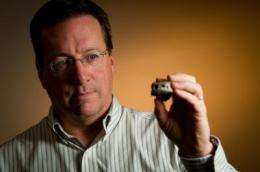
A study co-led by Todd Fenton, Michigan State University anthropologist, is the first to confirm the existence of the infectious disease brucellosis in ancient skeletal remains. Credit: Michigan State University

Two teams of Michigan State University researchers – one working at a medieval burial site in Albania, the other at a DNA lab in East Lansing – have shown how modern science can unlock the mysteries of the past.

The scientists are the first to confirm the existence of brucellosis, an infectious disease still prevalent today, in ancient skeletal remains.

The findings, which appear in the American Journal of Physical Anthropology, suggest brucellosis has been endemic to Albania since at least the Middle Ages.

Although rare in the United States, brucellosis remains a major problem in the Mediterranean region and other parts of the world. Characterized by chronic respiratory illness and fever, brucellosis is acquired by eating infected meat or unpasteurized dairy products or by coming into contact with animals carrying the brucella bacteria.

Todd Fenton, associate professor of anthropology, said advanced DNA testing at MSU allowed the researchers to confirm the existence of the disease in skeletons that were about 1,000 years old.

"For years, we had to hypothesize the cause of pathological conditions like this," Fenton said. "So the era of DNA testing and the contributions that DNA can make to my work are really exciting."
Scientists crack medieval bone code
Enlarge

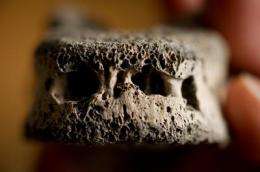
This vertebra, about 1,000 years old, was ravaged by brucellosis. Credit: Michigan State University

Here's how the discovery came about.

Fenton and a group of MSU graduate students were serving as the bioarcheologists, or bone specialists, for a multinational team of archaeologists excavating sites in the ancient Albanian city of Butrint. Once a large Roman colony, Butrint in its final centuries served as an outpost of the Byzantine Empire until it was abandoned in the Middle Ages due to flooding.

Fenton and his team developed biological profiles of the human remains, which included determining sex, age and skeletal pathologies, or health histories. Vertebrae from two of the Byzantine-era skeletons – both adolescent males from the 10th century to the 13th century – had significant lesions, leading the researchers to theorize the boys had suffered from tuberculosis.

Samples of the ancient bone were sent to the forensic DNA lab in East Lansing, which is headed by David Foran, director of MSU's Forensic Science Program. Foran and his team of graduate students took tiny portions of the bone, extracted DNA and tested it for any residual DNA that might still exist from the expected pathogen.

But the results came back negative for tuberculosis.

Fenton's team re-examined the bones that tested negative for tuberculosis and concluded the disease might instead be brucellosis. The infection from brucellosis and tuberculosis causes similar damage – basically eating away the bone – although no one had ever confirmed brucellosis in human recovered from an archaeological site.

Foran's team then developed a different set of tests for detecting the brucella bacteria and undertook a new round of testing on the diseased vertebrae.

This time the results came back positive for brucellosis.

Foran said the collaboration on the project highlights the benefits of modern science and interdisciplinary research, even when the respective research teams are some 5,000 miles apart.

"In this case it was a combination of inquisitiveness, persistence and of course collaboration," Foran said. "It is amazing to find something brand new in something that is a thousand years old."

Journal reference: American Journal of Physical Anthropology search and more info website

Provided by Michigan State University search and more info website

3.8 /5 (4 votes)  

Rank 3.8 /5 (4 votes)
Tags

Relevant PhysicsForums posts

More news stories

Change in developmental timing was crucial in the evolutionary shift from dinosaurs to birds: study

At first glance, it's hard to see how a common house sparrow and a Tyrannosaurus Rex might have anything in common. After all, one is a bird that weighs less than an ounce, and the other is a dinosaur that ...

Other Sciences / Archaeology & Fossils

created 8 hours ago | popularity 5 / 5 (6) | comments 0 | with audio podcast

Social welfare cuts ultimately come with heavy price, researchers say

(Phys.org) -- Slashing government funding for Medicaid, food stamps and other programs that serve the poor – while politically popular with some lawmakers and many conservatives – may do more harm ...

Other Sciences / Social Sciences

created May 24, 2012 | popularity 4.1 / 5 (22) | comments 155

Ancient Bethlehem seal unearthed in Jerusalem

Israeli archaeologists have discovered a 2,700-year-old seal that bears the inscription "Bethlehem," the Israel Antiquities Authority announced Wednesday, in what experts believe to be the oldest artifact ...

Other Sciences / Archaeology & Fossils

created May 23, 2012 | popularity 3.3 / 5 (15) | comments 24

Dollars and sense: Why are some people morally against tax?

As the U.S. presidential election campaigns heat up, the economic debate is dominated by bailouts, austerity and, inevitably, taxation. Now a new study published in Symbolic Interaction asks why tax is such an important issue ...

Other Sciences / Social Sciences

created May 23, 2012 | popularity 2.3 / 5 (3) | comments 19

Oldest Jewish archaeological evidence on the Iberian Peninsula

German archaeologists of the Friedrich Schiller University Jena found one of the oldest archaeological evidence so far of Jewish Culture on the Iberian Peninsula at an excavation site in the south of Portugal, ...

Other Sciences / Archaeology & Fossils

created May 25, 2012 | popularity 4.2 / 5 (6) | comments 12


Stunning image of smallest possible five-ringed structure

Scientists have created and imaged the smallest possible five-ringed structure – about 100,000 times thinner than a human hair – and you'll probably recognise its shape.

'Unzipped' carbon nanotubes could help energize fuel cells, batteries

Multi-walled carbon nanotubes riddled with defects and impurities on the outside could replace some of the expensive platinum catalysts used in fuel cells and metal-air batteries, according to scientists at ...

Computer model used to pinpoint prime materials for efficient carbon capture

When power plants begin capturing their carbon emissions to reduce greenhouse gases – and to most in the electric power industry, it's a question of when, not if – it will be an expensive undertaking.

T cells 'hunt' parasites like animal predators seek prey, study shows

By pairing an intimate knowledge of immune-system function with a deep understanding of statistical physics, a cross-disciplinary team at the University of Pennsylvania has arrived at a surprising finding: T cells use a movement ...

Land and sea species differ in climate change response: study

(Phys.org) -- Marine and terrestrial species will likely differ in their responses to climate warming, new research by Simon Fraser University and Australia’s University of Tasmania has found.

Yale study concludes public apathy over climate change unrelated to science literacy

Are members of the public divided about climate change because they don't understand the science behind it? If Americans knew more basic science and were more proficient in technical reasoning, would public consensus match ...