Scientists discover first-ever bee 'soldier'
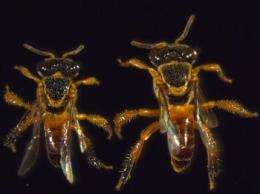
(PhysOrg.com) -- University of Sussex scientists working with researchers in Brazil have identified the first example of a 'soldier' bee.
The discovery was made by a team of scientists from the University of Sussex and the University of Sao Paulo including Professor Francis Ratnieks and Dr Christoph Grueter, from the University of Sussex Laboratory of Apiculture and Social Insects.
The team studied a common tropical stingless bee Tetragonisca angustula in Sao Paulo State in Brazil where it is known locally as Jataí. It nests in tree and wall cavities. Each nest has one queen and up to 10,000 workers.
Insect societies such as the Jataí’s are defined by cooperative and altruistic behaviour, with the workers caring for the nest and the queen’s offspring. This lifestyle also includes the division of labour among workers.
The research, published today in the journal Proceedings of the National Academy of Sciences (PNAS) states that:
-- Jataí guard bees are 30 per cent heavier than their forager nestmates;
-- they differ slightly in shape from foragers, with disproportionately larger legs and smaller heads;
-- approximately one per cent of workers bees reared in a colony are soldier-sized;
-- Jataí soldiers stand on the nest entrance tube and also hover near the entrance where they provide “early warning” detection of enemy attack
Like other social insects, Jataí use guard workers to protect the nest. A previous study by the team had shown that these guards were specialists who performed guarding duties for far longer (up to three weeks) than other types of worker bee, such as the honey bee, who spend just one day guarding the nest, progressing to other tasks as they get older.
The new research shows that Jataí guards, unlike their honey bee counterparts, are morphologically (physically) specialised to perform a particular task, being consistently larger than their nest mates.
Having larger-bodied guards is important for nest-defence, as they are better at fighting one of Jataí’s main enemies – the robber bee Lestrimelitta limao, which can kill off many colonies when raiding nests for food. These guards, then, are more like the ‘soldier’ workers found in some ant and termite colonies.

Even though the Jataí guard lacks a sting and is eventually killed, it can clamp its head onto the wing of a robber bee, preventing it from flying.
The discovery is significant in terms of the evolution of advanced insect societies. Large-bodied soldier workers have long been known in ants and termites, but this is the first evidence of a soldier bee – a worker physically designed for active defence of the nest.
Professor Ratnieks says: “Stingless bees are not defenceless. Jataí is one of the most common bees found in Brazil, but its sophisticated defences make it one of the most amazing.”
More information: A morphologically specialised soldier caste improves colony defense in a neotropical eusocial bee, Grüter, C., Menezes, C., Imperatriz-Fonseca, V. L., Ratnieks, F. L. W.. Proceedings of the National Academy of Sciences (2012). doi:10.1073/pnas.1113398109
Abstract
Division of labor among workers is common in insect societies and is thought to be important in their ecological success. In most species, division of labor is based on age (temporal castes), but workers in some ants and termites show morphological specialization for particular tasks (physical castes). Large-headed soldier ants and termites are well-known examples of this specialization. However, until now there has been no equivalent example of physical worker subcastes in social bees or wasps. Here we provide evidence for a physical soldier subcaste in a bee. In the neotropical stingless bee Tetragonisca angustula, nest defense is performed by two groups of guards, one hovering near the nest entrance and the other standing on the wax entrance tube. We show that both types of guards are 30% heavier than foragers and of different shape; foragers have relatively larger heads, whereas guards have larger legs. Low variation within each subcaste results in negligible size overlap between guards and foragers, further indicating that they are distinct physical castes. In addition, workers that remove garbage from the nest are of intermediate size, suggesting that they might represent another unrecognized caste. Guards or soldiers are reared in low but sufficient numbers (1–2% of emerging workers), considering that <1% usually perform this task. When challenged by the obligate robber bee Lestrimelitta limao, an important natural enemy, larger workers were able to fight for longer before being defeated by the much larger robber. This discovery opens up opportunities for the comparative study of physical castes in social insects, including the question of why soldiers appear to be so much rarer in bees than in ants or termites.
Journal information: Proceedings of the National Academy of Sciences
Provided by University of Sussex


