Rugged new strawberry has a hint of pineapple
January 13, 2012

Rugged new strawberry has a hint of pineapple

Enlarge

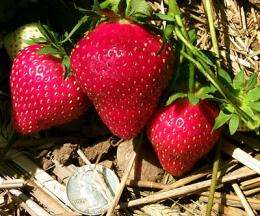
Herriot, a luscious new strawberry, grows up to 25 grams (a bit more than a half ounce), averaging about 11 grams.

(PhysOrg.com) -- Strawberry lovers will soon have Herriot -- a sweet treat featuring a flavor reminiscent of historic varieties and a slight pineapple overtone -- to look forward to, thanks to a new variety of large, heart-shaped fruit developed by Cornell.

Its high yields, vigor, and eye appeal should also make it a sweet option for growers, said breeder Courtney Weber, associate professor of .

"Herriot is one tough plant," said Weber. "Many of our trials are in the worst possible , and Herriot is always one of the last varieties standing. And it tastes good, too."

Herriot produces large -- up to 25 grams (a bit more than a half ounce), averaging about 11 grams -- heart-shaped, shiny red berries with a bright green calyx (the berry's green leafy top).

"Herriot really draws the eye because of the nice shine on the fresh berries. That makes them very attractive to farm-stand and pick-your-own customers," Weber said.

In trials and with commercial growers in New York, Massachusetts, Illinois, Minnesota and Ontario, Herriot yielded as much as 60 percent more than Jewel, the predominant midseason variety for perennial matted-row production that was also developed at Cornell.

At the New York State Agricultural Experiment Station in Geneva, N.Y., Herriot harvest consistently began two days before Jewel, blooming in mid-May and avoiding most damaging frosts.

It also shows good resistance to common leaf diseases and holds up well to summer renovation stress (the mowing, fertilizing and loosening of soil to prepare for next year's bed, which can be stressful to the plants), allowing for wider adaptation to variable soils, Weber said.

In development for 12 years, the variety is named for the one of Weber's favorite authors, James Herriot, the author of "All Creatures Great and Small."

Weber's small fruits breeding program at Cornell is focused on developing improved and raspberry varieties for New York growers. Previous releases -- including L'Amour and Clancy strawberries and Prelude, Encore and Crimson Giant raspberries -- have shown wide adaptation throughout New England, the mid-Atlantic states and the Midwest, as well as temperate regions of Europe.

Weber worked closely with the Cornell Center for Technology Enterprise and Commercialization to license the variety, and a patent will be filed later this year.

Provided by Cornell University search and more info website

3.7 /5 (9 votes)  

Filter


Move the slider to adjust rank threshold, so that you can hide some of the comments.


Display comments: newest first

350
Jan 13, 2012

Rank: 5 / 5 (1)
IMO patenting plants is absurd. Just wait until you can no longer grow a plant from last year's seeds (not talking legal terms) and the only sources of plant seeds for food are all from companies.
El_Nose
Jan 13, 2012

Rank: 4.8 / 5 (6)
a ths farmer is growing his soybeans minding his own business when a laywer shows up --- sir your going to have to destroy your soybean crop --- what says the farmer, why would I do that -- beacause said the laywer you do have a permit to grow the company I represent's genetically modified soybeans -- but exclaimed the farmer I don't buy GM seeds, I stick to the ordinary kind you can buy at the general store, been doin it for 3 generations now. -- well I am sorry sir we tested your plants, they are of our GM line. It seems your neighbors all use our GM soybeans and they must have pollinated some of your plants last year. So you can either pay per plant or detroy this years fields.

I wish I was making that conversation up --- but that logic stands up in court. Ask any farmer in Missouri Nebraska Iowa or Kansas
Isaacsname
Jan 13, 2012

Rank: 5 / 5 (1)
They might be able to patent the genes, but they cannot stop you from propagating runners into new plants.

Interesting about this, I had similar cultivars years ago, like 20 years ago.
Jorsher
Jan 13, 2012

Rank: 5 / 5 (2)
350 - You know this is already a reality? Along with what El Nose described, it's horrible.
DayJamming
Jan 13, 2012

Rank: not rated yet
I look forward to sampling this strawberry...a hint of pineapple sounds delish...

I don't have much of a fear from inventing new vegetables in a lab, but I do have a problem with the current intellectual property system that causes the most vulnerable farmers the most problems.
jsa09
Jan 14, 2012

Rank: 5 / 5 (2)
What you said El-Nose. Except that a farmer should be able to counter-sue because the GM cross pollination has ruined his non-GM crop. Monsanto should then pay for his lost production and for the replanting as well, for his standard non-GM crop.
PhotonX
Jan 14, 2012

Rank: not rated yet
They might be able to patent the genes, but they cannot stop you from propagating runners into new plants.


My thoughts exactly. After all, it's not *my* fault that this one runaway plant decided to send stolons over my entire planting bed, is it? Isn't this actually still one plant? I wonder if there are any legal judgments on this topic? If not, there probably soon will be, and almost certainly not in the interest of farmers or home gardeners.
Rank 3.7 /5 (9 votes)
Relevant PhysicsForums posts

More news stories

Manufacturing genes to attack flu virus

An international research team has manufactured a new protein that can combat deadly flu epidemics.

Biology / Biotechnology

created 8 hours ago | popularity not rated yet | comments 0 | with audio podcast

Scientist: Evolution debate will soon be history

(AP) -- Richard Leakey predicts skepticism over evolution will soon be history. Not that the avowed atheist has any doubts himself.

Biology / Evolution

created May 26, 2012 | popularity 3.4 / 5 (21) | comments 97

More plant species responding to global warming than previously thought

(Phys.org) -- Far more wild plant species may be responding to global warming than previous large-scale estimates have suggested.

Biology / Ecology

created May 22, 2012 | popularity 4.6 / 5 (14) | comments 18 | with audio podcast

For monogamous sparrows, it doesn't pay to stray (but they do it anyway)

It's quite common for a female song sparrow to stray from her breeding partner and mate with the male next door, but a new study shows that sleeping around can be costly.

Biology / Plants & Animals

created May 22, 2012 | popularity 5 / 5 (2) | comments 8 | with audio podcast

Thousands of shellfish found dead in Peru

Thousands of crustaceans were found dead off the coast of Lima following the mystery mass death of dolphins and pelicans, the Peruvian Navy said Friday.

Biology / Ecology

created May 26, 2012 | popularity 4.7 / 5 (7) | comments 7


Stunning image of smallest possible five-ringed structure

Scientists have created and imaged the smallest possible five-ringed structure – about 100,000 times thinner than a human hair – and you'll probably recognise its shape.

'Unzipped' carbon nanotubes could help energize fuel cells, batteries

Multi-walled carbon nanotubes riddled with defects and impurities on the outside could replace some of the expensive platinum catalysts used in fuel cells and metal-air batteries, according to scientists at ...

Change in developmental timing was crucial in the evolutionary shift from dinosaurs to birds: study

At first glance, it's hard to see how a common house sparrow and a Tyrannosaurus Rex might have anything in common. After all, one is a bird that weighs less than an ounce, and the other is a dinosaur that ...

Computer model used to pinpoint prime materials for efficient carbon capture

When power plants begin capturing their carbon emissions to reduce greenhouse gases – and to most in the electric power industry, it's a question of when, not if – it will be an expensive undertaking.

T cells 'hunt' parasites like animal predators seek prey, study shows

By pairing an intimate knowledge of immune-system function with a deep understanding of statistical physics, a cross-disciplinary team at the University of Pennsylvania has arrived at a surprising finding: T cells use a movement ...

Land and sea species differ in climate change response: study

(Phys.org) -- Marine and terrestrial species will likely differ in their responses to climate warming, new research by Simon Fraser University and Australia’s University of Tasmania has found.