Navy researchers investigate small-scale autonomous planetary explorers
Robotic exploration to remote regions, to include distant planetary bodies, is often limited by energy requirements to perform, in repetition, even the simplest tasks. With this in mind, researchers at the U.S. Naval Research Laboratory are looking into a novel approach that could some day aid scientific space and planetary research without the need for power-intense options often used today.
Integrating the NRL developed technologies in microrobotics, microbial fuel cells, and low power electronics, space robotics scientist Dr. Gregory P. Scott at NRL's Spacecraft Engineering Department inspires a novel autonomous microrover, weighing in at nearly one-kilogram and powered by an advanced microbial fuel cell (MFC) technology.
"The goal is to demonstrate a more efficient and reliable energy source for use in powering small robotic vehicles in environments where the option for human intervention is non-existent," said Scott. "Microbial fuel cells coupled with extremely low-power electronics and a low energy requirement for mobility addresses gaps in power technology applicable to all robotic systems, especially planetary robotics."
The MFC was selected because of its long-term durability owing to the ability of microorganisms to reproduce and the bacterium's high energy density compared with traditional lithium-ion power sources. This research explores in more detail the use of microbes as a power source and moves to eliminate the existing bulk associated with MFC infrastructure, such as large, power intensive pump systems and MFC mass and volume requirements.
A portion of the energy generated by the MFC will be used to maintain onboard electronics and control systems with the remaining energy directed toward slowly charging a battery or capacitor until a sufficient amount of electricity is collected. Once sufficient power is stored, the system can then discharge this collected energy to activate a more power intensive scientific instrument or to propel the rover forward using a novel tumbling or hopping locomotion system.
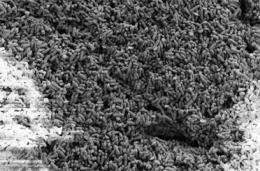
Focusing on a pure culture anaerobic bacterium, such as Geobacter sulfurreducens, as the core of the microbial fuel cell-based system, the power generation technology for this research would have an exceptionally long lifetime, beneficial for recharging onboard batteries or capacitors and providing for long-duration scouting missions.
"As we move forward in the utilization of MFCs as an energy generation method, this research begins to lay the groundwork for low powered electronics with a long-term potential for space and robotic applications," adds Scott.
Through his selection as a Fellow to the newly re-instated NASA Innovative Advanced Concepts (NIAC) program, Scott was awarded a research grant to investigate the initial phase of this innovative concept.
Provided by Naval Research Laboratory


