Researchers find gene critical to sense of smell in fruit fly
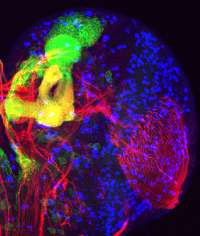
(Medical Xpress) -- Fruit flies don't have noses, but a huge part of their brains is dedicated to processing smells. Flies probably rely on the sense of smell more than any other sense for essential activities such as finding mates and avoiding danger.
UW-Madison researchers have discovered that a gene called distal-less is critical to the fly's ability to receive, process and respond to smells.
As reported in the current issue of the Proceedings of the National Academy of Sciences, the scientists also found evidence that distal-less is important for generating and maintaining self-renewing stem cells in the large brain structure that's responsible for processing odors and carrying out other important duties.
The corresponding gene in mammals and humans, called Dlx, is known to be important in the sense of smell. The Dlx gene has also been implicated in autism and epilepsy. By studying how distal-less works in fruit fly neurons, the scientists also hope to expand understanding of Dlx.
"We're really interested in knowing at a very fundamental level what distal-less is doing in the fly olfactory system and how it's doing it," says senior author Dr. Grace Boekhoff-Falk, associate professor of cell and regenerative biology at the School of Medicine and Public Health. "We're also hoping that what we learn in flies can give us a better understanding of how Dlx works in vertebrates, including humans."
Studying distal-less is much easier than studying Dlx, she adds, partly because mice and humans have six Dlx genes while flies have only one distal-less.
Odors enter fruit flies through nerve cells designed to receive smells--olfactory receptor neurons. From receptor neurons, projection neurons relay olfactory information to the large brain structure called the mushroom body (MB), which then triggers the animals to move in the right direction—towards the fragrance of food, for example, or away from the odor of a predator.
Boekhoff-Falk and her group have studied distal-less (dll) for years, previously investigating its role in the fruit fly hearing system and its limb development.
The current studies of the olfactory system were done in larvae rather than the more typically studied adult flies. Dissecting the younger, smaller flies demands the steadiest of hands, but the payoff is that larvae offer a substantially simpler view of brain development and wiring as well as insights into events occurring extremely early in development.
The researchers found dll was required for the development and growth of multiple cell types in the olfactory system, including those that receive, relay and process olfactory information. Dll must work for normal olfactory behavior to occur in larvae. And when dll is defective, the sense of smell is not present.
Zeroing in on the MB, the UW researchers also discovered an essential relationship between dll and the longest-living and most prolific neural stem cells found in fruit flies.
Boekhoff-Falk's team found that in flies with a mutated version of dll, these neural stem cells failed to proliferate. No other scientists have observed such strong defects in these cells at such an early stage.
The scientists identified markers that will allow them to learn how the stem cells decide which specialized cells they will become and how their growth may be regulated.
"We want to identify the niche, or the stem cell microenvironment, and the cells there that supply growth inputs needed to keep the stem-ness of the cells," she says.
Boekhoff-Falk believes the parallels to human stem cell biology may be strong. "Our model may be useful for further analysis of how this gene regulates stem cells," she says.
The experiments also opened the door to a better understanding of the evolution of the sense of smell.
"The prevailing view is that fly and mammal olfactory systems evolved independently, multiple times over history," says Boekhoff-Falk, who has a long-standing interest in evolutionary biology. "But our work challenges that view. We think that when it comes to the olfactory system there may be a common ancestor shared by flies and mammals."
Earlier work by others had shown that the "wiring diagrams," or the arrangements of nerves, involved in olfaction in flies and mammals are similar. However, this was attributed to convergent evolution, the process by which unrelated organisms independently evolve similar traits as a result of having to adapt to similar environments, rather than shared ancestry.
The new work from Boekhoff-Falk's group suggests that the underlying genetic mechanisms used in the developing olfactory systems of flies and mammals are similar.
"This supports the idea that the last common ancestor already had some form of olfactory system," she says, "and that the overall architecture and key elements of the underlying genetics have been well conserved over time."
The long-shared similarity makes studies of fly genes in the olfactory system more relevant to human disease than previously thought, she says.
All told, the findings make the fruit fly a powerful model for investigating dll function.
"We think these studies have the potential to be highly relevant to human biology," says Boekhoff-Falk.
Provided by University of Wisconsin-Madison


