New research explains how diamond rich kimberlite makes its way to Earth's surface
January 19, 2012 by Bob Yirka
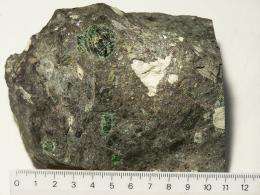
Picture of a diamond-bearing kimberlite rock, from a mine somewhere in the US. (Diamonds are not visible). Image: Wikipedia.
(PhysOrg.com) -- Kimberlite, a type of magma that is normally found deep within the Earth’s crust is known to somehow make its way to the surface at times, and when it does, it quite often has diamonds in it. Scientists have long believed that some process whereby some unknown substance being dissolved in water and carbon dioxide was responsible and that the rise was likely rapid, but other than that, had no real good explanation of how they moved upwards. Now, the riddle appears to be solved. Canadian volcanologist Kelly Russell and his colleagues at the University of British Columbia, as they describe in their upcoming paper in Nature, believe that when hot rising magma runs into silica rich minerals, carbon dioxide laden foam is released, forcing the minerals to the surface.
Russell says the leap was made when he and some colleagues tried heating rock samples to 1000°C to mimic the conditions found beneath the Earth’s surface. At one point, he tried sprinkling a silica rich mineral on the hot rocks to see what would happen. After just a few minutes, he writes, there was this foaming, and he and his colleague all knew at once that they’d solved the mystery.
It works like this, they say. When molten rock heavy with carbonate bubbles upwards, it at some point comes into contact with silica laden minerals. All this happens in an upper part of the mantel, where the rock typically has some amount of orthopyroxene in it. Carbon dioxide then bubbles upwards and out of the molten material making the magma buoyant. As it encounters more silica material, it becomes foamier and rises even faster, pushing its way to the surface in as little as just a few hours. The whole process keeps going because of the heat generated by the crystallization of other minerals. When they are exhausted, the process stops.
The whole process results in rocks, such as kimberlite being pushed to the surface, where many thousands or millions of years later, humans find them and begin extracting the diamonds that went along for the ride.
Because kimberlite, named for the town of Kimberly in South Africa where many early diamond mines were dug, is dense with crystals, it should be rather heavy, which would suggest trouble in pushing it up towards the surface. And while it does indeed appear to start out very heavy, it gets lighter as carbon dioxide is released in the reaction with the silicate material, allowing it to more easily be forced to the surface.
More information: Kimberlite ascent by assimilation-fuelled buoyancy, Nature 481, 352356 (19 January 2012) doi:10.1038/nature10740
Abstract
Kimberlite magmas have the deepest origin of all terrestrial magmas and are exclusively associated with cratons. During ascent, they travel through about 150 kilometres of cratonic mantle lithosphere and entrain seemingly prohibitive loads (more than 25 per cent by volume) of mantle-derived xenoliths and xenocrysts (including diamond). Kimberlite magmas also reputedly have higher ascent rates than other xenolith-bearing magmas. Exsolution of dissolved volatiles (carbon dioxide and water) is thought to be essential to provide sufficient buoyancy for the rapid ascent of these dense, crystal-rich magmas. The cause and nature of such exsolution, however, remains elusive and is rarely specified. Here we use a series of high-temperature experiments to demonstrate a mechanism for the spontaneous, efficient and continuous production of this volatile phase. This mechanism requires parental melts of kimberlite to originate as carbonatite-like melts. In transit through the mantle lithosphere, these silica-undersaturated melts assimilate mantle minerals, especially orthopyroxene, driving the melt to more silicic compositions, and causing a marked drop in carbon dioxide solubility. The solubility drop manifests itself immediately in a continuous and vigorous exsolution of a fluid phase, thereby reducing magma density, increasing buoyancy, and driving the rapid and accelerating ascent of the increasingly kimberlitic magma. Our model provides an explanation for continuous ascent of magmas laden with high volumes of dense mantle cargo, an explanation for the chemical diversity of kimberlite, and a connection between kimberlites and cratons.
Journal reference:
Nature
© 2011 PhysOrg.com
-
From lemons to lemonade: Reaction uses carbon dioxide to make carbon-based semiconductor,
32 comments
-
Thioridazine kills cancer stem cells in human while avoiding toxic side-effects of conventional cancer treatments,
3 comments
-
SpaceX private rocket blasts off for space station (Update),
42 comments
-
Climate scientists say they have solved riddle of rising sea,
31 comments
-
SpaceX capsule has 'new car' smell, astronauts say (Update),
4 comments
-
Hypothetical desert earth
21 hours ago
-
More human population = greater mass?
May 25, 2012
-
Conversion from aircraft bearing to normal degrees
May 23, 2012
-
Interpretation/Analysis of the Lab results(HEPA filter)
May 22, 2012
-
Has anyone here attended the The Urbino Summer School in Paleoclimatology?
May 22, 2012
-
Earthquakes: Mag 6 N. Italy and Mag 5.6 W. Bulgaria
May 21, 2012
- More from Physics Forums - Earth
More news stories
Land and sea species differ in climate change response: study
(Phys.org) -- Marine and terrestrial species will likely differ in their responses to climate warming, new research by Simon Fraser University and Australia’s University of Tasmania has found.
5 hours ago |
3.7 / 5 (3) |
5
|
Yale study concludes public apathy over climate change unrelated to science literacy
Are members of the public divided about climate change because they don't understand the science behind it? If Americans knew more basic science and were more proficient in technical reasoning, would public consensus match ...
7 hours ago |
4.8 / 5 (5) |
15
|
10 million years needed to recover from mass extinction
It took some 10 million years for Earth to recover from the greatest mass extinction of all time, latest research has revealed.
Space & Earth / Earth Sciences
7 hours ago |
4 / 5 (4) |
1
|
Sophisticated simulations predict future warming
The chances of our planet being hit by a global warming of 3 degrees Celsius by 2050 is as likely as it being hit by an increase of 1.4 degrees, new research shows. Presented in the journal Nature Geoscience, the British study ...
Space & Earth / Earth Sciences
May 22, 2012 |
4.4 / 5 (9) |
51
Aliens don't want to eat us, says former SETI director
Alien life probably isnt interested in having us for dinner, enslaving us or laying eggs in our bellies, according to a recent statement by former SETI director Jill Tarter.
Space & Earth / Space Exploration
May 25, 2012 |
4.4 / 5 (15) |
41
Stunning image of smallest possible five-ringed structure
Scientists have created and imaged the smallest possible five-ringed structure about 100,000 times thinner than a human hair and you'll probably recognise its shape.
'Unzipped' carbon nanotubes could help energize fuel cells, batteries
Multi-walled carbon nanotubes riddled with defects and impurities on the outside could replace some of the expensive platinum catalysts used in fuel cells and metal-air batteries, according to scientists at ...
Change in developmental timing was crucial in the evolutionary shift from dinosaurs to birds: study
At first glance, it's hard to see how a common house sparrow and a Tyrannosaurus Rex might have anything in common. After all, one is a bird that weighs less than an ounce, and the other is a dinosaur that ...
Computer model used to pinpoint prime materials for efficient carbon capture
When power plants begin capturing their carbon emissions to reduce greenhouse gases and to most in the electric power industry, it's a question of when, not if it will be an expensive undertaking.
T cells 'hunt' parasites like animal predators seek prey, study shows
By pairing an intimate knowledge of immune-system function with a deep understanding of statistical physics, a cross-disciplinary team at the University of Pennsylvania has arrived at a surprising finding: T cells use a movement ...
Scientists develop ultra-sensitive test that detects diseases in their earliest stages
Scientists have developed an ultra-sensitive test that should enable them to detect signs of a disease in its earliest stages, in research published today in the journal Nature Materials.
Jan 19, 2012
Rank: 1.3 / 5 (13)
Colorado, nnw of Denver. Lots of kimberlite pipes in the area.
Jan 19, 2012
Rank: 2.3 / 5 (3)
Jan 19, 2012
Rank: 5 / 5 (1)
Whether this hypothesis is too speculative or not will depend on the evidence reported in the upcoming article. On the face of it however, this idea appears to have promise as it may account for several puzzling features of these rocks and their origin.
Jan 19, 2012
Rank: 1 / 5 (12)
No, you're just ignorant of the scarcity of kimberlite formations in the continental US. They are known to exist in two States. Colorado and Arkansas.
Diamonds also occur in fluvial deposits in several states, but the tubes have long been eroded away, or at least, not be located.
Jan 20, 2012
Rank: 1 / 5 (18)
So then this finding now denies that it takes millions of years to form diamonds, as previously believed.
Perhaps that begins to explain why diamonds still contain significant amounts of radioactive C-14. Which in turn points to the fact that most probably the diamonds are not found "millions" of years later, but only thousands of years later.
Jan 20, 2012
Rank: not rated yet
Jan 20, 2012
Rank: not rated yet
Jan 20, 2012
Rank: 5 / 5 (4)
Now you're just a liar.
Jan 26, 2012
Rank: not rated yet