Novel contact lenses provide extended pain relief to laser eye surgery patients
Jan 18, 2012
Contact lenses provide extended pain relief to laser eye surgery patients

Scientists are reporting development of contact lenses that could provide a continuous supply of anesthetic medication to the eyes of patients who undergo laser eye surgery — an advance that could relieve patients of the burden of repeatedly placing drops of medicine into their eyes every few hours for several days. Their report appears in ACS' journal Langmuir.

Anuj Chauhan and colleagues explain that more than 1 million laser eye correction procedures are performed each year in the U.S. The surgery enables most to see clearly without eye glasses or . The procedure known as LASIK is the most common type of laser , but complications can develop if the patient undergoes trauma or is hit very hard at any time after the procedure. Photorefractive keratectomy (PRK) doesn't have this complication, and that's why it is preferred for athletes and those in the military. A downside to PRK, however, is a longer period of pain after surgery. To ease their pain, PRK patients place drops of several medications, including anesthetics, into their eyes every few hours, which can interfere with daily life and increase the risk of drug overdose. PRK patients receive a special "bandage contact lens" after surgery to help the outer layer of the eye heal.

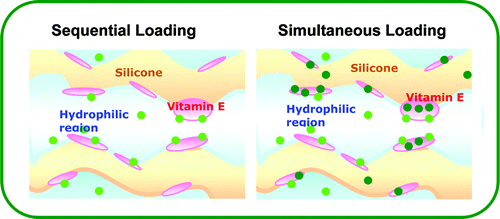
The researchers tested whether anesthetics loaded onto this type of lens could release the drugs over time automatically. They found that adding vitamin E to the lenses extended the time of release of three commonly used anesthetics from just under two hours to up to an entire day — or a few days in some instances. The vitamin E acts as a barrier, keeping the anesthetics on the eye, right where they are needed. The researchers say that, in the future, these lenses could serve as bandage contact lenses after PRK surgery while also delivering necessary pain medications.

Explore further: Protein study suggests drug side effects are inevitable

More information: Transport of Topical Anesthetics in Vitamin E Loaded Silicone Hydrogel Contact Lenses, Langmuir, 2012, 28 (2), pp 1478–1487. DOI: 10.1021/la203606z

Abstract
Transport of surface active anesthetic drugs through silicone hydrogel contact lenses containing nanosized vitamin E aggregates is explored for achieving extended anesthetics delivery. Commercial silicone hydrogel contact lenses release most ophthalmic drugs including local anesthetics for only a few hours, which is not adequate. Here we focus on creating dispersion of highly hydrophobic vitamin E aggregates in the lenses as barriers for drug diffusion for increasing the release durations. This approach has been shown previously to be successful in extending the release durations for some common hydrophilic ophthalmic drugs. The topical anesthetic drugs considered here (lidocaine, bupivacaine, and tetracaine) are hydrophilic at physiologic pH due to the charge, and so these cannot partition into the vitamin E barriers. However, these surface active drug molecules adsorb on the surface of the vitamin E barriers and diffuse along the surface, leading to only a small decrease in the effective diffusivity compared to non-surface-active hydrophilic drugs. The drug adsorption can be described by the Langmuir isotherm, and measurements of surface coverage of the drugs on the vitamin E provide an estimate of the available surface area of vitamin E, which can then be utilized to estimate the size of the aggregates. A diffusion controlled transport model that includes surface diffusion along the vitamin E aggregates and diffusion in the gel fit the transport data well. In conclusion, the vitamin E loaded silicone contact lens can provide continuous anesthetics release for about 1–7 days, depending on the method of drug loading in the lenses, and thus could be very useful for postoperative pain control after corneal surgery such as the photorefractive keratectomy (PRK) procedure for vision correction.

add to favorites email to friend print save as pdf

Related Stories

Study compares LASIK and LASEK eye surgery

Dec 21, 2006

A study comparing the safety, effectiveness and reliability of LASIK and LASEK has found no clinically significant differences between the two types of laser eye surgery.

A safer alternative to laser eye surgery?

May 11, 2010

A new type of procedure for correcting short-sightedness could be safer than laser eye surgery, according to a new Cochrane Systematic Review. The study also shows that patients prefer the new procedure, despite there being ...

Study: Lasik safer than contact lenses

Oct 11, 2006

Portland, Ore., researchers have said contact lens users are more likely than Lasik surgery patients to develop complications leading to further vision loss.

Contact lenses loaded with vitamin E may treat glaucoma

Mar 24, 2010

The popular dietary supplement vitamin E, loaded into special medicated contact lenses, can keep glaucoma medicine near the eye — where it can treat that common disease— almost 100 times longer than possible ...

Recommended for you

Protein study suggests drug side effects are inevitable

18 hours ago

A new study of both computer-created and natural proteins suggests that the number of unique pockets – sites where small molecule pharmaceutical compounds can bind to proteins – is surprisingly small, meaning drug side ...

Attacking MRSA with metals from antibacterial clays

May 17, 2013

In the race to protect society from infectious microbes, the bugs are outrunning us. The need for new therapeutic agents is acute, given the emergence of novel pathogens as well as old foes bearing heightened antibiotic resistance.

Keeping fruit, vegetables and cut flowers fresh longer

May 15, 2013

New technology offers the promise of reducing billions of dollars of losses that occur each year from the silent, invisible killer of fruits, vegetables and cut flowers—a gas whose effects are familiar to everyone who has ...

Why don't beetles freeze in the winter?

May 14, 2013

For 37 years, Queen's University Biochemistry professor Peter Davies has been unraveling the mystery of why some organisms including insects and fish don't freeze in the winter. His research into insect antifreeze protein ...

User comments : 0

More news stories

Protein study suggests drug side effects are inevitable

A new study of both computer-created and natural proteins suggests that the number of unique pockets – sites where small molecule pharmaceutical compounds can bind to proteins – is surprisingly small, meaning drug side ...

Non-wetting fabric drains sweat

(Phys.org) —Waterproof fabrics that whisk away sweat could be the latest application of microfluidic technology developed by bioengineers at the University of California, Davis.

Beautiful 'flowers' self-assemble in a beaker

By simply manipulating chemical gradients in a beaker of fluid, materials scientists at Harvard have found that they can control the growth behavior of crystals to create precisely tailored structures—such ...

Attacking MRSA with metals from antibacterial clays

In the race to protect society from infectious microbes, the bugs are outrunning us. The need for new therapeutic agents is acute, given the emergence of novel pathogens as well as old foes bearing heightened antibiotic resistance.

Study shows where scene context happens in our brain

In a remote fishing community in Venezuela, a lone fisherman sits on a cliff overlooking the southern Caribbean Sea. This man –– the lookout –– is responsible for directing his comrades on the water, ...

Green conversion of heat to electricity

Soon, it will be possible to produce electricity from heat over 30 degrees emitted from a waste incinerator, refinery, or data processor. The start-up Osmoblue has just confirmed the feasibility of this new ...

New rice contamination reported in China

Authorities are investigating rice mills in southern China following tests that found almost half of the staple grain in one of the country's largest cities was contaminated with a toxic metal.