Many bodies make one coherent burst of light: Researchers see superfluorescence from solid-state material
January 30, 2012

Many bodies make one coherent burst of light: Researchers see superfluorescence from solid-state material

Enlarge

Pumping laser pulses into a stack of quantum wells created an effect physicists had long sought but not seen until now: superfluorescence in a solid-state material. The Rice University lab of physicist Junichiro Kono reported the results in Nature Physics. (Credit: Tim Noe/Rice University)

In a flash, the world changed for Tim Noe – and for physicists who study what they call many-body problems. The Rice University graduate student was the first to see, in the summer of 2010, proof of a theory that solid-state materials are capable of producing an effect known as superfluorescence.

That can only happen when "many bodies" – in this case, electron-hole pairs created in a semiconductor – decide to cooperate.

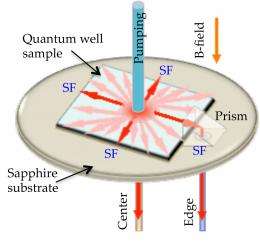
Noe, a student of Rice physicist Junichiro Kono, and their research team used high-intensity laser pulses, a strong and very cold temperatures to create the conditions for superfluorescence in a stack of 15 undoped quantum wells. The wells were made of indium, gallium and arsenic and separated by barriers of gallium-arsenide (GaAs). The researchers' results were reported this week in the journal .

Noe spent weeks at the only facility with the right combination of gear to carry out such an experiment, the National High Magnetic Field Laboratory at Florida State University. There, he placed the device in an ultracold (as low as 5 kelvins) chamber, pumped up the magnetic field (which effectively makes the "many body" particles – the electron-hole pairs – more sensitive and controllable) and fired a strong laser pulse at the array.

"When you shine light on a semiconductor with a photon energy larger than the band gap, you can create electrons in the conduction band and holes in the valence band. They become conducting," said Kono, a Rice professor of electrical and computer engineering and in physics and astronomy. "The electrons and holes recombine – which means they disappear – and emit light. One electron-hole pair disappears and one photon comes out. This process is called photoluminescence."

The Rice experiment acted just that way, but pumping strong laser light into the layers created a cascade among the quantum wells. "What Tim discovered is that in these extreme conditions, with an intense pulse of light on the order of 100 femtoseconds (quadrillionths of a second), you create many, many electron-hole pairs. Then you wait for hundreds of picoseconds (mere trillionths of a second) and a very strong pulse comes out," Kono said.

In the quantum world, that's a long gap. Noe attributes that "interminable" wait of trillionths of a second to the process going on inside the . There, the 8-nanometer-thick layers soaked up energy from the laser as it bored in and created what the researchers called a magneto-plasma, a state consisting of a large number of electron-hole pairs. These initially incoherent pairs suddenly line up with each other.

"We're pumping (light) to where absorption's only occurring in the GaAs layers," Noe said. "Then these electrons and holes fall into the well, and the light hits another GaAs layer and another well, and so on. The stack just increases the amount of light that's absorbed." The electrons and holes undergo many scattering processes that leave them in the wells with no coherence, he said. But as a result of the exchange of photons from spontaneous emission, a large, macroscopic coherence develops.

Like a capacitor in an electrical circuit, the wells become saturated and, as the researchers wrote, "decay abruptly" and release the stored charge as a giant pulse of coherent radiation.

"What's unique about this is the delay time between when we create the population of electron-hole pairs and when the burst happens. Macroscopic coherence builds up spontaneously during this delay," Noe said.

Kono said the basic phenomenon of superfluorescence has been seen for years in molecular and atomic gases but wasn't sought in a solid-state material until recently. The researchers now feel such superfluorescence can be fine-tuned. "Eventually we want to observe the same phenomenon at room temperature, and at much lower magnetic fields, maybe even without a magnetic field," he said.

Even better, Kono said, it may be possible to create superfluorescent pulses with any desired wavelength in solid-state materials, powered by electrical rather than light energy.

The researchers said they expect the paper to draw serious interest from their peers in a variety of disciplines, including condensed matter physics; quantum optics; atomic, molecular and optical physics; semiconductor optoelectronics; quantum information science; and materials science and engineering.

There's much work to be done, Kono said. "There are several puzzles that we don't understand," he said. "One thing is a spectral shift over time: The wavelength of the burst is actually changing as a function of time when it comes out. It's very weird, and that has never been seen."

Noe also observed superfluorescent emission with several distinct peaks in the time domain, another mystery to be investigated.

More information: http://www.nature. … hys2207.html

Provided by Rice University search and more info website

4.8 /5 (4 votes)  

Filter


Move the slider to adjust rank threshold, so that you can hide some of the comments.


Display comments: newest first

thales
Jan 30, 2012

Rank: 5 / 5 (3)
One semiconductor plus extreme cold plus strong magnetic fields plus a powerful laser burst = quantum laser capacitor.

That's pretty frickin' awesome.
Callippo
Jan 30, 2012

Rank: 5 / 5 (1)
This is what the random laser is called and it's not new thing at all - maybe with exception of the usage of the quantum dots as the lasing environment. http://en.wikiped...om_laser Now the same stuff is repackaged under the name "superfluorescent emission". The authors of university news probably believe, the people are complete imbeciles.
Callippo
Jan 30, 2012

Rank: 3 / 5 (1)
The wavelength of the burst is actually changing as a function of time when it comes out. It's very weird, and that has never been seen."
When we smash the EM pulse into LED diod, it's wavelength is shifting during pulse too. The explanation is trivial though - the PN junction is heated temporarily and its band gap is shrinking.
Hueight
Jan 30, 2012

Rank: not rated yet
Quantum dots?
axemaster
Jan 31, 2012

Rank: not rated yet
There's much work to be done, Kono said. "There are several puzzles that we don't understand," he said. "One thing is a spectral shift over time: The wavelength of the burst is actually changing as a function of time when it comes out. It's very weird, and that has never been seen."

Ha! My friend was working on a wave analysis technique recently that explains that. Look up aliasing and see if you can't figure it out ^_^

HINT: Try looking at the e-folding times and frequency evolution of a system, then convert it into quantum mechanical terms in your head, and suddenly it will be pretty obvious...
Rank 4.8 /5 (4 votes)
Relevant PhysicsForums posts

More news stories

Is a classical electrodynamics law incompatible with special relativity?

(Phys.org) -- The laws of classical electromagnetism that were developed in the 19th century are the same laws that scientists use today. They include Maxwell’s four equations along with the Lorentz la ...

Physics / General Physics

created May 24, 2012 | popularity 4.7 / 5 (18) | comments 43 | with audio podcast feature

Landmark calculation clears the way to answering how matter is formed

(Phys.org) -- An international collaboration of scientists, including Thomas Blum, associate professor of physics, is reporting in landmark detail the decay process of a subatomic particle called a kaon – ...

Physics / General Physics

created May 25, 2012 | popularity 4.3 / 5 (22) | comments 52 | with audio podcast

Lying in wait for WIMPs: Researchers seek to dramatically increase sensitivity of Large Underground Xenon detector

Although it's invisible, dark matter accounts for at least 80 percent of the matter in the universe. No one knows what it is, but most scientists would bet on weakly interacting massive particles, or WIMPs.

Physics / General Physics

created May 23, 2012 | popularity 4 / 5 (7) | comments 18 | with audio podcast

Hawaii lab turns laser-powered bubbles into microrobots

(Phys.org) -- A team of scientists from the University of Hawaii are working on microrobots created from bubbles of air in a saline solution. The bubbles take on their title of “robots” as a laser ...

Physics / General Physics

created May 23, 2012 | popularity 5 / 5 (4) | comments 2 | with audio podcast weblog

Sound increases the efficiency of boiling

Scientists at the Georgia Institute of Technology achieved a 17-percent increase in boiling efficiency by using an acoustic field to enhance heat transfer. The acoustic field does this by efficiently removing vapor bubbles ...

Physics / Soft Matter

created May 24, 2012 | popularity 5 / 5 (2) | comments 2


Stunning image of smallest possible five-ringed structure

Scientists have created and imaged the smallest possible five-ringed structure – about 100,000 times thinner than a human hair – and you'll probably recognise its shape.

'Unzipped' carbon nanotubes could help energize fuel cells, batteries

Multi-walled carbon nanotubes riddled with defects and impurities on the outside could replace some of the expensive platinum catalysts used in fuel cells and metal-air batteries, according to scientists at ...

Change in developmental timing was crucial in the evolutionary shift from dinosaurs to birds: study

At first glance, it's hard to see how a common house sparrow and a Tyrannosaurus Rex might have anything in common. After all, one is a bird that weighs less than an ounce, and the other is a dinosaur that ...

Computer model used to pinpoint prime materials for efficient carbon capture

When power plants begin capturing their carbon emissions to reduce greenhouse gases – and to most in the electric power industry, it's a question of when, not if – it will be an expensive undertaking.

T cells 'hunt' parasites like animal predators seek prey, study shows

By pairing an intimate knowledge of immune-system function with a deep understanding of statistical physics, a cross-disciplinary team at the University of Pennsylvania has arrived at a surprising finding: T cells use a movement ...

Land and sea species differ in climate change response: study

(Phys.org) -- Marine and terrestrial species will likely differ in their responses to climate warming, new research by Simon Fraser University and Australia’s University of Tasmania has found.