A new theory emerges for where some fish became four-limbed creatures
December 27, 2011

A new theory emerges for where some fish became four-limbed creatures

Enlarge

A small fish crawling on stumpy limbs from a shrinking desert pond is an icon of can-do spirit, emblematic of a leading theory for the evolutionary transition between fish and amphibians. This theorized image of such a drastic adaptation to changing environmental conditions, however, may, itself, be evolving into a new picture.

University of Oregon scientist Gregory J. Retallack, professor of , says that his discoveries at numerous sites in Maryland, New York and Pennsylvania suggests that "such a plucky hypothetical ancestor of ours probably could not have survived the overwhelming odds of perishing in a trek to another shrinking pond."

This scenario comes from the late Devonian, about 390 million years ago to roughly 360 million years ago. Paleontologist Alfred Romer, who died in 1973 after serving on the faculties at the University of Chicago and Harvard University, saw this time as a period of struggle and escape -- and important in fish-tetrapod transition -- to ensure survival.

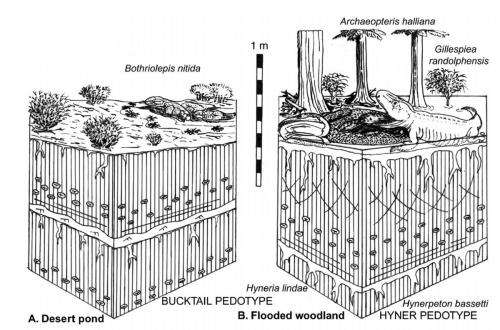
Reporting in the May 2011 issue of the Journal of Geology, Retallack, who also is co-director of paleontological collections at the UO's Museum of Natural and Cultural History, argues for a very different explanation. He examined numerous buried soils in rocks yielding footprints and bones of early transitional fossils between fish and amphibians of Devonian and Carboniferous geological age. What he found raises a major challenge to Romer's theory.

"These transitional fossils were not associated with drying ponds or deserts, but consistently were found with humid woodland soils," he said. "Remains of drying ponds and desert soils also are known and are littered with , but none of our distant ancestors. Judging from where their fossils were found, transitional forms between fish and amphibians lived in wooded floodplains. Our distant ancestors were not so much foolhardy, as opportunistic, taking advantage of floodplains and lakes choked with roots and logs for the first time in geological history."

Limbs proved handy for negotiating woody obstacles, and flexible necks allowed for feeding in shallow water, Retallack said. By this new woodland hypothesis, the limbs and necks, which distinguish salamanders from fish, did not arise from reckless adventure in deserts, but rather were nurtured by a newly evolved habitat of humid, wooded floodplains.

The findings, he said, dampen both the desert hypothesis of Romer and a newer inter-tidal theory put forth by Grzegorz Niedbwiedzki and colleagues at the University of Warsaw. In 2010, they published their discovery of eight-foot-long, 395-million-year-old tetrapods in ancient lagoonal mud in southeastern Poland, where Retallack also has been studying fossil soils with Polish colleague Marek Narkeiwicz.

"Ancient soils and sediments at sites for transitional fossils around the world are critical for understanding when and under what conditions fish first walked," Retallack said. "The Darwin of chrome adorning many car trunks represents a particular time and place in the long evolutionary history of life on earth."

Provided by University of Oregon search and more info website

4.3 /5 (8 votes)  

Filter


Move the slider to adjust rank threshold, so that you can hide some of the comments.


Display comments: newest first

dweeb
Dec 27, 2011

Rank: 2.5 / 5 (4)
mudskipper : the likelihood that re-emergent evolution is the result of similar genetic changes resulting from similar selection pressures that may suggest an environment , though comparable selection pressures may arise in alternate environments
hcl
Dec 27, 2011

Rank: 1 / 5 (3)
"such a plucky hypothetical ancestor of ours probably could not have survived the overwhelming odds of perishing in a trek to another shrinking pond."


Awkward sentences in paper, awkward sentences of press release... same author?
irjsiq
Dec 28, 2011

Rank: 1.8 / 5 (5)
I have long thought that 'hominids' Evolved for that purpose! Then 'We' began to out-think Evolution, and began 'giving orders', instead of just being utilized for 'transport' of ?Our? 'inner-ecosystem'! Old 'Truth': "Bacteria can exist without us! "We CANNOT exist without Bacteria!"

Roy J Stewart,
Phoenix AZ
Crazy_council
Dec 28, 2011

Rank: not rated yet
this theory make a lot of sence, fish would have had developed limbs while still being underwater, skipping across the surface may have just been a bonus to this. I would imagin that wooded ponds and lakes are more stable than shorelines over many years
Moebius
Dec 29, 2011

Rank: 5 / 5 (1)
mudskipper : the likelihood that re-emergent evolution is the result of similar genetic changes resulting from similar selection pressures that may suggest an environment , though comparable selection pressures may arise in alternate environments


Not exactly sure what you are saying but I was going to say that I think 4 leggedness developed in shore shallows where fish can escape predators, where the water is so shallow they can barely swim and can benefit from a different form of locomotion. The mudskipper is probably a perfect example of a transitional fish that could evolve into a 4 legged land animal given time and opportunity and that is probably how it happened.
Shifty0x88
Dec 30, 2011

Rank: not rated yet
I was thinking more like the snakeheads, which can breath air, and can "walk" from pond to pond.

Then let evolution take it's course with fewer and farther away ponds.... eventually leading to legs (2 were simply not enough)
Rank 4.3 /5 (8 votes)
Relevant PhysicsForums posts

More news stories

Change in developmental timing was crucial in the evolutionary shift from dinosaurs to birds: study

At first glance, it's hard to see how a common house sparrow and a Tyrannosaurus Rex might have anything in common. After all, one is a bird that weighs less than an ounce, and the other is a dinosaur that ...

Other Sciences / Archaeology & Fossils

created 8 hours ago | popularity 5 / 5 (5) | comments 0 | with audio podcast

Social welfare cuts ultimately come with heavy price, researchers say

(Phys.org) -- Slashing government funding for Medicaid, food stamps and other programs that serve the poor – while politically popular with some lawmakers and many conservatives – may do more harm ...

Other Sciences / Social Sciences

created May 24, 2012 | popularity 4.1 / 5 (22) | comments 155

Ancient Bethlehem seal unearthed in Jerusalem

Israeli archaeologists have discovered a 2,700-year-old seal that bears the inscription "Bethlehem," the Israel Antiquities Authority announced Wednesday, in what experts believe to be the oldest artifact ...

Other Sciences / Archaeology & Fossils

created May 23, 2012 | popularity 3.3 / 5 (15) | comments 24

Dollars and sense: Why are some people morally against tax?

As the U.S. presidential election campaigns heat up, the economic debate is dominated by bailouts, austerity and, inevitably, taxation. Now a new study published in Symbolic Interaction asks why tax is such an important issue ...

Other Sciences / Social Sciences

created May 23, 2012 | popularity 2.3 / 5 (3) | comments 19

Oldest Jewish archaeological evidence on the Iberian Peninsula

German archaeologists of the Friedrich Schiller University Jena found one of the oldest archaeological evidence so far of Jewish Culture on the Iberian Peninsula at an excavation site in the south of Portugal, ...

Other Sciences / Archaeology & Fossils

created May 25, 2012 | popularity 4.2 / 5 (6) | comments 12


Stunning image of smallest possible five-ringed structure

Scientists have created and imaged the smallest possible five-ringed structure – about 100,000 times thinner than a human hair – and you'll probably recognise its shape.

'Unzipped' carbon nanotubes could help energize fuel cells, batteries

Multi-walled carbon nanotubes riddled with defects and impurities on the outside could replace some of the expensive platinum catalysts used in fuel cells and metal-air batteries, according to scientists at ...

Computer model used to pinpoint prime materials for efficient carbon capture

When power plants begin capturing their carbon emissions to reduce greenhouse gases – and to most in the electric power industry, it's a question of when, not if – it will be an expensive undertaking.

T cells 'hunt' parasites like animal predators seek prey, study shows

By pairing an intimate knowledge of immune-system function with a deep understanding of statistical physics, a cross-disciplinary team at the University of Pennsylvania has arrived at a surprising finding: T cells use a movement ...

Land and sea species differ in climate change response: study

(Phys.org) -- Marine and terrestrial species will likely differ in their responses to climate warming, new research by Simon Fraser University and Australia’s University of Tasmania has found.

Yale study concludes public apathy over climate change unrelated to science literacy

Are members of the public divided about climate change because they don't understand the science behind it? If Americans knew more basic science and were more proficient in technical reasoning, would public consensus match ...