Survey reveals scientists have trouble accessing human embryonic stem cell lines
The promise of stem cell research for drug discovery and cell-based therapies depends on the ability of scientists to acquire stem cell lines for their research.
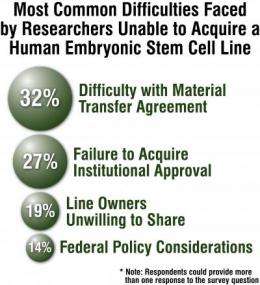
A survey of more than 200 human embryonic stem cell researchers in the United States found that nearly four in ten researchers have faced excessive delay in acquiring a human embryonic stem cell line and that more than one-quarter were unable to acquire a line they wanted to study.
"The survey results provide empirical data to support previously anecdotal concerns that delays in acquiring or an inability to acquire certain human embryonic stem cell lines may be hindering stem cell science in the United States," said Aaron Levine, an assistant professor in the School of Public Policy in the Ivan Allen College of Liberal Arts at the Georgia Institute of Technology.
Results of the survey were published in the December issue of the journal Nature Biotechnology. Funding for the study was provided by the Kauffman Foundation's Roadmap for an Entrepreneurial Economy Program.
Levine administered the web-based survey in November 2010 to more than 1,400 stem cell scientists working at U.S. academic and non‐profit medical research institutions. Almost 400 respondents from 32 states completed the survey. Of those, 205 respondents reported using human embryonic stem cells in their research, and their responses were used in this study.
The surveyed scientists cited four main reasons for their problems accessing human embryonic stem cell lines: difficulty obtaining material transfer agreements, failure to acquire research approval from internal institutional oversight committees, cell line owners that were unwilling to share and federal policy considerations.
"Bureaucratic challenges may be inevitable in this ethically contentious and politically sensitive field, but policymakers should attempt to mitigate these issues by doing things like encouraging institutions to accept third-party ownership verification and providing clearer guidance on human embryonic stem cell research not eligible for federal funding," said Levine, who is also a member of the Georgia Tech Institute for Bioengineering and Bioscience.
The broad patents assigned to the initial inventors of the method used to isolate embryonic stem cells and numerous narrower patents claiming specific human embryonic stem cell-related techniques are also factors complicating access to human embryonic stem cell lines, according to Levine.
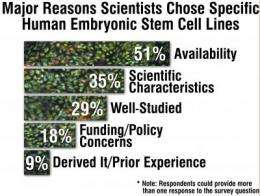
When survey respondents were asked how many of the more than 1,000 existing human embryonic stem cell lines they used, 76 percent reported using three or fewer lines and 54 percent reported using two or fewer lines in their research. More than half of the 130 respondents cited access issues as a major reason they chose to use specific cell lines in their research.
"These results illustrate that many human embryonic stem cell scientists in the United States are not conducting comparative studies with a diverse set of human embryonic stem cell lines, which raises concern that at least some results are cell-line specific rather than broadly applicable," said Levine. "Federal and state funding agencies may want to consider encouraging research using multiple diverse human embryonic stem cell lines to improve the reliability of research results."
Embryonic stem cell lines are being used to develop new cellular therapies for various diseases, to screen for new drugs and to better understand inherited diseases. It's crucial that diverse lines are available for this research to ensure that all individuals benefit from the results.
While availability was cited as the most common factor affecting scientists' choices regarding which cell lines to use, other considerations included suitability for a specific project, familiarity with specific lines, a desire to reduce complications in the laboratory, cost, the extent of relevant literature and the preferences of scientists' colleagues.
Three of the initial human embryonic stem cell lines derived at the University of Wisconsin in the late 1990s were the lines most commonly used by respondents. Cell lines H1, H9 and H7 were used by 79, 68 and 26 percent of respondents, respectively. Scientists also reported using more than 100 other lines, but each of these was used by fewer than 12 percent of respondents.
"Other research communities in the life sciences have experienced material access problems and they addressed them, in part, by creating centralized information and data sharing hubs, including public DNA sequence databases, tissue banks and mouse repositories. The stem cell research community has taken promising steps in this direction, but this analysis should encourage the community to continue and, if possible, accelerate these efforts," added Levine.
Provided by Georgia Institute of Technology


