SMOS detects freezing soil as winter takes grip
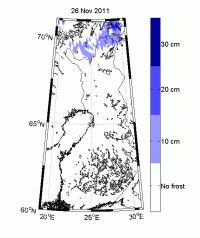
SMOS has shown that it is able to detect frozen soil from space. The depth to which the soil is frozen can also be inferred. From the animation, which shows northern Finland, the difference between 26 November 2010 and 26 November 2011 can be seen clearly. This year’s late frost is associated with Europe’s mild weather this autumn. Credits: Finnish Meteorological Institute
(PhysOrg.com) -- ESAs SMOS satellite is designed to observe soil moisture and ocean salinity, but this innovative mission is showing that it can also offer new insight into Earths carbon and methane cycles by mapping soil as it freezes and thaws.
The launch of the Soil Moisture and Ocean Salinity (SMOS) mission in November 2009 opened up a new era of monitoring Earth using a new remote-sensing technique.
The satellite is capturing images of brightness temperature. These images correspond to microwave radiation emitted from Earths surface and can be related to soil moisture and ocean salinity.
Variability in soil moisture and ocean salinity is a consequence of the continuous exchange of water between the oceans, the atmosphere and the land Earths water cycle.
While SMOS provides essential information for understanding the water cycle, weather and climate system, scientists from the Finnish Meteorological Institute have recently developed a method of using the data to detect and map frozen soils.
Not only can the extent be mapped, but also the depth of the frozen layer can be inferred.
The animation shown above compares data from 26 November 2010 and 26 November 2011. Last year large parts of northern Finland were frozen to depths exceeding 30 cm. This year, however, autumn has been much milder and only a small area had frozen by 26 November.
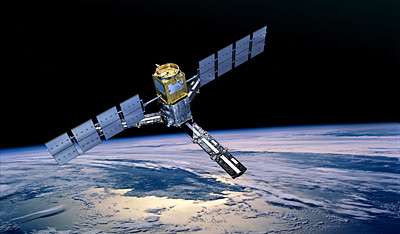
The Soil Moisture and Ocean Salinity (SMOS) mission makes global observations of soil moisture over Earth’s landmasses and salinity over the oceans. Variations in soil moisture and ocean salinity are a consequence of the continuous exchange of water between the oceans, the atmosphere and the land - Earth’s water cycle. Credits: ESA/AOES Medialab
Interestingly, as the next maps show, the advance of winter this year can be closely monitored.The image on the left shows the state of the soil on 26 November and one below shows how much more soil has frozen just four days later.
As soil freezes every year, it stores large amounts of carbon and methane, which are released back into the atmosphere when it thaws in the spring.
Moreover, there is great concern that rising global temperatures will cause permanently frozen soil, permafrost, in high latitudes to thaw releasing massive volumes of carbon and methane and adding further to the greenhouse effect.
Dr Kimmo Rautiainen from the Finnish Meteorological Institute (FMI) said, The state of the soil has always been of particular interest in northern latitudes.
Detecting frozen soils and the depth to which they are frozen from space has been an unresolved scientific problem.
However, we are now confident that the novel observations provided by the SMOS mission will help advance our understanding of processes occurring in cold regions.
Using SMOS data, the scientists have developed a method of inferring the depth of the frozen layer.
During the freezing process, brightness temperatures increase until the top 50 cm of the soil is frozen. Over winter the readings remain stable, even under the presence of deep snow. Thawing in spring then leads to a decrease in brightness temperature.
The SMOS data have been validated by observations taken from a ground-based radiometer at FMIs Arctic Research Centre in Sodankylä, northern Finland.
Through a study being carried out within ESAs Support to Science Element, the methods of detecting frozen soil will be refined further.
It is envisaged that similar data will be produced and released for use in applications such as numerical weather prediction and hydrology.
Provided by
European Space Agency
-
From lemons to lemonade: Reaction uses carbon dioxide to make carbon-based semiconductor,
32 comments
-
Thioridazine kills cancer stem cells in human while avoiding toxic side-effects of conventional cancer treatments,
3 comments
-
SpaceX private rocket blasts off for space station (Update),
42 comments
-
Climate scientists say they have solved riddle of rising sea,
31 comments
-
SpaceX capsule has 'new car' smell, astronauts say (Update),
4 comments
-
Hypothetical desert earth
20 hours ago
-
More human population = greater mass?
May 25, 2012
-
Conversion from aircraft bearing to normal degrees
May 23, 2012
-
Interpretation/Analysis of the Lab results(HEPA filter)
May 22, 2012
-
Has anyone here attended the The Urbino Summer School in Paleoclimatology?
May 22, 2012
-
Earthquakes: Mag 6 N. Italy and Mag 5.6 W. Bulgaria
May 21, 2012
- More from Physics Forums - Earth
More news stories
Land and sea species differ in climate change response: study
(Phys.org) -- Marine and terrestrial species will likely differ in their responses to climate warming, new research by Simon Fraser University and Australia’s University of Tasmania has found.
3 hours ago |
3.7 / 5 (3) |
3
|
Yale study concludes public apathy over climate change unrelated to science literacy
Are members of the public divided about climate change because they don't understand the science behind it? If Americans knew more basic science and were more proficient in technical reasoning, would public consensus match ...
5 hours ago |
4.8 / 5 (4) |
11
|
10 million years needed to recover from mass extinction
It took some 10 million years for Earth to recover from the greatest mass extinction of all time, latest research has revealed.
Space & Earth / Earth Sciences
5 hours ago |
5 / 5 (3) |
1
|
Sophisticated simulations predict future warming
The chances of our planet being hit by a global warming of 3 degrees Celsius by 2050 is as likely as it being hit by an increase of 1.4 degrees, new research shows. Presented in the journal Nature Geoscience, the British study ...
Space & Earth / Earth Sciences
May 22, 2012 |
4.4 / 5 (9) |
51
Aliens don't want to eat us, says former SETI director
Alien life probably isnt interested in having us for dinner, enslaving us or laying eggs in our bellies, according to a recent statement by former SETI director Jill Tarter.
Space & Earth / Space Exploration
May 25, 2012 |
4.4 / 5 (14) |
41
'Unzipped' carbon nanotubes could help energize fuel cells, batteries
Multi-walled carbon nanotubes riddled with defects and impurities on the outside could replace some of the expensive platinum catalysts used in fuel cells and metal-air batteries, according to scientists at ...
Change in developmental timing was crucial in the evolutionary shift from dinosaurs to birds: study
At first glance, it's hard to see how a common house sparrow and a Tyrannosaurus Rex might have anything in common. After all, one is a bird that weighs less than an ounce, and the other is a dinosaur that ...
Computer model used to pinpoint prime materials for efficient carbon capture
When power plants begin capturing their carbon emissions to reduce greenhouse gases and to most in the electric power industry, it's a question of when, not if it will be an expensive undertaking.
T cells 'hunt' parasites like animal predators seek prey, study shows
By pairing an intimate knowledge of immune-system function with a deep understanding of statistical physics, a cross-disciplinary team at the University of Pennsylvania has arrived at a surprising finding: T cells use a movement ...
Scientists develop ultra-sensitive test that detects diseases in their earliest stages
Scientists have developed an ultra-sensitive test that should enable them to detect signs of a disease in its earliest stages, in research published today in the journal Nature Materials.
Manufacturing genes to attack flu virus
An international research team has manufactured a new protein that can combat deadly flu epidemics.
Dec 16, 2011
Rank: 1 / 5 (2)
That will be welcomed news for those seriously interested in understanding Earths carbon and methane cycles!
Hopefully those presenting data from ESAs SMOS satellite will avoid bias that might cause the new results to be labeled as more politically-motivated AGW propaganda [1-4].
1. http://www.foxnew...er-fire/
2. http://dl.dropbox...asks.pdf
3. http://joannenova...idation/
4. http://dl.dropbox...oots.pdf
Best wishes,
O. K. Manuel
www.omatumr.com