The smallest conceivable switch: Targeted proton transfer within a molecule
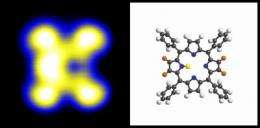
Physicists at the Technische Universitaet Muenchen have created a nano switch based on a single porphyrin ring. If one of two protons from the inside of the ring is removed, the remaining proton can take on any one of four positions, initiated by a single tunnel electron from the tip of a scanning tunneling microscope. Credit: Knud Seufert / Technische Universitaet Muenchen
For a long time miniaturization has been the magic word in electronics. Dr. Willi Auwaerter and Professor Johannes Barth, together with their team of physicists at the Technische Universitaet Muenchen (TUM), have now presented a novel molecular switch in the journal Nature Nanotechnology. Decisive for the functionality of the switch is the position of a single proton in a porphyrin ring with an inside diameter of less than half a nanometer. The physicists can set four distinct states on demand.
Porphyins are ring-shaped molecules that can flexibly change their structure, making them useful for a wide array of applications. Tetraphenylporphyrin is no exception: It likes to take on a saddle shape and is not limited in its functionality when it is anchored to a metal surface. The molecule holds has a pair of hydrogen atoms that can change their positions between two configurations each. At room temperature this process takes place continuously at an extremely rapid rate.
In their experiment, the scientists suppressed this spontaneous movement by cooling the sample. This allowed them to induce and observe the entire process in a single molecule using a scanning tunneling microscope. This kind of microscope is particularly well suited for the task since in contrast to other methods it can be used not only to determine the initial and final states, but also allows the physicists to control the hydrogen atoms directly. In a further step they removed one of the two protons from the inside of the porphyrin ring. The remaining proton could now take on any one of four positions. A tiny current that flows through the fine tip of the microscope stimulates the proton transfer, setting a specific configuration in the process.
Although the respective positions of the hydrogen atoms influence neither the basic structure of the molecule nor its bond to the metallic surface, the states are not identical. This small but significant difference, taken together with the fact that the process can be arbitrarily repeated, forms the basis of a switch whose state can be changed up to 500 times per second. A single tunneled electron initiates the proton transfer.
The molecular switch has a surface area of only one square nanometer, making it the smallest switch implemented to date. The physicists are thrilled by their demonstration and are also very happy about new insights into the mechanism behind the proton transfer resulting from their study. Knud Seufert played a key role with his experiments: "To operate a four-state switch by moving a single proton within a molecule is really fascinating and represents a true step forward in nano-scale technologies."
More information: Willi Auwaerter, Knud Seufert, Felix Bischoff, David Ecija, Saranyan Vijayaraghavan, Sushobhan Joshi, Florian Klappenberger, Niveditha Samudrala, and Johannes V. Barth, A surface-anchored molecular four-level conductance switch based on single proton transfer, Nature Nanotechnology, Advance Online Publication, 11 December 2011 DOI:http://dx.doi.org/ … ANO.2011.211
Journal reference:
Nature Nanotechnology
Provided by Technische Universitaet Muenchen
-
From lemons to lemonade: Reaction uses carbon dioxide to make carbon-based semiconductor,
32 comments
-
Thioridazine kills cancer stem cells in human while avoiding toxic side-effects of conventional cancer treatments,
3 comments
-
SpaceX private rocket blasts off for space station (Update),
42 comments
-
Climate scientists say they have solved riddle of rising sea,
31 comments
-
SpaceX capsule has 'new car' smell, astronauts say (Update),
4 comments
-
Why does a boiled egg rotates while a raw egg doesn't?
1 hour ago
-
Lightning strike in mindair
1 hour ago
-
Why does light move?
3 hours ago
-
How to calculate the repulsion force between a permanent and an electromagnet?
4 hours ago
-
Why does light allow us to see things?
4 hours ago
-
Room temperature superconductivity
4 hours ago
- More from Physics Forums - General Physics
More news stories
'Unzipped' carbon nanotubes could help energize fuel cells, batteries
Multi-walled carbon nanotubes riddled with defects and impurities on the outside could replace some of the expensive platinum catalysts used in fuel cells and metal-air batteries, according to scientists at ...
Nanotechnology / Nanomaterials
5 hours ago |
1 / 5 (1) |
0
|
Dopant gives graphene solar cells highest efficiency yet
(Phys.org) -- By taking advantage of graphenes favorable electrical and optical properties, and then adding an organic dopant, researchers have achieved the highest power conversion efficiency yet for ...
In nanorod crystal growth, nanoparticles seen as artificial atoms
In the growth of crystals, do nanoparticles act as "artificial atoms" forming molecular-type building blocks that can assemble into complex structures? This is the contention of a major but controversial theory ...
May 24, 2012 |
4.8 / 5 (6) |
0
|
First direct observation of oriented attachment in nanocrystal growth
Berkeley Lab researchers have reported the first direct observation of nanoparticles undergoing oriented attachment, the critical step in biomineralization and the growth of nanocrystals. A better understanding ...
May 24, 2012 |
4.7 / 5 (3) |
0
|
Synthetic nano-waste does not disappear
(Phys.org) -- Tiny particles of cerium oxide do not burn or change in the heat of a waste incineration plant. They remain intact on combustion residues or in the incineration system, as a new study by Swiss ...
Nanotechnology / Bio & Medicine
May 25, 2012 |
5 / 5 (2) |
1
|
Change in developmental timing was crucial in the evolutionary shift from dinosaurs to birds: study
At first glance, it's hard to see how a common house sparrow and a Tyrannosaurus Rex might have anything in common. After all, one is a bird that weighs less than an ounce, and the other is a dinosaur that ...
Computer model used to pinpoint prime materials for efficient carbon capture
When power plants begin capturing their carbon emissions to reduce greenhouse gases and to most in the electric power industry, it's a question of when, not if it will be an expensive undertaking.
T cells 'hunt' parasites like animal predators seek prey, study shows
By pairing an intimate knowledge of immune-system function with a deep understanding of statistical physics, a cross-disciplinary team at the University of Pennsylvania has arrived at a surprising finding: T cells use a movement ...
Land and sea species differ in climate change response: study
(Phys.org) -- Marine and terrestrial species will likely differ in their responses to climate warming, new research by Simon Fraser University and Australia’s University of Tasmania has found.
Yale study concludes public apathy over climate change unrelated to science literacy
Are members of the public divided about climate change because they don't understand the science behind it? If Americans knew more basic science and were more proficient in technical reasoning, would public consensus match ...
10 million years needed to recover from mass extinction
It took some 10 million years for Earth to recover from the greatest mass extinction of all time, latest research has revealed.