S.Africa ideal for world's largest telescope: minister
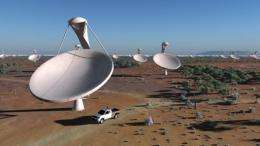
An artist's impression released by the SPDO shows dishes of the future Square Kilometre Array radio telescope. Dishes will form a substantial part of the SKA; around 3000 dishes, each 15 m in diameter, are currently planned. South Africa is well-placed to host the world's largest telescope because it would cost cheaper, according to the deputy science minister.
South Africa is well-placed to host the world's largest telescope because the costs would be lower, according to the deputy science minister.
South Africa is competing with Australia to win the contract for the Square Kilometre Array (SKA), a multi-billion dollar instrument that will be 50 times more sensitive than today's most powerful radio telescopes.
The bid will be decided by February or March next year, but the global economic crisis might give South Africa an advantage, said deputy science minister Derek Hanekom on a flight to the Karoo, a semi-desert region in the remote Northern Cape province Monday night.
"The cost will probably escalate to two billion dollars" and funding countries are finding their budgets stretched, he told journalists.
"It's a big one, so that's why South Africa is a good place."
If South Africa wins the bidding, engineers will connect antennas in the arid Karoo region by remote link to a network of dishes stretching across southern and eastern Africa and as far away as Ghana.
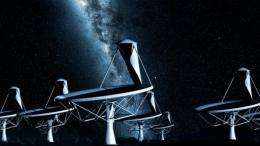
An artist impression's released by the SPDO shows dishes of the future Square Kilometre Array (SKA) radio telescope by night. Dishes will form a substantial part of the SKA; around 3000 dishes, each 15 m in diameter, are currently planned.
Australia's bid puts the core site at Mileura station, about 100 kilometres (60 miles) west of Meekathara in western Australia. Other antennas would be distributed across Australia and New Zealand.The SKA steering committee, which represents a consortium of 17 countries involved in the project, is expected to make the final decision.
But cheaper labour, construction and electricity also gave South Africa the country an advantage over Australia, said Justin Jonas, the engineer and astronomer who heads the project in the country.
"To go on site is also cheaper, you need just one hour to fly there (from Cape Town)."
Scientists hope the SKA, a massive new radio telescope linking 3,000 antenna dishes, will shed new light on fundamental questions about the universe, including how it began, why it's expanding and whether it contains life beyond our planet.
South Africa has the largest optical telescope in the southern hemisphere near Sutherland, a town in the southwest of the country.
Its northwestern neighbour Namibia has the High Energy Stereoscopic System, the biggest cosmic ray telescope in the world, 100 kilometres (60 miles) south of the capital, Windhoek.
"SA has pretty much ideal conditions for astronomy," said Hanekom.
(c) 2011 AFP
-
From lemons to lemonade: Reaction uses carbon dioxide to make carbon-based semiconductor,
32 comments
-
Thioridazine kills cancer stem cells in human while avoiding toxic side-effects of conventional cancer treatments,
3 comments
-
SpaceX private rocket blasts off for space station (Update),
42 comments
-
Climate scientists say they have solved riddle of rising sea,
31 comments
-
SpaceX capsule has 'new car' smell, astronauts say (Update),
4 comments
-
Distance of planets from stars and revolution
5 hours ago
-
revamping general concept and cosmological principle
May 25, 2012
-
Transiting Exoplanet Light Curve
May 25, 2012
-
Math behind Theoretical Physics
May 24, 2012
-
Do we know whats at the center of galaxies yet?
May 23, 2012
-
Structure of the Milky Way?
May 20, 2012
- More from Physics Forums - General Astronomy
More news stories
Land and sea species differ in climate change response: study
(Phys.org) -- Marine and terrestrial species will likely differ in their responses to climate warming, new research by Simon Fraser University and Australia’s University of Tasmania has found.
3 hours ago |
3.7 / 5 (3) |
3
|
Yale study concludes public apathy over climate change unrelated to science literacy
Are members of the public divided about climate change because they don't understand the science behind it? If Americans knew more basic science and were more proficient in technical reasoning, would public consensus match ...
5 hours ago |
4.8 / 5 (4) |
11
|
10 million years needed to recover from mass extinction
It took some 10 million years for Earth to recover from the greatest mass extinction of all time, latest research has revealed.
Space & Earth / Earth Sciences
5 hours ago |
5 / 5 (3) |
1
|
Sophisticated simulations predict future warming
The chances of our planet being hit by a global warming of 3 degrees Celsius by 2050 is as likely as it being hit by an increase of 1.4 degrees, new research shows. Presented in the journal Nature Geoscience, the British study ...
Space & Earth / Earth Sciences
May 22, 2012 |
4.4 / 5 (9) |
51
Aliens don't want to eat us, says former SETI director
Alien life probably isnt interested in having us for dinner, enslaving us or laying eggs in our bellies, according to a recent statement by former SETI director Jill Tarter.
Space & Earth / Space Exploration
May 25, 2012 |
4.4 / 5 (14) |
41
'Unzipped' carbon nanotubes could help energize fuel cells, batteries
Multi-walled carbon nanotubes riddled with defects and impurities on the outside could replace some of the expensive platinum catalysts used in fuel cells and metal-air batteries, according to scientists at ...
Change in developmental timing was crucial in the evolutionary shift from dinosaurs to birds: study
At first glance, it's hard to see how a common house sparrow and a Tyrannosaurus Rex might have anything in common. After all, one is a bird that weighs less than an ounce, and the other is a dinosaur that ...
Computer model used to pinpoint prime materials for efficient carbon capture
When power plants begin capturing their carbon emissions to reduce greenhouse gases and to most in the electric power industry, it's a question of when, not if it will be an expensive undertaking.
T cells 'hunt' parasites like animal predators seek prey, study shows
By pairing an intimate knowledge of immune-system function with a deep understanding of statistical physics, a cross-disciplinary team at the University of Pennsylvania has arrived at a surprising finding: T cells use a movement ...
Scientists develop ultra-sensitive test that detects diseases in their earliest stages
Scientists have developed an ultra-sensitive test that should enable them to detect signs of a disease in its earliest stages, in research published today in the journal Nature Materials.
Manufacturing genes to attack flu virus
An international research team has manufactured a new protein that can combat deadly flu epidemics.
