Test paves way for 15,000-ton neutrino detector
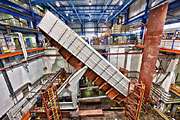
Last month, the preparations for the assembly of the NOvA neutrino detector passed a pivotal test in an assembly building at the Department of Energy’s Fermi National Accelerator Laboratory.
Scientists, engineers and technicians from Fermilab, Argonne National Laboratory and the University of Minnesota successfully operated for the first time the NOvA pivoter, the hydraulic system used to move and rotate huge, 200-ton blocks of detector components for the assembly of the 15,000-ton particle detector. Watch this video with a time lapse of the pivoter test and a fly-through animation of the NOvA building:
The full-size pivoter, six times as wide as the one tested at Fermilab, is under construction in Ash River, Minnesota, the site of the NOvA experiment.
When operational, the experiment will examine the world’s highest-intensity, longest-distance neutrino beam, sent from Fermilab to Ash River—500 miles straight through the earth. By measuring the composition of the neutrino beam with a 222-ton detector at Fermilab and a larger detector in Ash River, scientists expect to discover how the masses of the three known types of neutrino—the lightest fundamental building blocks of matter—stack up. Scientists from 28 institutions are working on the NOvA experiment.
Provided by Ames Laboratory


