Mountains and buried ice on Mars
December 5, 2011

Mountains and buried ice on Mars

Enlarge

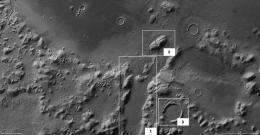
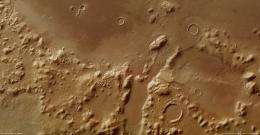
Phlegra Montes is a range of gently curving mountains and ridges on Mars. They extend from the northeastern portion of the Elysium volcanic province to the northern lowlands. This image is centred at 33°N/162°E. The High-Resolution Stereo Camera (HRSC) on ESA’s Mars Express collected the data for these images on 1 June 2011 during orbit 9465. The images have a ground resolution of about 16 m per pixel. Credits: ESA/DLR/FU Berlin (G. Neukum)

(PhysOrg.com) -- New images from Mars Express show the Phlegra Montes mountain range, in a region where radar probing indicates large volumes of water ice are hiding below. This could be a source of water for future astronauts.

Phlegra Montes is a range of gently curving mountains and ridges on . It extends from the northeastern portion of the Elysium volcanic province to the northern lowlands, spanning latitudes from roughly 30°N to 50°N.

The mountains themselves are probably not volcanic in origin, but have been raised by ancient tectonic forces that squeezed different regions of the surface together.

New images from the high-resolution stereo camera on ESA’s orbiter allow a closer inspection and show that almost every mountain is surrounded by ‘lobate debris aprons’ – curved features typically observed around plateaus and at these latitudes.

Mountains and buried ice on Mars
Enlarge

Phlegra Montes is a range of gently curving mountains and ridges on Mars. Flow patterns attributable to water are widely visible across the image. Linear flow patterns can be seen inside the valley (Box 1). Nearly every mountain is surrounded by an apron of rocky debris (Box 2). Over time, this debris appears to have moved down the mountainside and looks similar to the debris found covering glaciers here on Earth. Lobe-shaped structures seen inside impact craters in the region (Box 3) are known as concentric crater fill and are perhaps another indication of subsurface water ice. The High-Resolution Stereo Camera on ESA’s Mars Express collected the data for these images on 1 June 2011 during orbit 9465. Credits: ESA/DLR/FU Berlin (G. Neukum)

Previous studies have shown that this material appears to have moved down the mountain slopes over time, and looks similar to the debris found covering glaciers here on Earth.

The suggestion then is that there may be glaciers buried just below the surface in this region.  

This interpretation is backed up by the on NASA’s Mars Reconnaissance Orbiter looking beneath the martian surface.

The radar shows that lobate debris aprons are indeed strongly associated with the presence of water ice, perhaps only 20 m down.

Further evidence for relatively recent glaciation can be seen inside impact craters in the region. Series of ridges are thought to have developed when the ancient craters filled with snow. Over time, the snow compacted to form glaciers which then sculpted the crater floors.
Mountains and buried ice on Mars
Enlarge

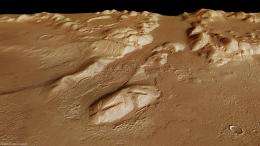
Phlegra Montes is a range of gently curving mountains and ridges on Mars. They extend from the northeastern portion of the Elysium volcanic province to the northern lowlands. The High-Resolution Stereo Camera on ESA’s Mars Express collected the data for these images on 1 June 2011 during orbit 9465. This perspective view has been calculated from the Digital Terrain Model derived from the stereo channels. Credits: ESA/DLR/FU Berlin (G. Neukum)

There are yet more glacial flow patterns visible in the valley at the centre of the image.

It is believed that mid-latitude glaciers developed at various times in the last several hundred million years, when the polar axis of Mars was significantly different from today, leading to quite different climatic conditions.

All of this points to plentiful just below the surface in Phlegra Montes. If this proves to be true, such ice fields could provide future with a source of water on the Red Planet.

Provided by European Space Agency search and more info website


Rank 5 /5 (2 votes)
Relevant PhysicsForums posts
  • Distance of planets from stars and revolution
    created5 hours ago
  • revamping general concept and cosmological principle
    createdMay 25, 2012
  • Transiting Exoplanet Light Curve
    createdMay 25, 2012
  • Math behind Theoretical Physics
    createdMay 24, 2012
  • Do we know whats at the center of galaxies yet?
    createdMay 23, 2012
  • Structure of the Milky Way?
    createdMay 20, 2012
  • More from Physics Forums - General Astronomy

More news stories

Land and sea species differ in climate change response: study

(Phys.org) -- Marine and terrestrial species will likely differ in their responses to climate warming, new research by Simon Fraser University and Australia’s University of Tasmania has found.

Space & Earth / Environment

created 3 hours ago | popularity 3.7 / 5 (3) | comments 3 | with audio podcast

Yale study concludes public apathy over climate change unrelated to science literacy

Are members of the public divided about climate change because they don't understand the science behind it? If Americans knew more basic science and were more proficient in technical reasoning, would public consensus match ...

Space & Earth / Environment

created 5 hours ago | popularity 4.8 / 5 (4) | comments 11 | with audio podcast

10 million years needed to recover from mass extinction

It took some 10 million years for Earth to recover from the greatest mass extinction of all time, latest research has revealed.

Space & Earth / Earth Sciences

created 5 hours ago | popularity 5 / 5 (3) | comments 1 | with audio podcast

Sophisticated simulations predict future warming

The chances of our planet being hit by a global warming of 3 degrees Celsius by 2050 is as likely as it being hit by an increase of 1.4 degrees, new research shows. Presented in the journal Nature Geoscience, the British study ...

Space & Earth / Earth Sciences

created May 22, 2012 | popularity 4.4 / 5 (9) | comments 51

Aliens don't want to eat us, says former SETI director

Alien life probably isn’t interested in having us for dinner, enslaving us or laying eggs in our bellies, according to a recent statement by former SETI director Jill Tarter.

Space & Earth / Space Exploration

created May 25, 2012 | popularity 4.4 / 5 (14) | comments 41


'Unzipped' carbon nanotubes could help energize fuel cells, batteries

Multi-walled carbon nanotubes riddled with defects and impurities on the outside could replace some of the expensive platinum catalysts used in fuel cells and metal-air batteries, according to scientists at ...

Change in developmental timing was crucial in the evolutionary shift from dinosaurs to birds: study

At first glance, it's hard to see how a common house sparrow and a Tyrannosaurus Rex might have anything in common. After all, one is a bird that weighs less than an ounce, and the other is a dinosaur that ...

Computer model used to pinpoint prime materials for efficient carbon capture

When power plants begin capturing their carbon emissions to reduce greenhouse gases – and to most in the electric power industry, it's a question of when, not if – it will be an expensive undertaking.

T cells 'hunt' parasites like animal predators seek prey, study shows

By pairing an intimate knowledge of immune-system function with a deep understanding of statistical physics, a cross-disciplinary team at the University of Pennsylvania has arrived at a surprising finding: T cells use a movement ...

Scientists develop ultra-sensitive test that detects diseases in their earliest stages

Scientists have developed an ultra-sensitive test that should enable them to detect signs of a disease in its earliest stages, in research published today in the journal Nature Materials.

Manufacturing genes to attack flu virus

An international research team has manufactured a new protein that can combat deadly flu epidemics.