Microneedle sensors may allow real-time monitoring of body chemistry
Dec 13, 2011
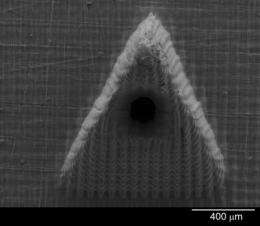
This is a scanning electron micrograph of a hollow microneedle, which was prepared out of an acrylate-based polymer. In this study, hollow microneedles were integrated with sensors for detection of glucose, lactate, and pH levels in a selective and simultaneous manner. Credit: Roger Narayan, North Carolina State University

Researchers from North Carolina State University, Sandia National Laboratories, and the University of California, San Diego have developed new technology that uses microneedles to allow doctors to detect real-time chemical changes in the body – and to continuously do so for an extended period of time.

"We've loaded the hollow channels within microneedles with electrochemical that can be used to detect specific molecules or pH levels," says Dr. Roger Narayan, co-author of a paper describing the research, and a professor in the joint biomedical engineering department of NC State's College of Engineering and the University of North Carolina at Chapel Hill.

Existing technology relies on taking samples and testing them, whereas this approach allows continuous monitoring, Narayan explains. "For example, it could monitor glucose levels in a diabetic patient," Narayan says. Microneedles are very small needles in which at least one dimension – such as length – is less than one millimeter.

"The idea is that customized microneedle sensor arrays could be developed and incorporated into wearable devices, such as something like a wristwatch, to help answer specific medical or research questions," Narayan says. "It's also worth pointing out that microneedles are not painful."

In addition to its clinical applications, the may also create opportunities for new research endeavors. For example, the sensor arrays could be used to track changes in lactate levels while people are exercising – rather than measuring those levels only before and after exercise.

The researchers developed a proof-of-concept sensor array incorporating three types of sensors, which could measure pH, glucose and lactate. However, Narayan says the array could be modified to monitor a wide variety of chemicals.

The paper, "Multiplexed Microneedle-based Biosensor Array for Characterization of Metabolic Acidosis," is published online in the journal Talanta. The paper was co-authored by Narayan and NC State Ph.D. students Philip Miller and Shelby Skoog as well as researchers from Sandia National Laboratories and the University of California, San Diego. The research was funded by the National Science Foundation, the National Institutes of Health, and the Department of Energy.

Explore further: Study finds chemical behind cancer resistance in naked mole rats

Related Stories

Ceramic hybrid needles take the sting out of shots

Jan 07, 2008

New polymerization technology may one day take the pain out of injections and blood draws. A team of researchers at the University of North Carolina and Laser Zentrum Hannover have recently used two-photon polymerization ...

Recommended for you

Long distance calls by sugar molecules

Jun 18, 2013

All our cells wear a coat of sugar molecules, so-called glycans. ETH Zurich and Empa researchers have now discovered that glycans rearrange water molecules over long distances. This may have an effect on ...

Researchers discover a way to detect new viruses

Jun 17, 2013

(Phys.org) —In research published in Biochemical and Biophysical Research Communications, Saint Louis University researchers describe a technology that can detect new, previously unknown viruses. The te ...

User comments : 2

Adjust slider to filter visible comments by rank

Display comments: newest first

TheGhostofOtto1923
3 / 5 (2) Dec 13, 2011
I suppose these could be used to monitor athletes and expectant mothers for the presence of drugs? Women who are detected endangering the health of their fetuses could be immediately incarcerated, in a nice comfy clinic I suppose, until the future human being is brought to term.

Along with genetic screening and corrective therapy this will one day be mandatory.
gtfieldson
not rated yet Dec 13, 2011
The ideas have been kicking around for a while, but it's nice to see someone actually realizing the concept.

See US patent 6,091,975, for example.

More news stories

DNA constructs antenna for solar energy

Researchers at Chalmers University of Technology have found an effective solution for collecting sunlight for artificial photosynthesis. By combining self-assembling DNA molecules with simple dye molecules, ...

Unexpected behavior of well-known catalysts

Industrial palladium-copper catalysts change their structures before they get to work, already during the activation process. As a result, the reaction is catalysed by a catalyst that is different from the ...

Danish chemists in molecular chip breakthrough

Electronic components built from single molecules using chemical synthesis could pave the way for smaller, faster and more green and sustainable electronic devices. Now for the first time, a transistor made ...

China astronauts float water blob in kids' lecture

Astronauts struck floating martial arts poses, twirled gyroscopes and manipulated wobbling globes of water during a lecture Thursday from China's orbiting space station that's part of efforts to popularize ...