LRO observes final lunar eclipse of the year
Dec 09, 2011 By Nancy Jones
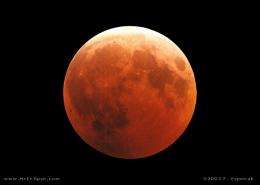
This 2003 image shows the ruddy appearance typical of the moon during a lunar eclipse. Credit: Fred Espenak

(PhysOrg.com) -- Orbiting 31 miles above the lunar surface, NASA's Lunar Reconnaissance Orbiter (LRO) spacecraft will get a "front-row seat" to the total lunar eclipse on Dec. 10, 2011.

LRO's instrument will record how quickly targeted areas on the moon's day side cool off during the eclipse. The degree of cooling is dependent on factors such as how rocky the surface is, how densely packed the is, and its . By studying the during the eclipse, scientists can learn even more about our nearest celestial neighbor.

From beginning to end, the eclipse will last from 11:33 UT (6:33 a.m. EST, 3:33 a.m. PST) to 17:30 UT (12:30 p.m. EST, 9:30 a.m. PST). Totality, the time when Earth's shadow completely covers the moon, will last 51 minutes. All of the United States will see some portion of the eclipse. The West Coast will have a more complete view of this particular eclipse.

The West Coast will see totality as the moon sets and the sun rises. For West Coast viewers, the eclipse begins at 3:33 a.m. PST. The peak, when the moon is a deep red, occurs at 6:30 a.m. PST.

For East Coast residents, the only stage of the eclipse that will be visible is the earliest portion when the moon begins to enter Earth's shadow. This dimming is very slight and may be difficult to see.

A lunar eclipse occurs when Earth is directly between the sun and the moon, blocking the sun's rays and casting a shadow on the moon. As the moon moves deeper and deeper into Earth's shadow, the moon changes color before your very eyes, turning from gray to an orange or deep shade of red.

The moon takes on this new color because sunlight is still able to pass through Earth's atmosphere and cast a glow on the moon. Our atmosphere filters out most of the blue colored light, leaving the red and orange hues that we see during a lunar eclipse. If there are additional dust particles in the atmosphere, the moon will appear to be a darker shade of red.

Unlike solar eclipses, lunar eclipses are perfectly safe to view without any special glasses or equipment. All you need is your own two eyes. Our next opportunity to view a from the U.S. is April 15, 2014, so mark your calendars!

Explore further: NASA head views progress on asteroid lasso mission

add to favorites email to friend print save as pdf

Related Stories

New lunar eclipse video released

Jun 09, 2011

(PhysOrg.com) -- In anticipation of the upcoming lunar eclipse later this month, NASA has released a new video that shows how lunar eclipses work.

Get Ready For Total Lunar Eclipse Wednesday Night

Feb 19, 2008

In the late night hours of Feb. 20, 2008, a total lunar eclipse will dazzle the night sky. And this lunar eclipse may be worth staying up for, because it will be the last one until December 2010.

Partial lunar eclipse visible in western skies

Jun 27, 2010

(AP) -- Skygazers got a treat Saturday when a portion of the moon crossed into the Earth's shadow during a partial lunar eclipse visible in the western United States and Canada, the Pacific and eastern Asia.

Total Lunar Eclipse

Feb 14, 2008

On Wednesday evening, February 20th, the full Moon over the Americas will turn a delightful shade of red and possibly turquoise, too. It's a total lunar eclipse—the last one until Dec. 2010.

Recommended for you

Dark, massive asteroid to fly by Earth on May 31

6 hours ago

It's 1.7 miles long. Its surface is covered in a sticky black substance similar to the gunk at the bottom of a barbecue. If it impacted Earth it would probably result in global extinction. Good thing it is ...

Research team explains 'Lazarus' comets

9 hours ago

Astronomers from the University of Antioquia have discovered a graveyard of comets. These once-dormant comets, dubbed by astronomers as "The Lazarus comets," are now rejuvenated.

NASA ships sensors for seafaring satellite to France

10 hours ago

(Phys.org) —Three NASA-built instruments that are integral components of the next in a series of U.S./European ocean altimetry satellites have arrived in France for integration with their spacecraft in ...

Trip into space with DiCaprio costs $1.55m

10 hours ago

Leonardo DiCaprio is going to get closer to stars of a different kind as he heads into space aboard the Virgin Galactic, and a well-heeled bidder at the Cannes Film Festival has paid 1.2 million euros (1.5 million) to be ...

User comments : 0

More news stories

Galaxies fed by funnels of fuel

(Phys.org) —Computer simulations of galaxies growing over billions of years have revealed a likely scenario for how they feed: a cosmic version of swirly straws.

Dark, massive asteroid to fly by Earth on May 31

It's 1.7 miles long. Its surface is covered in a sticky black substance similar to the gunk at the bottom of a barbecue. If it impacted Earth it would probably result in global extinction. Good thing it is ...

Source of life running out: water scientists

The majority of people on Earth people will face severe water shortages within a generation or two if pollution and waste continues unabated, scientists warned at a conference in Bonn Friday.

Google eyes emerging markets networks

Google has become deeply involved in a series of projects to build and operate wireless networks in emerging markets including sub-Saharan Africa and Southeast Asia, a report said Friday.

Facial-recognition technology proves its mettle

(Phys.org) —In a study that evaluated some of the latest in automatic facial recognition technology, researchers at Michigan State University were able to quickly identify one of the Boston Marathon bombing ...