Invisible fungi crucial for rainforest diversity
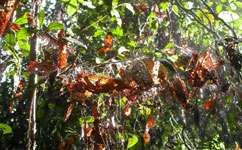
A complex network of fungi in the lower canopy could be one reason tropical rainforests are home to so many different types of insects, spiders and centipedes, say scientists.
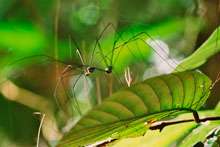
They found that nearly half of these creatures – called arthropods – are largely dependent on an almost-invisible network of fungi that traps dead leaves that have fallen from the upper canopy.
When the researchers removed the fungi, both the numbers and diversity of arthropods dropped dramatically.
The findings could help conservationists figure out how to retain some level of arthropod diversity in managed landscapes like oil palm plantations, or logged forest.
The fungi branch through the lower canopy extending from the forest floor up to around 30 metres high, catching falling leaves wherever their strands go.
"These fungi are everywhere, and form a messy tangle in the forest understory. You can't really see it until you look for it. You're always looking past it, moving it out of the way as you walk through the forest," explains Dr. Jake Snaddon from the University of Oxford, lead author of the study.
This could be why, up until now, its importance was almost entirely overlooked.
Scientists have an idea that the extraordinary numbers and types of arthropods in tropical rainforests is in some way connected to the biological complexity of this habitat. But exactly what contribution these fungal networks make in supporting lots of different types of insects, spiders and millipedes isn't well understood.
So together with a team of researchers from the UK and Malaysia, Snaddon decided to find out. They started by analysing how leaf litter builds up in the canopy.
"Nobody had really looked at the part this system had to play before now," Snaddon says.
"Initially when I started looking, I could see the leaf litter, but I had to look a lot harder to see the actual fungi."
The fungus attaches itself to living vegetation, using it as a support network. When dead plant matter falls into the network, the fungus send out tiny filaments known as hyphae to grow into it and break it down.
The researchers found that this network of fungi traps more leaf litter than any other known rainforest litter-trapping systems like fern mats or bromeliads. They estimate that the network traps around 260 kilograms of leaf litter per hectare, compared with around 100 kilograms per hectare caught by bromeliads.
When they tried removing the network from a small section of Malaysian rainforest, the numbers of arthropods fell by 70 per cent and the variety of species dropped by nearly 60 per cent.
'These fungi play a crucial role in the maintenance of canopy diversity, making a huge contribution to the abundance of insects, spiders and a whole range of arthropods,' says Snaddon.
It seems that these litter-trapping fungi provide both food and a home for a wide variety of rainforest organisms. Not just that, but they probably provide a means of connection for creatures living far apart from each other.
"It acts like a huge network, connecting different parts of the canopy together. It's possible that arthropods use it like a superhighway to get from place to place," says Snaddon.
"We often focus on the more showy forest species, but this study demonstrates that all species are important," he adds.
The next step will be to figure out if these networks also exist in degraded habitats such as palm oil plantations and logged areas of forest. 'They need consistently damp conditions, which you might not find in degraded areas,' Snaddon says.
The study is published in Biology Letters.
More information: Jake L. Snaddon, et al., Biodiversity hanging by a thread: the importance of fungal litter-trapping systems in tropical rainforests, Biology Letters, published 21 December 2011, doi:10.1098/rsbl.2011.1115
Journal information: Biology Letters
Provided by PlanetEarth Online
This story is republished courtesy of Planet Earth online, a free, companion website to the award-winning magazine Planet Earth published and funded by the Natural Environment Research Council (NERC).


