Insecticides an increasing problem in future for streams in Europe
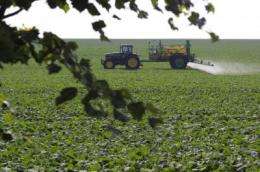
Europe's streams will in future be more heavily polluted with insecticides than before. This is the conclusion of a study by the Helmholtz Centre for Environmental Research (UFZ) for which scientists compared the situation of 1990 with climate and land use change scenarios in 2090. The risks for streams caused by the use of insecticides in agriculture will increase significantly in many regions of Europe, and particularly in Scandinavia, the Baltic countries and in Central Europe, according to scientists in the journal Ecological Applications.
Large parts of Germany will also belong to the approximately 40% of Europe's surface area in which streams will no longer have a good ecological status due to agricultural pesticides. The aim of the EU Water Framework Directive of achieving and sustainably maintaining a good chemical and ecological status will therefore be even more difficult to achieve in future. The scientists therefore recommend to drastically reduce the exposure of pesticides to streams. This can be achieved not only by a reduction in the use of pesticides, but also by setting up buffer zones along the streams. This will reduce the amount of pesticides which are washed by rain from the fields into rivers. These buffer zones can also act as a refuge for threatened species, from where they can recolonise.
For their study the scientists evaluated for the European Union for example data on the amount of insecticides used, the plant species cultivated and land use and visualised the results in maps. Only Slovenia, Cyprus and the latest members of the EU, Bulgaria and Romania, were not considered due to a lack of data. They then compared the base line situation of 1990 with a climate scenario for 2090. The forecast is therefore based on a wide range of assumptions concerning how the climate and land use in Europe might develop in the next few decades. "For the expected climate changes we took those values which the Intergovernmental Panel on Climate Change (IPCC) published in 2007 as the so-called A1B scenario. At that time this was a worst-case scenario, with the world's average temperature expected to rise by 2.8 degrees by the end of the 21st century. Many scientists now believe that the actual temperature rise might be well above this," states PD Dr. Matthias Liess of the UFZ. "If CO2 emissions and as a result the temperature rise are higher, the ecological risks for streams will also increase faster and the expected pollution levels will be reached much sooner."
To date there have been very few studies which investigate the impact of climate change on the ecological risks of pesticides for waterlife on large spatial scales. There are only estimates for 12 coastal states of the USA, and these expect there will be a general increase in the use of insecticides of up to 28 per cent between 2000 and 2100. The European study, though, expects a much higher increase of up to 23 times the amount of insecticides currently being used for some countries, depending in the degree of temperature rise and the assumed land use changes. The UFZ researchers were able to establish a link between the use of insecticides and temperature. The climatic changes will result in an increase in the rate of development of insects and their rate of survival in winter. Due to these general improvements in development conditions, an increased spread of insects is also expected. Therefore, the warmer it gets in a region, the more insecticides will be used. For insecticides, or so-called plant protection products, are used in agriculture to protect crops against pest insects. "We concentrated on insecticides in this study because invertebrates are affected much more by these than by other groups of pesticides," explains Dr. Mira Kattwinkel of the UFZ.
The starting situation and as a result the forecasts based on the scenarios for 2090 differ greatly in Europe. Regions with a very high ecological risk are currently located particularly in Spain, Italy and France. However, the researchers also rated the risk in large parts of Central Germany, the Czech Republic, Northern France and South East Great Britain as high. On the other hand the ecological risks for streams in Sweden, Finland and the three Baltic countries have so far been very low. The researchers expect the greatest changes will be in these countries in future as well as to a certain degree in Central Europe. "We expect that agricultural land use and as a result the use of insecticides will increase significantly there as temperatures rise," explains Mira Kattwinkel. The Nordic countries, which currently set a good environmental example when it comes to the use of insecticides, would then fall in some areas to the level of Central Europe with regard to pollution of the streams. All in all, the scenario for 2090 expects that on average the use of insecticides will more than double in Europe compared to 1990, while there is a high variance between the countries.
More information: Mira Kattwinkel, Jan-Valentin Kühne, Kaarina Foit, Matthias Liess (2011): Climate change, agricultural insecticide exposure, and risk for freshwater communities. Ecological Applications, 21(6), 2011, pp.2068-2081 dx.doi.org/10.1890/10-1993.1
Provided by Helmholtz Association of German Research Centres


