The impact of human activities on a selection of lakes in Tanzania
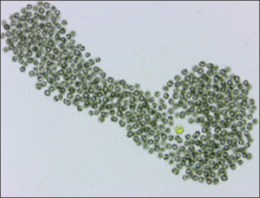
Cyanobacteria
An increase in human activity is posing a threat to natural aquatic ecosystems in Tanzania and contributing to environmental damage and ecological changes. Doctoral research carried out by Hezron Emmanuel Nonga shows that agriculture and livestock farming leads to eutrophication in lakes and the proliferation of cyanobacteria which produce microcystins. New information about microcystins and other mycotoxins in Tanzanian lakes is useful for appraising the risk linked to drinking water and edible fish, which in turn affects the health of both humans and animals.
In Tanzania, there are many and varied wetland areas and aquatic ecosystems which are productive but also vulnerable. Hezron Emmanual Nonga's doctoral research project has studied how human activities affect ecosystems in wetlands and has also examined the incidence of cyanobacteria, the production of microcystins and the possible effects of these toxins on wild species.
The study was carried out on three alkaline (high pH) lakes (of which lake Manyara was the most important) in the north of Tanzania. In addition, similar experiments were conducted in the fresh-water Lake Victoria in the Northwest of the country.
Sociological, cross-sectional studies were conducted in order to ascertain what effects human activities have had on the wetlands and ecosystems around the lakes. The results of these studies show that non-sustainable human activities contributed significantly to the environmental damage detected in the selected lakes in Tanzania.
In addition, Nonga carried out field and laboratory experiments over a period of time in order to determine physical and chemical parameters, the incidence of phytoplankton, concentrations of different microcystins and microcystin-producing bacteria in the lakes. This research has resulted in new data which will be useful for appraising the risk of the lakes as sources of drinking water and edible fish.
Pathological examinations of dwarf flamingos (Phoeniconaias minor Geoffroy) at Lake Manyara revealed a high concentration of microcystins in the birds' liver, which may be one of the reasons for the observed mass death of these birds. However, further studies are needed in order to confirm whether microcystins are to blame for this increase in mortality.
The sociological study showed that Lake Manyara and the surrounding wetlands are valuable resources for local communities but that exploitation is too intensive. The main source of income for people living near the lake is from agriculture and livestock, and these are currently far from sustainable. Limited access to expertise, easily available pesticides and lack of knowledge about the latter has led to the uncontrolled spread of chemicals, with hitherto unknown consequences for the environment. Soil erosion and the frequent drying-out of Lake Manyara and rivers in the area have moreover led to a lack of water and high animal mortality.
In order to protect the resources of these wetland areas, human activities must be better controlled and a more sustainable exploitation of land and water resources introduced. It is necessary to make the farmers aware of the importance of environment-friendly agriculture and train them in the use of pesticides and pest control.
Nonga's doctoral research was carried out in Tanzania and at The Norwegian School of Veterinary Science in Norway.
More information: Hezron Emmanuel Nonga defended his doctoral thesis on 19th December 2011 at The Norwegian School of Veterinary Science. His thesis is entitled: "Impact of human activities in selected lake ecosystems in Tanzania and occurrence of microcystins and potential microcystin-producing cyanobacteria.
Provided by
Norwegian School of Veterinary Science
-
From lemons to lemonade: Reaction uses carbon dioxide to make carbon-based semiconductor,
32 comments
-
Thioridazine kills cancer stem cells in human while avoiding toxic side-effects of conventional cancer treatments,
3 comments
-
SpaceX private rocket blasts off for space station (Update),
42 comments
-
Climate scientists say they have solved riddle of rising sea,
31 comments
-
SpaceX capsule has 'new car' smell, astronauts say (Update),
4 comments
-
Hypothetical desert earth
22 hours ago
-
More human population = greater mass?
May 25, 2012
-
Conversion from aircraft bearing to normal degrees
May 23, 2012
-
Interpretation/Analysis of the Lab results(HEPA filter)
May 22, 2012
-
Has anyone here attended the The Urbino Summer School in Paleoclimatology?
May 22, 2012
-
Earthquakes: Mag 6 N. Italy and Mag 5.6 W. Bulgaria
May 21, 2012
- More from Physics Forums - Earth
More news stories
Land and sea species differ in climate change response: study
(Phys.org) -- Marine and terrestrial species will likely differ in their responses to climate warming, new research by Simon Fraser University and Australia’s University of Tasmania has found.
6 hours ago |
3.8 / 5 (4) |
5
|
Yale study concludes public apathy over climate change unrelated to science literacy
Are members of the public divided about climate change because they don't understand the science behind it? If Americans knew more basic science and were more proficient in technical reasoning, would public consensus match ...
8 hours ago |
4.8 / 5 (5) |
20
|
10 million years needed to recover from mass extinction
It took some 10 million years for Earth to recover from the greatest mass extinction of all time, latest research has revealed.
Space & Earth / Earth Sciences
8 hours ago |
4 / 5 (4) |
1
|
Sophisticated simulations predict future warming
The chances of our planet being hit by a global warming of 3 degrees Celsius by 2050 is as likely as it being hit by an increase of 1.4 degrees, new research shows. Presented in the journal Nature Geoscience, the British study ...
Space & Earth / Earth Sciences
May 22, 2012 |
4.1 / 5 (10) |
51
Aliens don't want to eat us, says former SETI director
Alien life probably isnt interested in having us for dinner, enslaving us or laying eggs in our bellies, according to a recent statement by former SETI director Jill Tarter.
Space & Earth / Space Exploration
May 25, 2012 |
4.4 / 5 (15) |
41
Stunning image of smallest possible five-ringed structure
Scientists have created and imaged the smallest possible five-ringed structure about 100,000 times thinner than a human hair and you'll probably recognise its shape.
'Unzipped' carbon nanotubes could help energize fuel cells, batteries
Multi-walled carbon nanotubes riddled with defects and impurities on the outside could replace some of the expensive platinum catalysts used in fuel cells and metal-air batteries, according to scientists at ...
Change in developmental timing was crucial in the evolutionary shift from dinosaurs to birds: study
At first glance, it's hard to see how a common house sparrow and a Tyrannosaurus Rex might have anything in common. After all, one is a bird that weighs less than an ounce, and the other is a dinosaur that ...
Computer model used to pinpoint prime materials for efficient carbon capture
When power plants begin capturing their carbon emissions to reduce greenhouse gases and to most in the electric power industry, it's a question of when, not if it will be an expensive undertaking.
T cells 'hunt' parasites like animal predators seek prey, study shows
By pairing an intimate knowledge of immune-system function with a deep understanding of statistical physics, a cross-disciplinary team at the University of Pennsylvania has arrived at a surprising finding: T cells use a movement ...
Scientists develop ultra-sensitive test that detects diseases in their earliest stages
Scientists have developed an ultra-sensitive test that should enable them to detect signs of a disease in its earliest stages, in research published today in the journal Nature Materials.
Dec 28, 2011
Rank: 1 / 5 (4)
. . . On the environment have been exaggerated
Government-funded scientists manipulated data for decades that showed a single supernova gave birth to the Solar System and Earth's heat source is a pulsar.
This paper in press shows experimental observations that have been hidden, ignored or manipulated since 1971:
http://arxiv.org/...1499.pdf
Two weeks ago NASA announced that it is giving $1.4 million to Washington University to see if silicon carbide (SiC) grains in meteorites formed directly from supernova debris.
That is an intriguing development: Measurements made on SiC grains at Washington University already showed the grains formed directly from a supernova explosion and resembled "fall-out" grains collected after nuclear explosions here on Earth:
https://dl-web.dr...334d37e3
Happy New Year !
Oliver K. Manuel
http://myprofile....anuelo09
Dec 28, 2011
Rank: 1 / 5 (4)
www.omatumr.com/a...aphy.pdf
Or listen to the History Channel report on Japan's Atomic Bomb project.
Dec 28, 2011
Rank: 1 / 5 (4)
http://acapella.h...820.html