Did a good sense of smell give us an evolutionary advantage over Neanderthals?
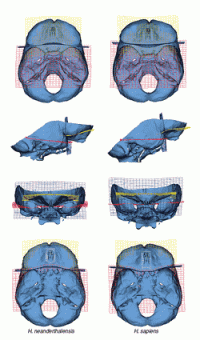
(PhysOrg.com) -- Our sense of smell may have been as important as language in helping to give us, modern humans, an evolutionary advantage over other human relatives such as the Neanderthals, scientists report in the journal Nature Communications today.
Scientists have found that areas of the brain, the temporal lobes that correspond to cognition (for example language, memory and social function) and the olfactory bulbs that correspond to sense of smell, are larger in Homo sapiens compared to other human species. They are about 12% larger than those of Neanderthals, Homo neanderthalensis.
This suggests that these two areas work together and are more important in the evolution of the modern human brain than previously thought.
The research team was led by Markus Bastir and Antonio Rosas of the Spanish Natural Science Museum (CSIC) and included Chris Stringer and Robert Kruszynski at the Natural History Museum.
They analysed fossil skulls of hominins (ancient human relatives) including Homo sapiens, Homo neanderthalensis and Homo erectus. ‘We used a new and very precise way to measure and compare the volumes of areas inside hominin skulls dating up to nearly 2 million years ago,’ says Kruszynski.
They produced 3D models that helped reveal the detail of the internal structures. Kruszynski says, ‘Those of Homo sapiens - our own species - showed a surprising change of internal architecture compared with their predecessors, in the area housing the olfactory and temporal regions.
'Such changes were not so evident in the Neanderthal skulls that were studied. The different evolutionary pathways that these two species took may be part of the process that led to the distinct patterns found in Homo neanderthalensis and Homo sapiens.'
Until now, sense of smell has been thought of as less significant for humans compared to our other senses. Stringer explains, ‘It has been traditional to believe that we have reduced olfactory (smell) senses compared with other primates, and by implication, earlier humans. However, the data in this study suggest the opposite - that modern humans actually have an enhanced sense of smell.
‘This might be because of the greater range of environments in which we live and the greater range of foods modern humans exploit, and/or an increased social role for olfaction in our more complex social interactions.’
Links between smell and cognition
Scientists know that smells are processed in the same brain regions responsible for processing emotion, motivation, fear, memory, pleasure and attraction, making them an important aspect of social interactions. And olfaction is among the oldest sense in vertebrates, ‘the only one that establishes a direct connection between the brain and its environment,’ says Bastir.
The links between cognition and olfaction have caused neuroscientists to use the term ‘higher olfactory functions’ to describe those brain functions that combine the two.
The team says that the larger olfactory bulbs and temporal lobes of Homo sapiens would have made evolutionary sense in a social context. They would have contributed to kinship recognition, enhanced family relations, group cohesion and social learning, all crucial factors that scientists believe allowed modern humans to progress and become the only surviving human species.
Publication details
The paper 'Evolution of the base of the brain in highly encephalized human species' is published today in the journal Nature Communications. www.nature.com/ncomms/index.html
Journal information: Nature Communications
Provided by American Museum of Natural History


