Early defoliation of Great Lakes wine grapes tested
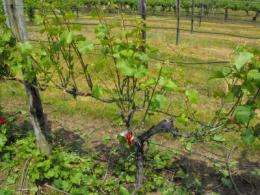
Wine grape production in the Great Lakes Viticultural Region can be a challenging enterprise. Spring frost, winter injury, short and variable growing seasons, and cool, humid growing conditions subject grape vines to disease, including harvest season cluster rot. Tight-clustered wine grape varieties in the region show varying susceptibility to cluster rot; cultivars such as Pinot gris, Pinot noir, Riesling, Seyval, and Vignoles are all susceptible, making it difficult to achieve maximum fruit maturity for these economically important varieties.
Leaf removal in the fruiting zone has been used successfully as a vineyard management practice during the summer season. When used on high-density canopies, leaf removal techniques improve clusters' microclimate, reducing conditions that can cause bunch rot complex diseases and improving fruit quality. However, leaf removal can also affect fruit quality negatively. Excessive leaf removal can lead to overexposed clusters (high light intensity and high temperature) and reduced berry color in red cultivars. Moreover, the effects of leaf removal on yield vary depending on timing and severity.
Paolo Sabbatini and G. Stanley Howell from the Department of Horticulture at Michigan State University conducted experiments to determine whether early leaf removal influences vine performance, or if non-destructive, short-term photosynthesis reduction at the beginning of bloom would influence vine performance in a manner similar to leaf removal. The experiments were conducted at the Horticulture Teaching Research Center in East Lansing and the Southwest Michigan Research and Extension Center in Benton Harbor, Michigan. The research findings were published in HortScience.
Fruit set reduction resulting from early leaf removal, in all the cultivars except Pinot noir, confirmed the importance of carbohydrate supply during the fruit set period. Vines subjected to removal of four or six basal leaves had an average fruit set reduction of approximately 45% from a non-treated control. "Cluster weight and berries per cluster were similarly reduced with a greater effect on the basal than the apical cluster of the shoot. Reduced fruit set was associated with a reduction in cluster compactness and harvest season rot", said Sabbatini. "This was also reflected in yield and basic fruit chemistry parameters associated with the importance of basal leaves to the developing cluster."
The experiments showed a strong negative effect of early leaf removal in year one of the study on vine performance in year two. This "carryover effect" increased shootless nodes per vine, reduced the number of clusters per shoot and per vine, and dramatically reduced fruit set and yield per vine.
"From our data, we cannot assess whether this carryover is related to reduced bud cold hardiness or bud damage resulting from the leaf removal practice", the researchers added. "Unless these negative carryover responses can be ameliorated, this approach to reduce cluster compactness and cluster rot will not be acceptable. We speculate that this could be readily accommodated through retaining non-fruiting shoots at the head with all leaves retained that serve as canes to be retained for production in the next year".
More information: The complete study and abstract are available on the ASHS HortScience electronic journal web site: hortsci.ashspublications.org/c … /abstract/45/12/1804
Provided by American Society for Horticultural Science


