Blood-sucking mosquitoes keep their cool
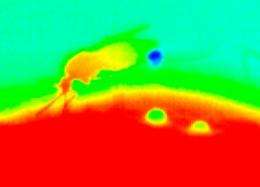
The mosquito performs evaporative cooling. The retention of the fluid drop attached to the abdomen end leads to a fall of the abdomen temperature causing a clear temperature gradient along the mosquito body. N.B., the color of the droplet does not reflect the real temperature, because of the difference in the emissivity between the cuticle of the mosquito and the drop surface. Credit: Lahondčre et al. Current Biology
No one likes being bitten by whining mosquitoes, but have you ever considered what the experience is like for them as their cold-blooded bodies fill with our warm blood? Now researchers reporting online on December 15 in Current Biology have uncovered the mosquitoes' secret to avoiding heat stress: they give up cooling droplets of their hard-won meals.
The study shows for the first time that blood-feeding insects are capable of controlling their body temperature, the researchers say.
"During feeding on a warm-blooded host, such as a human being, mosquitoes ingest quite a large amount of hot blood in a short period of time," said Claudio Lazzari of Université François Rabelais. "We aimed to determine to what extent these insects are exposed to the risk of overheating during the blood intake."
Mosquitoes have to be quick, lest their host turns into a potential predator, Lazzari points out. But that influx of heat could send their internal body temperature soaring past physiological limits.
Insects' body temperatures generally do depend on the environment around them. However, earlier studies have shown that insects, including bees and aphids, can control their temperature with beads of nectar or sap. Mosquitoes, too, will give up drops of fluid during feeding.
"What intrigued us was why they eliminate fresh blood, which is a precious and risky-to-obtain nutritive element," Lazzari said.
To find out, he and Chloé Lahondère used a camera that depends on heat to form images, much as a regular camera depends on light. Those images highlighted differences in temperature between the body parts of mosquitoes as they fed. Their heads reached temperatures close to that of the ingested blood, while the rest of their bodies remained closer to ambient temperature. That temperature variation wasn't observed when mosquitoes dined on sugar water instead.
The researchers showed that the cooling depended on those drops of fluid the insects excrete from their backsides as they feed. Lazzari and Lahondère say that the mosquitoes' strategy no doubt protects them and any malaria-causing (Plasmodium) parasites they might be carrying. The new understanding of mosquito physiology is more than a curiosity; it could lead to strategies aimed to control mosquitoes and the diseases they spread.
"Blocking or delaying the production of the excreted fluid would have a double impact on the physiology of mosquitoes: on water and thermal balance," Lazzari said. "Indirectly, this would affect microorganisms transmitted by insects by modifying the thermal environment to which they are exposed."
More information: DOI:10.1016/j.cub.2011.11.029
Provided by
Cell Press
-
From lemons to lemonade: Reaction uses carbon dioxide to make carbon-based semiconductor,
32 comments
-
Thioridazine kills cancer stem cells in human while avoiding toxic side-effects of conventional cancer treatments,
3 comments
-
SpaceX private rocket blasts off for space station (Update),
42 comments
-
Climate scientists say they have solved riddle of rising sea,
31 comments
-
SpaceX capsule has 'new car' smell, astronauts say (Update),
4 comments
-
What would stain as translucent on light-coloured fabric?
May 26, 2012
-
How do I identify different bacteria on culture plates?
May 26, 2012
-
Why Do Dogs do Strange things...
May 25, 2012
-
What does exophillic and endophillic mean in terms of mosquito and their control?
May 24, 2012
-
Semen stains glows under black lights (uv light)?
May 23, 2012
-
Question on Human Chromosome 2
May 23, 2012
- More from Physics Forums - Biology
More news stories
Manufacturing genes to attack flu virus
An international research team has manufactured a new protein that can combat deadly flu epidemics.
6 hours ago |
not rated yet |
0
|
Scientist: Evolution debate will soon be history
(AP) -- Richard Leakey predicts skepticism over evolution will soon be history. Not that the avowed atheist has any doubts himself.
May 26, 2012 |
3.5 / 5 (20) |
91
More plant species responding to global warming than previously thought
(Phys.org) -- Far more wild plant species may be responding to global warming than previous large-scale estimates have suggested.
May 22, 2012 |
4.6 / 5 (14) |
18
|
For monogamous sparrows, it doesn't pay to stray (but they do it anyway)
It's quite common for a female song sparrow to stray from her breeding partner and mate with the male next door, but a new study shows that sleeping around can be costly.
May 22, 2012 |
5 / 5 (2) |
8
|
Thousands of shellfish found dead in Peru
Thousands of crustaceans were found dead off the coast of Lima following the mystery mass death of dolphins and pelicans, the Peruvian Navy said Friday.
May 26, 2012 |
4.7 / 5 (7) |
7
Stunning image of smallest possible five-ringed structure
Scientists have created and imaged the smallest possible five-ringed structure about 100,000 times thinner than a human hair and you'll probably recognise its shape.
'Unzipped' carbon nanotubes could help energize fuel cells, batteries
Multi-walled carbon nanotubes riddled with defects and impurities on the outside could replace some of the expensive platinum catalysts used in fuel cells and metal-air batteries, according to scientists at ...
Change in developmental timing was crucial in the evolutionary shift from dinosaurs to birds: study
At first glance, it's hard to see how a common house sparrow and a Tyrannosaurus Rex might have anything in common. After all, one is a bird that weighs less than an ounce, and the other is a dinosaur that ...
Computer model used to pinpoint prime materials for efficient carbon capture
When power plants begin capturing their carbon emissions to reduce greenhouse gases and to most in the electric power industry, it's a question of when, not if it will be an expensive undertaking.
T cells 'hunt' parasites like animal predators seek prey, study shows
By pairing an intimate knowledge of immune-system function with a deep understanding of statistical physics, a cross-disciplinary team at the University of Pennsylvania has arrived at a surprising finding: T cells use a movement ...
Land and sea species differ in climate change response: study
(Phys.org) -- Marine and terrestrial species will likely differ in their responses to climate warming, new research by Simon Fraser University and Australia’s University of Tasmania has found.