Researchers discover that changes in bioelectric signals cause tadpoles to grow eyes in back, tail
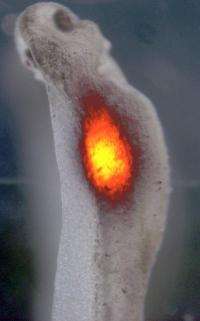
Changing the bioelectric voltage in embryonic frog cell in tadpole's back caused cell to develop into a functioning eye. Credit: Michael Levin and Sherry Aw
For the first time, scientists have altered natural bioelectrical communication among cells to directly specify the type of new organ to be created at a particular location within a vertebrate organism. Using genetic manipulation of membrane voltage in Xenopus (frog) embryos, biologists at Tufts University's School of Arts and Sciences were able to cause tadpoles to grow eyes outside of the head area.
The researchers achieved most surprising results when they manipulated membrane voltage of cells in the tadpole's back and tail, well outside of where the eyes could normally form. "The hypothesis is that for every structure in the body there is a specific membrane voltage range that drives organogenesis," said Pai. "These were cells in regions that were never thought to be able to form eyes. This suggests that cells from anywhere in the body can be driven to form an eye."
To do this, they changed the voltage gradient of cells in the tadpoles' back and tail to match that of normal eye cells. The eye-specific gradient drove the cells in the back and tailwhich would normally develop into other organsto develop into eyes.
These findings break new ground in the field of biomedicine because they identify an entirely new control mechanism that can be capitalized upon to induce the formation of complex organs for transplantation or regenerative medicine applications, according to Michael Levin, Ph.D., professor of biology and director of the Center for Regenerative and Developmental Biology at Tufts University's School of Arts and Sciences. Levin is senior and corresponding author on the work published in the journal Development online December 7 2011, in advance of print.
"These results reveal a new regulator of eye formation during development, and suggest novel approaches for the detection and repair of birth defects affecting the visual system," he said. "Aside from the regenerative medicine applications of this new technique for eyes, this is a first step to cracking the bioelectric code."
Tufts post-doctoral fellow Vaibhav P. Pai Ph.D., is first author of the paper, entitled "Transmembrane Voltage Potential Controls Embryonic Eye Patterning in Xenopus laevis." .
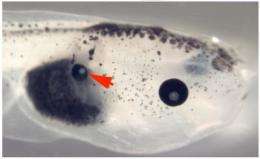
Eye developed in midsection of tadpole. Credit: Michale Levin and Sherry Aw
Signals Turn On Eye GenesFrom the outset of their research, the Tufts' biologists wanted to understand how cells use natural electrical signals to communicate in their task of creating and placing body organs. In recent research, Tufts biologist Dany S. Adams showed that bioelectrical signals are necessary for normal face formation in the Xenopus (frog) embryos. In the current set of experiments, the Levin lab identified and marked hyperpolarized (more negatively charged) cell clusters located in the head region of the frog embryo.
They found that these cells expressed genes that are involved in building the eye called Eye Field Transcription Factors (EFTFs). Sectioning of the embryo through the developed eye and analyzing the eye regions under fluorescence microscopy showed that the hyperpolarized cells contributed to development of the lens and retina. The researchers hypothesized that these cells turned on genes that are necessary for building the eye.
Changing the Signals Lead to Defects
Next, the researchers were able to show that changing the bioelectric code, or depolarizing these cells, affected normal eye formation. They injected the cells with mRNA encoding ion channels, which are a class of gating proteins embedded in the membranes of the cell. Like gates, each ion channel protein selectively allows a charged particle to pass in and out of the cell.
Using individual ion channels that allow, the researchers changed the membrane potential of these cells. This affected expression of EFTF genes, causing abnormalities to occur: Tadpoles from these experiments were normal except that they had deformed or no eyes at all.
Further, the Tufts biologists were also able to show that they could control the incidence of abnormal eyes by manipulating the voltage gradient in the embryo. "Abnormalities were proportional to the extent of disruptive depolarization," said Pai. "We developed techniques to raise or lower voltage potential to control gene expression."
Electric Properties of Cells Can Be Manipulated to Generate Specific Organs
The researchers achieved most surprising results when they manipulated membrane voltage of cells in the tadpole's back and tail, well outside of where the eyes could normally form.
"The hypothesis is that for every structure in the body there is a specific membrane voltage range that drives organogenesis," said Pai. "By using a specific membrane voltage, we were able to generate normal eyes in regions that were never thought to be able to form eyes. This suggests that cells from anywhere in the body can be driven to form an eye."
Levin and his colleagues are pursuing further research, additionally targeting the brain, spinal cord, and limbs. The findings, he said "will allow us to have much better control of tissue and organ pattern formation in general. We are developing new applications of molecular bioelectricity in limb regeneration, brain repair, and synthetic biology." Additional authors include post-doctoral fellow Sherry Aw, Tufts Postdoctoral Associate Tal Shomrat, and Research Associate Joan M. Lemire. Funding for this research came from the National Institutes of Health.
More information: "Transmembrane voltage potential controls embryonic eye patterning in Xenopus laevis," Vaibhav P. Pai, Sherry Aw, Tal Shormat, Joan M. Lemire, Development, published online before print December 20, 2011,doi:10.1242/dev.073759
Journal reference:
Development
Provided by Tufts University
-
From lemons to lemonade: Reaction uses carbon dioxide to make carbon-based semiconductor,
32 comments
-
Thioridazine kills cancer stem cells in human while avoiding toxic side-effects of conventional cancer treatments,
3 comments
-
SpaceX private rocket blasts off for space station (Update),
42 comments
-
Climate scientists say they have solved riddle of rising sea,
31 comments
-
SpaceX capsule has 'new car' smell, astronauts say (Update),
4 comments
-
What would stain as translucent on light-coloured fabric?
May 26, 2012
-
How do I identify different bacteria on culture plates?
May 26, 2012
-
Why Do Dogs do Strange things...
May 25, 2012
-
What does exophillic and endophillic mean in terms of mosquito and their control?
May 24, 2012
-
Semen stains glows under black lights (uv light)?
May 23, 2012
-
Question on Human Chromosome 2
May 23, 2012
- More from Physics Forums - Biology
More news stories
Manufacturing genes to attack flu virus
An international research team has manufactured a new protein that can combat deadly flu epidemics.
6 hours ago |
not rated yet |
0
|
Scientist: Evolution debate will soon be history
(AP) -- Richard Leakey predicts skepticism over evolution will soon be history. Not that the avowed atheist has any doubts himself.
May 26, 2012 |
3.5 / 5 (20) |
91
More plant species responding to global warming than previously thought
(Phys.org) -- Far more wild plant species may be responding to global warming than previous large-scale estimates have suggested.
May 22, 2012 |
4.6 / 5 (14) |
18
|
For monogamous sparrows, it doesn't pay to stray (but they do it anyway)
It's quite common for a female song sparrow to stray from her breeding partner and mate with the male next door, but a new study shows that sleeping around can be costly.
May 22, 2012 |
5 / 5 (2) |
8
|
Thousands of shellfish found dead in Peru
Thousands of crustaceans were found dead off the coast of Lima following the mystery mass death of dolphins and pelicans, the Peruvian Navy said Friday.
May 26, 2012 |
4.7 / 5 (7) |
7
Stunning image of smallest possible five-ringed structure
Scientists have created and imaged the smallest possible five-ringed structure about 100,000 times thinner than a human hair and you'll probably recognise its shape.
'Unzipped' carbon nanotubes could help energize fuel cells, batteries
Multi-walled carbon nanotubes riddled with defects and impurities on the outside could replace some of the expensive platinum catalysts used in fuel cells and metal-air batteries, according to scientists at ...
Change in developmental timing was crucial in the evolutionary shift from dinosaurs to birds: study
At first glance, it's hard to see how a common house sparrow and a Tyrannosaurus Rex might have anything in common. After all, one is a bird that weighs less than an ounce, and the other is a dinosaur that ...
Computer model used to pinpoint prime materials for efficient carbon capture
When power plants begin capturing their carbon emissions to reduce greenhouse gases and to most in the electric power industry, it's a question of when, not if it will be an expensive undertaking.
T cells 'hunt' parasites like animal predators seek prey, study shows
By pairing an intimate knowledge of immune-system function with a deep understanding of statistical physics, a cross-disciplinary team at the University of Pennsylvania has arrived at a surprising finding: T cells use a movement ...
Land and sea species differ in climate change response: study
(Phys.org) -- Marine and terrestrial species will likely differ in their responses to climate warming, new research by Simon Fraser University and Australia’s University of Tasmania has found.

Dec 08, 2011
Rank: not rated yet
http://www.physor...een.html
What is seen is the future structure. The voltage gradient is to an embryo, what a blueprint is for man made objects.
A blueprint can exist in any form for any physical object - as imagination (which is voltage gradient) or as voltage gradient for the future structure of biological life in an embryonic stage.
Dec 08, 2011
Rank: 5 / 5 (1)
Otoh, I wonder if the eyes were actually connected to the brain and fully functional. If you think about it, this could be revolutionary...
Dec 08, 2011
Rank: not rated yet
But if it's as simple as that, they should be able to create an eye where they want just using implanted electrodes! I can't help thinking that molecular pathways that lead to organ formation work by a more complex mechanism than just a voltage. Their genetic manipulations also have more complex effects than that voltage.
Dec 08, 2011
Rank: 5 / 5 (1)
@david - not necessarily. biochemical voltage may still depend on the chemicals involved. Also, it's a very subtle, specific, and small amount. If we introduced an electrode or battery, you probably would get a developmental effect, but not the exact expected one.
On a serious note - There have been a lot of places that have found deformed frogs in the last couple of years. I have a feeling that all you need to do is find the chemical that can create that exact electrical potential and mimics the biochemical interactions.
Dec 08, 2011
Rank: 2 / 5 (4)
Dec 08, 2011
Rank: 2.8 / 5 (98)
This is how they figure such things out, Christ.
There is no DNA manual, they have to write it as they go along.
First they can grow eyes in random places. Eventually they may figure out how to regenerate an eye in the correct place in a living organism.
The fact that you don't realize this shouldn't surprise anyone as you are one of the most consistent and sad examples of the Dunning-Kruger effect I've seen here.
http://en.wikiped...r_effect
The Dunning-Kruger effect is a cognitive bias in which unskilled people (Pirouette) make poor decisions and reach erroneous conclusions, but their incompetence denies them the metacognitive ability to recognize their mistakes.
Dec 08, 2011
Rank: 2.6 / 5 (5)
That's evidence that FrankHerbert$hithead aka Pirouline and other aliases, is incapable of reading comprehension of easy sentences and paragraphs. He obviously refuses to take REMEDIAL READING COMPREHENSION AND INSTEAD PREFERS TO MISQUOTE THOSE HE WISHES TO VICTIMIZE. HE IS PROBABLY A PAID AGENT FROM A COMPETING SCIENCE WEBSITE, HIRED TO DRIVE MEMBERS AWAY FROM PHYSORG.COM THROUGH HARASSMENT AND INTIMIDATION.
Dec 08, 2011
Rank: 2.8 / 5 (96)
Do you even know what "quote" or "misquote" mean?
Dec 09, 2011
Rank: 5 / 5 (2)
That wasn't quite my point, which was that the effect you get ought to depend more on which genes are being turned on at that point than on what the biochemical voltage happens to be. Isn't the voltage just a side-effect of the real cause of the developmental change. If this is the case, it would be misleading to suggest that the voltage "does all the work".
Dec 09, 2011
Rank: 5 / 5 (1)
Cause or effect?
Obviously, my guess is that the DNA sets up a structure that has certain chemicals and voltages that activate other protiens and DNA in certain areas. I mean, from their experiment, it strongly suggests that the voltage potential is an integral marker for differation. Part of the cause, rather than part of the effect.
That said, there is some room to say that the mRNA they used exclusively caused the change without regard to the electric potential through an unknown chemical interaction.
Dec 11, 2011
Rank: not rated yet
Dec 12, 2011
Rank: not rated yet