Belize protected area boosting predatory fish populations
December 21, 2011

Belize protected area boosting predatory fish populations

Enlarge

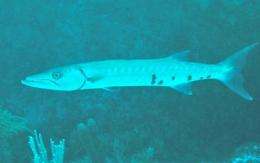
During a 14-year study by the Wildlife Conservation Society, conservationists found that fishing closures in a Glover’s Reef atoll resulted in an increase in predatory fish such as barracudas (pictured here) and groupers, but not the herbivorous fish (parrotfish and surgeonfish) that eat the kind of algae that smothers reefs. Credit: Tim McClanahan/Wildlife Conservation Society

A 14-year study by the Wildlife Conservation Society in an atoll reef lagoon in Glover's Reef, Belize has found that fishing closures there produce encouraging increases in populations of predatory fish species. However, such closures have resulted in only minimal increases in herbivorous fish, which feed on the algae that smother corals and inhibit reef recovery.

The findings will help WCS researchers in their search for new solutions to the problem of restoring Caribbean reefs damaged by fishing and climate change.

The study appears in an online version of Aquatic Conservation: Marine and Freshwater Ecosystems. The authors include: Tim McClanahan, N.A. Muthiga, and R.A. Coleman of the .

Belize protected area boosting predatory fish populations
Enlarge

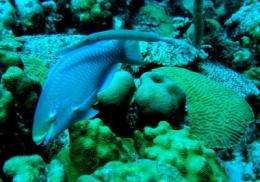
Conservationists are hopeful that Belize's nation-wide fishing ban on parrotfish -- an important herbivorous species (pictured here) -- may help degraded reef systems rebound. Credit: Wildlife Conservation Society

Specifically, the fishing closures have resulted in the recovery of species such as , groupers, snappers, and other predatory fish. Herbivorous fish such as and , however, managed only slight recoveries, along with a small amount of the herbivory needed to reduce erect algae and promote the growth of more hard corals. This modest recovery of herbivorous fish has not been sufficient in reversing the degradation of the reefs by that have overgrown the reef and replaced the coral that once occupied 75 percent, but now represent less than 20 percent, of the cover. The authors note that a recent national-level ban by the Belizean government on the fishing of parrotfish—a widespread herbivorous species—may be the key to reef recovery, provided that the fishing ban is

enforced and met with compliance. WCS provided valuable data through its monitoring program at Glover's Reef to justify the landmark measure to protect reef grazers.

"The fishing ban in the fully protected portion of the was expected to result in an increase in predatory fish and—more importantly—herbivorous fish such as parrotfish that in turn reverse the degraded condition of algal dominance in this reef," said Dr. Tim McClanahan, lead author of the study and head of WCS's coral reef research and conservation program. "What happened was a recovery of predatory fish, but not of the herbivorous fish, a finding that is forcing us to come up with a more effective model of reef management and recovery. If the nation-wide ban on parrotfish is successful, then we can see if this type of large-scale management is the only effective solution for protecting ."

According to the authors, a number of factors could be contributing to the unpredicted responses of fishing closures, which considerably complicates the understanding of coral reef ecology and management. The complex web of species interactions may produce unexpected cascading effects because of underestimates in the possible responses to bans on fishing. Other possible reason: the size of the closure may be too small to produce the desired effect, or there may be a failure of compliance with fishers following the ban. The authors also mention that environmental factors such as oceanographic oscillations and warming waters complicate any attempt to establish cause-and-effect relationships in these systems, as they noted a loss in coral cover across the 1998 El Niño that killed many corals worldwide.

"It is encouraging to see the recovery of large such as groupers and snappers under significant pressure elsewhere in Belize, but the lagging herbivorous fish is a warning that there is no single solution to coral reef conservation," said Dr. Caleb McClennen, Director of WCS's Marine Program. "While no-take zones are critical, more comprehensive ecosystem-based management is essential throughout the range of targeted species for long term recovery of the entire Meso-American Barrier Reef."

From Fiji to Kenya to Glover's Reef, Dr. Tim McClanahan's research examines the ecology, fisheries, effects, and management of coral reefs at key sites throughout the world. This work has been supported by the John D. and Catherine T. MacArthur Foundation and The Tiffany & Co. Foundation. WCS wishes to acknowledge the Oak Foundation and The Summit Foundation for their generous support of this study and our marine conservation work throughout Belize.

Provided by Wildlife Conservation Society search and more info website

Filter


Move the slider to adjust rank threshold, so that you can hide some of the comments.


Display comments: newest first

omatumr
Dec 21, 2011

Rank: 1 / 5 (2)
This work has been supported by the John D. and Catherine T. MacArthur Foundation and The Tiffany & Co. Foundation. WCS (Wildlife Conservation Society) wishes to acknowledge the Oak Foundation and The Summit Foundation


Thanks for this report on the study by the Wildlife Conservation Society for the MacArthur, Tiffany, Oak and Summit Foundations.

Are Belize citizens allowed any input? Or does the Belize government operate independently of its citizens?
Rank not rated yet
Relevant PhysicsForums posts

More news stories

Land and sea species differ in climate change response: study

(Phys.org) -- Marine and terrestrial species will likely differ in their responses to climate warming, new research by Simon Fraser University and Australia’s University of Tasmania has found.

Space & Earth / Environment

created 4 hours ago | popularity 3.7 / 5 (3) | comments 5 | with audio podcast

Yale study concludes public apathy over climate change unrelated to science literacy

Are members of the public divided about climate change because they don't understand the science behind it? If Americans knew more basic science and were more proficient in technical reasoning, would public consensus match ...

Space & Earth / Environment

created 6 hours ago | popularity 4.8 / 5 (5) | comments 12 | with audio podcast

10 million years needed to recover from mass extinction

It took some 10 million years for Earth to recover from the greatest mass extinction of all time, latest research has revealed.

Space & Earth / Earth Sciences

created 6 hours ago | popularity 5 / 5 (3) | comments 1 | with audio podcast

Sophisticated simulations predict future warming

The chances of our planet being hit by a global warming of 3 degrees Celsius by 2050 is as likely as it being hit by an increase of 1.4 degrees, new research shows. Presented in the journal Nature Geoscience, the British study ...

Space & Earth / Earth Sciences

created May 22, 2012 | popularity 4.4 / 5 (9) | comments 51

Aliens don't want to eat us, says former SETI director

Alien life probably isn’t interested in having us for dinner, enslaving us or laying eggs in our bellies, according to a recent statement by former SETI director Jill Tarter.

Space & Earth / Space Exploration

created May 25, 2012 | popularity 4.4 / 5 (15) | comments 41


Stunning image of smallest possible five-ringed structure

Scientists have created and imaged the smallest possible five-ringed structure – about 100,000 times thinner than a human hair – and you'll probably recognise its shape.

'Unzipped' carbon nanotubes could help energize fuel cells, batteries

Multi-walled carbon nanotubes riddled with defects and impurities on the outside could replace some of the expensive platinum catalysts used in fuel cells and metal-air batteries, according to scientists at ...

Change in developmental timing was crucial in the evolutionary shift from dinosaurs to birds: study

At first glance, it's hard to see how a common house sparrow and a Tyrannosaurus Rex might have anything in common. After all, one is a bird that weighs less than an ounce, and the other is a dinosaur that ...

Computer model used to pinpoint prime materials for efficient carbon capture

When power plants begin capturing their carbon emissions to reduce greenhouse gases – and to most in the electric power industry, it's a question of when, not if – it will be an expensive undertaking.

T cells 'hunt' parasites like animal predators seek prey, study shows

By pairing an intimate knowledge of immune-system function with a deep understanding of statistical physics, a cross-disciplinary team at the University of Pennsylvania has arrived at a surprising finding: T cells use a movement ...

Scientists develop ultra-sensitive test that detects diseases in their earliest stages

Scientists have developed an ultra-sensitive test that should enable them to detect signs of a disease in its earliest stages, in research published today in the journal Nature Materials.