UQ students name and describe insect species
Nov 15, 2011
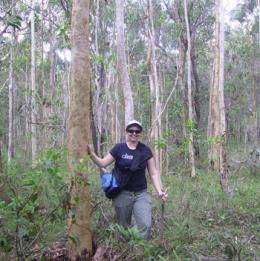
Phd candidate, Penelope Mills, in the habitat where Apiomorpha nookara was found

(PhysOrg.com) -- Third-year Biological Sciences students at The University of Queensland have applied their knowledge from the classroom to name and describe a species of gall insect; Apiomorpha nookara.

Students Penelope Mills (now a PhD student in the School of Biological Sciences), Melanie Macdonald and Lisa Rigby were working together on the project.

They said the newly discovered gall-inducing insect has a tight association with a single of eucalypt in Australia.

"We named the insect Apiomorpha nookara, as the species epithet is an of the region in northern NSW where it was first found," Ms. Mills said.

"Our paper is different from many other species descriptions," Ms. Mills said.

"Unlike taxonomy papers that describe only the visible features of the animal, we have also included other information such as the chromosome number and showing how it is related to other gall insects."

The students said that it is the shape of the gall which makes Apiomorpha nookara quite distinct from those made by other gall insects.

Unlike its close relatives that have a single chamber in the gall in which the adult female lives, feeds and gives birth - Apiomorpha nookara has a second, outer chamber.

"We don't know why this species has the second chamber and what purpose it serves," Ms. Mills said.

"It might help prevent other insects from attacking and killing the female inside the gall."

Without the work of these students, yet another of Australia's endemic but would still be waiting for a name.

The students' names will now be associated with the species forever.

The paper, titled "A recently discovered species of Apiomorpha Rubsaamen (Hemiptera: Coccoidea: Eriococcidae) with unusual gall morphology", was published on November 8 in the international taxonomic .

Explore further: Front-row seats to climate change

add to favorites email to friend print save as pdf

Related Stories

Wasps wage war on behalf of wiliwili trees

Sep 28, 2010

A black, two-millimeter-long wasp from East Africa is helping wage war on one of its own kind—the Erythrina gall wasp, an invasive species that's decimated Hawaii's endemic wiliwili (Erythrina sandwicensis) and in ...

What should goldenrod do to avoid an insect attack? Duck

Mar 08, 2010

A field of golden-flowered stems swaying in an autumn breeze may evoke a peaceful scene. But this tranquility belies serious battles between natural enemies that took place in the spring. In particular, young ...

Recommended for you

Honeybees trained in Croatia to find land mines

9 hours ago

(AP)—Mirjana Filipovic is still haunted by the land mine blast that killed her boyfriend and blew off her left leg while on a fishing trip nearly a decade ago. It happened in a field that was supposedly ...

Front-row seats to climate change

May 17, 2013

By day, insects provide the white noise of the South, but the night belongs to the amphibians. In a typical year, the Southern air hangs heavy from the humidity and the sounds of wildlife.

Captured in silken netting and sticky hairs

May 16, 2013

The great ecological success of spiders is often substantiated by the evolution of silk and webs. Biologists of the Kiel University and the University of Bern now found an alternative adaptation to hunting ...

User comments : 0

More news stories

Honeybees trained in Croatia to find land mines

(AP)—Mirjana Filipovic is still haunted by the land mine blast that killed her boyfriend and blew off her left leg while on a fishing trip nearly a decade ago. It happened in a field that was supposedly ...

Heat-related deaths in Manhattan projected to rise

Residents of Manhattan will not just sweat harder from rising temperatures in the future, says a new study; many may die. Researchers say deaths linked to warming climate may rise some 20 percent by the 2020s, ...

Kinks and curves at the nanoscale

One of the basic principles of nanotechnology is that when you make things extremely small—one nanometer is about five atoms wide, 100,000 times smaller than the diameter of a human hair—they are going ...