Toyota shows machines to help sick, elderly move
November 1, 2011 By YURI KAGEYAMA , AP Business Writer
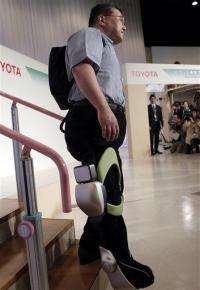
Eiichi Saitoh, a professor in rehabilitation medicine, steps down with an "independent walk assist" device as Toyota Motor Corp. displays experimental health care robots at a Toyota showroom in Tokyo Tuesday, Nov. 1, 2011. Saitoh demonstrated the "walk assist" device on, strapping the computerized metallic brace onto his right leg, which was paralyzed by polio. (AP Photo/Itsuo Inouye)
Toyota unveiled its ambitions for high-tech health care Tuesday, displaying experimental robots that the auto giant says can lift disabled patients from their hospital beds or help them walk.
The company aims to commercialize products such as its "independent walk assist" device sometime after 2013 - seeking to position itself in an industry with great potential in Japan, one of the world's most rapidly aging nations.
Eiichi Saitoh, a professor in rehabilitation medicine, demonstrated the "walk assist" device on Tuesday, strapping the computerized metallic brace onto his right leg, which was paralyzed by polio.
He showed reporters at a Toyota facility in Tokyo how the brace could bend at the knee as needed, allowing him to walk more naturally and rise from a chair with greater ease than the walker he now uses. Wearing a backpack-like battery, Saitoh walked up and down a flight of stairs, smiling with delight.
Saitoh said he had tried Toyota's machines with patients and was confident they helped people recover more quickly from strokes and other ailments that curtailed movement.
"It may be difficult to predict the future, but the era of an aging society is definitely coming," he said. "We need partner robots to enrich our lives."
Toyota also demonstrated an intelligent machine with padded arms that can help health care workers lift disabled patients from their beds and then carry them around. Another mobility aid worked like a skateboard to help people relearn balance.
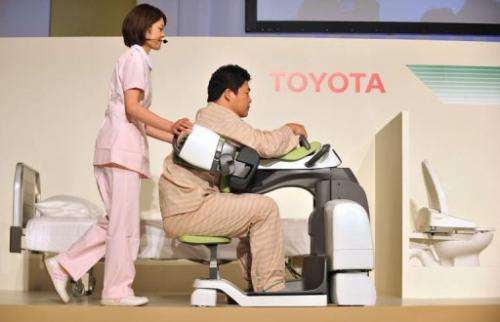
Fujita Health University senior assistant professor Yukari Suzuki (L) demonstrates a prototype robot 'Patient Transfer Assist' reducing the heavy physical burden of moving patients, developed by Japan's Toyota Motor Corporation, during a press preview at a showroom in Tokyo, on November 1.
Toyota officials said technology for autos such as sensors, motors and computer software are being used in such computerized gadgets to help people get around, and what they learn about mobility for people will likely be of use in future cars.Prices and overseas sales plans of all the machines are still undecided, according to Toyota.
General Manager Akifumi Tamaoki said more tests were needed on more people to insure safety and reliability, and gain user feedback, but the commercial products in the works were going to be smaller and lighter than the prototype versions shown.
"We define gentle and smart machines as partner robots," he said.
Toyota has previously shown human-shaped robots that played the trumpet and violin, and those that move around and talk about Toyota cars at showrooms.
Rival Japanese automaker Honda Motor Co. has developed a sophisticated humanoid robot called Asimo, which can run, talk and dance. But Asimo has been limited to showrooms and labs and has yet to enter any hospital or home.
Toyota faces competition from other manufacturers that are all working on gadgets to tap into the health care business. Honda also has demonstrated machines worn on the legs that help people move, as have some universities.
Hirohisa Hirukawa, a robot exert at the government-backed National Institute of Advanced Industrial Science and Technology, said more time would be needed to see the full busineses potential of the Toyota machines but was upbeat.
"I feel that the walk-assist device has real potential to sell to consumers," he said in an email.
Tamaoki said Toyota is keeping its offerings simple, compared to those from Honda, so they can enter everyday life easily.
©2011 The Associated Press. All rights reserved. This material may not be published, broadcast, rewritten or redistributed.
-
From lemons to lemonade: Reaction uses carbon dioxide to make carbon-based semiconductor,
32 comments
-
Thioridazine kills cancer stem cells in human while avoiding toxic side-effects of conventional cancer treatments,
3 comments
-
SpaceX private rocket blasts off for space station (Update),
42 comments
-
Climate scientists say they have solved riddle of rising sea,
31 comments
-
SpaceX capsule has 'new car' smell, astronauts say (Update),
4 comments
-
Need a rigid insulation material???
20 hours ago
-
magnets or EMF in car bumpers to protect from fender bender
May 26, 2012
-
length of wire in a coil of known dimensions?
May 25, 2012
-
India Engineering Powerhouse
May 25, 2012
-
electromagnet core dereference between hard and soft iron
May 25, 2012
-
Measuring water pressure in an open tank
May 24, 2012
- More from Physics Forums - General Engineering
More news stories
Browser wars flare in mobile space
The browser wars are heating up again, but this time the fight is for dominance of the mobile Internet.
12 hours ago |
5 / 5 (2) |
3
Probability of contamination from severe nuclear reactor accidents is higher than expected: study
Catastrophic nuclear accidents such as the core meltdowns in Chernobyl and Fukushima are more likely to happen than previously assumed. Based on the operating hours of all civil nuclear reactors and the number ...
Technology / Energy & Green Tech
May 22, 2012 |
3.6 / 5 (22) |
56
|
HyperSolar shows dirty water no barrier to power world
(Phys.org) -- The Santa Barbara, California, company, HyperSolar, is set to transparently share the ups and downs of its research experiences toward the companys ultimate vision, successfully producing ...
SpotterRF debuts Radar Backpack Kit (w/ Video)
(Phys.org) -- SpotterRF has announced a special radar backpack kit designed to enhance situational awareness for soldiers on the ground. The company says its special radar is designed for warfighters as part ...
Tesla to launch electric sedan in US on June 22
Tesla Motors said Tuesday it would begin deliveries of "the world's first premium electric sedan" on June 22, slightly ahead of schedule.
Technology / Energy & Green Tech
May 22, 2012 |
4.5 / 5 (12) |
18
Nvidia trumpets Tegra 3 phone design wins for 2012
(Phys.org) -- Nvidias competitive war paint has a name, Tegra 3. On the heels of Nvidia announcements about lowering costs of its Tegra 3 processors and Nvidia-enabled tablets running Android Ice Cream ...
'Unzipped' carbon nanotubes could help energize fuel cells, batteries
Multi-walled carbon nanotubes riddled with defects and impurities on the outside could replace some of the expensive platinum catalysts used in fuel cells and metal-air batteries, according to scientists at ...
T cells 'hunt' parasites like animal predators seek prey, study shows
By pairing an intimate knowledge of immune-system function with a deep understanding of statistical physics, a cross-disciplinary team at the University of Pennsylvania has arrived at a surprising finding: T cells use a movement ...
Computer model used to pinpoint prime materials for efficient carbon capture
When power plants begin capturing their carbon emissions to reduce greenhouse gases and to most in the electric power industry, it's a question of when, not if it will be an expensive undertaking.
Change in developmental timing was crucial in the evolutionary shift from dinosaurs to birds: study
At first glance, it's hard to see how a common house sparrow and a Tyrannosaurus Rex might have anything in common. After all, one is a bird that weighs less than an ounce, and the other is a dinosaur that ...
Land and sea species differ in climate change response: study
(Phys.org) -- Marine and terrestrial species will likely differ in their responses to climate warming, new research by Simon Fraser University and Australia’s University of Tasmania has found.

Nov 01, 2011
Rank: 5 / 5 (3)
http://www.physor...eil.html
Nov 02, 2011
Rank: not rated yet