A Tocqueville for our time
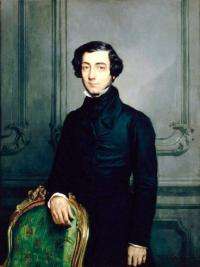
Almost two centuries after he traveled around the United States studying its people and government, the French writer Alexis de Tocqueville remains one of the most influential of all commentators on American politics. Tocqueville’s two-volume masterwork, Democracy in America, published in 1835 and 1840, retains “the uncanny glamour of scripture, cited by all who wish to say something about democracy and its prospects or America and its destiny,” writes MIT emeritus historian Arthur Kaledin in a new book about Tocqueville.
And because Tocqueville often related the strengths of the U.S. government to the optimism and vitality of the country’s culture — “Every day in America is new,” he wrote — citing him allows Americans a double dose of self-flattery: The country’s government works because of the qualities of the people.
But was Tocqueville as sanguine about American democracy as the popular image of his work suggests? Almost certainly not, Kaledin asserts in his book, Tocqueville and His America: A Darker Horizon, published this fall by Yale University Press.
“Tocqueville from the start also saw cultural and social tendencies that he thought would weaken American democracy,” Kaledin says. In his view, Tocqueville, while indeed recognizing real strengths in American society, had grave worries about the materialism, individualism and anti-intellectualism in American culture. “Tocqueville saw that an excess of materialism would create great problems for democracy, and the belief that everything was possible would lead to cultural and social confusion,” Kaledin says.
Aristocratic unease
Kaledin’s interest in Tocqueville grew out of his work teaching American history at MIT dating back to the 1960s, when he joined the Institute. Only in recent decades have all of Tocqueville’s writings become available to scholars, however. By looking beyond Democracy in America, and exhaustively scrutinizing Tocqueville’s notebooks and correspondence, Kaledin has produced an interpretation of his canonical work that is very much grounded in the circumstances of Tocqueville’s life.
Tocqueville was born into an aristocratic French family in 1805, at a time of democratic upheaval and a changing world order; his parents had nearly been guillotined during the French Revolution. In 1830, Tocqueville and his friend Gustave de Beaumont commenced a nine-month trip around the United States, ostensibly to study its prison system for the French government. Democracy in America resulted from this trip. As Kaledin writes, the book represents “Tocqueville’s struggle to make sense of and to reintegrate the shattered world into which he was born and in which he always felt displaced.” And while Tocqueville was far more receptive to democracy than almost anyone in his social circle, Kaledin observes, he always had profound “apprehensions about the prospects for democracy” stemming from his background.
Those apprehensions, in Kaledin’s view, largely focused on the problems a democratic culture might pose for democratic politics. For instance, Kaledin says, to an extent greater than is usually emphasized, Tocqueville thought “populism would gradually lead to an anti-intellectual culture and to mediocrity in political leadership.” Tocqueville was also, Kaledin says, uneasy with the extent to which American culture “heavily emphasized material values over all others.”
As Kaledin readily acknowledges, Tocqueville was highly impressed with Americans and their expectations of equality and participation in politics. But those favorable reactions were intertwined with constant concerns. Consider one of the most influential Tocquevillean ideas: that Americans’ propensity to form associations is a distinctive cultural and political strength, enabling the country to have a healthy civic sphere. Yet in Kaledin’s view, Tocqueville was also keenly aware of the “hyperindividualism” of America, which, Kaledin says, “makes it difficult to achieve a feeling for the common good.”
Or, as Tocqueville wrote, the United States offered the prospect of a land where people have “no traditions, or common habits to forge links between their minds, and they have neither power nor the wish nor the time to come to a common understanding.” In such a condition, he believed, the possibility of productive politics would diminish.
A Tocqueville for the ‘dark side’ of politics
Historians who have read Tocqueville and His America have found Kaledin’s integration of Tocqueville’s life and thought compelling.
“I think it’s a dramatically important book,” says Stanley Katz, a historian and legal scholar at Princeton University’s Woodrow Wilson School of Public and International Affairs. “The key is the insight into Tocqueville the man. He comes across as a much more conflicted, tortured, complicated person than in most accounts.”
As a result, Katz says, the book “gives us a way of understanding Democracy in America that we haven’t had before. It is possible to read it as a mostly affirmative text on American politics and society, but Kaledin is arguing that Tocqueville was deeply conflicted about this. … If you understand that, you see that some of his comments about politics in America aren’t nearly so affirmative as we might think.”
And while Tocqueville has remained firmly in intellectual fashion for at least a half-century, the current dysfunction in Washington, Katz adds, makes a reinterpretation of his work especially timely. “I think it’s highly relevant right now,” Katz says. “This is a time when we have to think about the dark side of American politics. It’s one of the most powerful books I’ve read in a long time.”
For his part, Kaledin also spends a little time in the book pondering what Tocqueville would have made of American politics and society today, or even of the election of Barack Obama in 2008.
“Surely he would have been impressed by evidence of advances toward equality in a multicultural, multiethnic society,” writes Kaledin writes. Still, he adds, “the current political and cultural disarray of American life would only corroborate his analysis of the disintegrative tendencies inherent in democratic culture … he would at best have remained caught in the doubt that seemed to be his fate.”
Provided by Massachusetts Institute of Technology


