How does a plant survive with few mates or pollinators? A European herb has figured out its own way
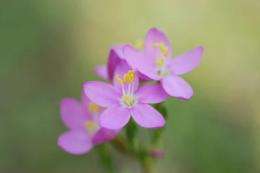
In plants that rely on animals for pollination, the number of seeds they produce, or their relative fitness, is influenced by pollinator visits and the successful deposition of pollen. The number of visits a plant may receive depends partly on pollinator density as well as on conspecific plant density. But what if a plant happens to grow in a population that is small or has very few pollinators visiting its flowers? Will all the effort put into flowering and attracting pollinators have gone to waste? Some plants, including a bright pink, short-lived, western European herb, have found a way to ensure their future reproductive fitness despite such limitations.
When few pollinators are available, plants are visited less often, and thus do not receive as much pollen and produce fewer seeds than they would under more optimal conditions. Additionally, when plants occur in small populations, pollinator behavior may change, which also influences pollen deposition rates and pollen quality—pollinators may increase the amount of time they spend at each flower on the same plant (depositing more self-pollen) or may switch to foraging on other more abundant flowering species (depositing more hetero-specific pollen).
Some plant species have coped with such unpredictable situations by evolving autonomous selfing, where a flower can self-pollinate without the help of a pollinator. However, there may be variable costs of inbreeding depression associated with relying entirely on this mode of reproduction.
Rein Brys and colleagues (from the Terrestrial Ecology Unit, University of Ghent, Belgium and the Plant Ecology Unit, University of Leuven, Belgium) investigated to what extent population size and pollinator availability affected the number of seeds that were produced via self-pollination in the monocarpic herb Centaurium erythraea in a highly fragmented dune area in Belgium. They published their findings in the November issue of the American Journal of Botany.
Centaurium erythraea is pollinated primarily by hoverflies. However, when Brys and his colleagues first started working on this species, they noticed an extraordinary thing. "A remarkable characteristic of this species," notes Brys, "is its surprising and elegant way of realizing delayed selfing, in which anthers curl at the end of a flowers' life in order to shed pollen and guarantee self-pollination."
In situations where autonomous self-fertilization occurs after the chance of out-crossed pollination (e.g., at the end of a flower's life), then autonomous selfing ensures that the plant has at least some chance of passing its genes on to the next generation. This delayed selfing may incur no costs of pollen and/or ovule discounting and may provide reproductive assurance when successful pollinator-mediated seed production fails.
To test the reproductive assurance hypothesis under circumstances where plant populations varied in size and pollinator availability, Brys and colleagues used emasculation experiments in 22 C. erythraea populations, and compared the seed set of flowers in which anthers were removed prior to flowering—and thus could not self-pollinate—with unmanipulated control flowers that were still able to self-pollinate. For each population they determined plant population size (by counting the number of flowering individuals) and pollinator density (using insect traps), and examined how seed set varied with these factors.
The authors found that pollinator-mediated seed set significantly depended upon population size and pollinator availability. The contribution of autonomous seed set, on the other hand, varied greatly among the populations studied, accounting for 19% to 87% of total seed production. More self-pollinated seeds were produced in plants found in populations that were smaller and/or had fewer pollinators, indicating that when pollinators were scarce, plants were able to augment seed production via autonomous self-pollination—a good back-up plan that potentially ensures a constant seed set despite varying environmental variables.
"Our study is one of the first that clearly reveals that delayed selfing in this hoverfly-pollinated short-lived herb confers reproductive assurance and thus functions as a perfect back-up strategy to rely on in unpredictable pollination environments—when populations become small and/or pollinator limited," comments Brys.
"Another remarkable finding," he adds, "is that we were able to show that under these variable pollination environments this mode of autonomous selfing guarantees constant seed set overall."
Indeed, delayed selfing seems to be the perfect solution for this species, which is often found in transient habitats in which population size and pollinators may vary tremendously.
Brys and colleagues now want to delve a little deeper and investigate whether this system of mixed mating represents a stable mating strategy or is just a transient phase towards an obligate selfing or outcrossing mating strategy. "We are also investigating which floral traits may cause variation in the ability to provide reproductive assurance and consequently function as a target of selection," Brys said, "given the observation that the species shows relatively high and variable levels of inbreeding depression."
More information: Brys, Rein, Eske de Crop, Maurice Hoffmann, and Hans Jacquemyn. (2011). Importance of autonomous selfing is inversely related to population size and pollinator availability in a monocarpic plant. American Journal of Botany 98(11): 1834-1840. DOI: 10.3732/ajb.1100154
Journal information: American Journal of Botany
Provided by American Journal of Botany


