Just the two of us: Stable dinucleotide-RNA duplexes show promise in biotechnology
November 23, 2011

Just the two of us: Stable dinucleotide-RNA duplexes show promise in biotechnology

Enlarge

(PhysOrg.com) -- Nucleic acid technology has revolutionized the field of biomedicine, as it can be effectively utilized in the diagnosis, treatment, and prevention of genetic diseases The efficacy of most oligonucleotide therapies is, however, limited as a result of the lability of oligonucleotides in biological fluids and, in particular, their poor delivery to the site of action.

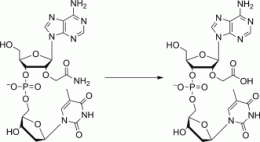
A Swedish team headed by R. Strömberg recently reported in the European Journal of Organic Chemistry that modification of oligonucleotides with a 2'-O-carbamoyl moiety greatly increases the stability of these compounds, which may render their use in constructs for biotechnological and therapeutic applications viable.

Efficiency in the regulation of gene expression is readily achieved if turnover of the target RNA is obtained, but this can only occur if native enzymes recognize the relevant oligonucleotide complex. The ability to catalytically cleave a specific sequence of RNA at a specific site is of high potential value in biotechnology and therapy. Thus, the development of oligonucleotide-based artificial nucleases (OBANs) as artificial enzymes capable of cleaving mRNA sequences arising from genetic or viral diseases is highly sought.

In this context, the scientists set out to modify oligonucleotides with the judicious choice of a 2'-carbamoylmethyl (CM) moiety. Substitution at the 2-position was an important prerequisite, as this has been shown to lead to the formation of stable duplexes with the target , and it was also believed that the CM moiety could further increase the stability of the duplex through hydrogen bonding.

The team was able to show that the 2'-O-carbamoyl modification substantially protected the dinucleotide against enzyme-catalyzed degradation by phosphodiesterase I and made it virtually resistant to degradation by phosphodiesterase II. This, together with the reported increased thermal stability of the duplexes, makes the often-neglected 2'-O-carbamoyl moiety an interesting modification in the pursuit of future compounds that may one day help in the treatment of .

More information: Roger Strömberg, Stability of a 2'-O-(Carbamoylmethyl)adenosine-Containing Dinucleotide, European Journal of Organic Chemistry, http://dx.doi.org/ … oc.201101264

Journal reference: European Journal of Organic Chemistry search and more info website

Provided by Wiley search and more info website


Rank 5 /5 (1 vote)
Relevant PhysicsForums posts
  • Calculating partial pressures Pa and Pw
    created2 hours ago
  • Gibbs Free Energy Change/Entropy
    created12 hours ago
  • What's the rule to covalent character
    created13 hours ago
  • Schwartz reagent-- NMR/MS/IR
    createdMay 26, 2012
  • High school chemistry EEI
    createdMay 25, 2012
  • oxidation of I- by KMnO4
    createdMay 25, 2012
  • More from Physics Forums - Chemistry

More news stories

Computer model used to pinpoint prime materials for efficient carbon capture

When power plants begin capturing their carbon emissions to reduce greenhouse gases – and to most in the electric power industry, it's a question of when, not if – it will be an expensive undertaking.

Chemistry / Materials Science

created 4 hours ago | popularity not rated yet | comments 0 | with audio podcast

Scientists develop ultra-sensitive test that detects diseases in their earliest stages

Scientists have developed an ultra-sensitive test that should enable them to detect signs of a disease in its earliest stages, in research published today in the journal Nature Materials.

Chemistry / Analytical Chemistry

created 4 hours ago | popularity not rated yet | comments 0 | with audio podcast

New CO2-removing catalyst can take the heat

(Phys.org) -- The current method of removing the greenhouse gas carbon dioxide (CO2) from the flues of coal-fired power plants uses so much energy that no one bothers to use it. So says Roger Aines, principal ...

Chemistry / Materials Science

created May 24, 2012 | popularity 5 / 5 (9) | comments 10 | with audio podcast

High-speed method to aid search for solar energy storage catalysts

Eons ago, nature solved the problem of converting solar energy to fuels by inventing the process of photosynthesis.

Chemistry / Materials Science

created May 25, 2012 | popularity 5 / 5 (3) | comments 4 | with audio podcast

Researchers demonstrate possible primitive mechanism of chemical info self-replication

(Phys.org) -- When scientists think about the replication of information in chemistry, they usually have in mind something akin to what happens in living organisms when DNA gets copied: a double-stranded molecule ...

Chemistry / Materials Science

created May 25, 2012 | popularity 5 / 5 (4) | comments 2 | with audio podcast


Nvidia trumpets Tegra 3 phone design wins for 2012

(Phys.org) -- Nvidia’s competitive war paint has a name, Tegra 3. On the heels of Nvidia announcements about lowering costs of its Tegra 3 processors and Nvidia-enabled tablets running Android Ice Cream ...

'Unzipped' carbon nanotubes could help energize fuel cells, batteries

Multi-walled carbon nanotubes riddled with defects and impurities on the outside could replace some of the expensive platinum catalysts used in fuel cells and metal-air batteries, according to scientists at ...

T cells 'hunt' parasites like animal predators seek prey, study shows

By pairing an intimate knowledge of immune-system function with a deep understanding of statistical physics, a cross-disciplinary team at the University of Pennsylvania has arrived at a surprising finding: T cells use a movement ...

Change in developmental timing was crucial in the evolutionary shift from dinosaurs to birds: study

At first glance, it's hard to see how a common house sparrow and a Tyrannosaurus Rex might have anything in common. After all, one is a bird that weighs less than an ounce, and the other is a dinosaur that ...

Land and sea species differ in climate change response: study

(Phys.org) -- Marine and terrestrial species will likely differ in their responses to climate warming, new research by Simon Fraser University and Australia’s University of Tasmania has found.

Scientist: Evolution debate will soon be history

(AP) -- Richard Leakey predicts skepticism over evolution will soon be history. Not that the avowed atheist has any doubts himself.