Smartphones can make you smarter when used as mobile teaching tools
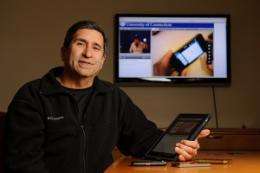
Smartphones are capable of many things, from identifying your location and bringing you the news to playing video games. Now, thanks to a UConn professor’s efforts to make lectures and class discussion available on mobile devices, smartphones can make you smarter as well.
This semester, Oskar Harmon, an associate professor of economics in the College of Liberal Arts and Sciences who teaches at the Stamford campus, began making his lectures available as Flash files that can be played on Android devices and MP4 files that can be played on iPhones. He has also made class discussion available on Facebook, so his students can participate online from their mobile devices.
Harmon was inspired to make his lectures and class discussion available on mobile devices after his daughter got an iPhone last year. The ability to maintain constant contact with other people through texting and social networking sites especially impressed him, and he recognized immediately that mobile media offered a new way to help students learn.
In particular, Harmon hopes to maximize student interaction with the course material. Quoting from a speech by Vice Provost Sally Reis, he says, “Teachers of my generation are ‘digital immigrants,’ and our students are natives who grew up using digital media. We need to adapt and learn how to make use of digital media as online educators.”
Recognizing the widespread use of smart-phones among students, Harmon saw an opportunity to make his coursework more accessible. He made his lectures available as online videos that could be easily navigated, while also creating online forums on Facebook and YouTube to foster class participation. The public atmosphere allows students to build a community that allows them to collaborate and discuss coursework on their own time. Also, interactive programs such as Sumo Paint and Google Draw enable students to draw economic graphs digitally and compare their work with others’.
“The use of hyperlink interface allows students to easily move to the parts of the lecture they are most interested in,” says Harmon. “My students have told me that this allows them to replay the parts of the lectures they need help with. Of course, during a live lecture there is no instant replay.”
Aside from making coursework easier to access, Harmon sees mobile media in cultural terms. As a teacher of online and blended online and in-class courses, he recognizes how valuable class time is in traditional live lectures. However, he wanted to offer his students more options by making coursework available through mobile media. With resources available in-class, online, and now on mobile devices, students can make use of the format that helps them most.
“Feedback has been very positive so far,” says Harmon. “Many students find it helpful for reviewing the course material and for getting help with homework as they are commuting to and from class.” He says the ability to communicate digitally at any time has helped students stay up to date with coursework while holding jobs or even while recovering from an illness.
Harmon has long sought ways to support his teaching with online technology, going back to 1994, when the head of the Department of Economics at that time, Stephen Miller, allowed him to get teaching assistant support via email. Until then, as a faculty member teaching at the Stamford campus, he could not receive teaching assistant help from TAs based in Storrs. His interest in using technology for teaching moved beyond email when he received a $26,000 grant from the Institute for Teaching and Learning in May 2000 and used it to help introduce Web CT course software to faculty and students at UConn Stamford.
In acknowledgement of the help he received from UConn’s Institute for Teaching and Learning in applying digital media to learning, Harmon calls his digital approach “iTL”, meaning “interactive teaching and learning.” He sees his recent work as the beginning of a University-wide effort to use mobile media alongside the current browser-based websites. In particular, he envisions live updates and apps that make all of the University’s resources available with a tap of the finger.
Although he is already using technology to educate students in new ways, Harmon continues to seek new online programs and new ways to use mobile media. “My students are always making great suggestions,” he says. “Anything I can do to increase their exposure to the course material is a good thing.”
Provided by University of Connecticut


