Tear drops may rival blood drops in testing blood sugar in diabetes
Nov 09, 2011
Tear drops may rival blood drops in testing blood sugar in diabetes

Scientists are reporting development and successful laboratory testing of an electrochemical sensor device that has the potential to measure blood sugar levels from tears instead of blood — an advance that could save the world's 350 million diabetes patients the discomfort of pricking their fingers for droplets of blood used in traditional blood sugar tests. Their report appears in ACS' journal Analytical Chemistry.

Mark Meyerhoff and colleagues explain that about 5 percent of the world's population (and about 26 million people in the U.S. alone) have diabetes. The disease is a fast-growing public health problem because of a sharp global increase in obesity, which makes people susceptible to developing type 2 diabetes. People with diabetes must monitor their blood levels several times a day to make sure they are within a safe range. Current handheld glucose meters require a drop of blood, which patients draw by pricking their fingers with a small pin or lancet. However, some patients regard that pinprick as painful enough to discourage regular testing. That's why Meyerhoff's team is working to develop a new, pain-free device that can use tear glucose levels as an accurate reflection of .

Tests of their approach in laboratory rabbits, used as surrogates for humans in such experiments, showed that levels of glucose in tears track the amounts of glucose in the blood. "Thus, it may be possible to measure tear multiple times per day to monitor blood glucose changes without the potential pain from the repeated invasive blood drawing method," say the researchers.

Explore further: Reading the unreadable

More information: Measurement of Tear Glucose Levels with Amperometric Glucose Biosensor/Capillary Tube Configuration, Anal. Chem., 2011, 83 (21), pp 8341–8346. DOI: 10.1021/ac201700c

Abstract
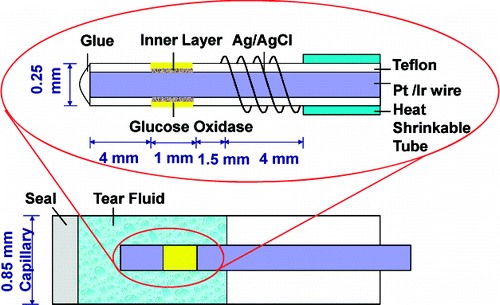
An amperometric needle-type electrochemical glucose sensor intended for tear glucose measurements is described and employed in conjunction with a 0.84 mm i.d. capillary tube to collect microliter volumes of tear fluid. The sensor is based on immobilizing glucose oxidase on a 0.25 mm o.d. platinum/iridium (Pt/Ir) wire and anodically detecting the liberated hydrogen peroxide from the enzymatic reaction. Inner layers of Nafion and an electropolymerized film of 1,3-diaminobenzene/resorcinol greatly enhance the selectivity for glucose over potential interferences in tear fluid, including ascorbic acid and uric acid. Further, the new sensor is optimized to achieve very low detection limits of 1.5 ± 0.4 μM of glucose (S/N = 3) that is required to monitor glucose levels in tear fluid with a glucose sensitivity of 0.032 ± 0.02 nA/μM (n = 6). Only 4–5 μL of tear fluid in the capillary tube is required when the needle sensor is inserted into the capillary. The glucose sensor was employed to measure tear glucose levels in anesthetized rabbits over an 8 h period while also measuring the blood glucose values. A strong correlation between tear and blood glucose levels was found, suggesting that measurement of tear glucose is a potential noninvasive substitute for blood glucose measurements, and the new sensor configuration could aid in conducting further research in this direction.

add to favorites email to friend print save as pdf

Related Stories

Contact lenses check blood sugar

Nov 13, 2006

A scientist in Baltimore has developed a contact lens that can provide diabetics with a non-invasive way to monitor blood sugar.

New device for patients to monitor blood glucose levels

Aug 09, 2010

People with type 1 diabetes must keep a careful eye on their blood glucose levels: Too much sugar can damage organs, while too little deprives the body of necessary fuel. Most patients must prick their fingers ...

Home glucose tests may not help

Jun 28, 2007

A British study shows patient monitoring of glucose levels may not be essential to controlling type 2 diabetes for those not taking insulin.

Carrot cake study on sugar in type 2 diabetes

Jan 08, 2008

Patients with type 2 diabetes are often advised to cut out sucrose (table sugar) all together. However, in recent years this traditional advice has been questioned by some researchers who suggest that moderate amounts of ...

Recommended for you

Attacking MRSA with metals from antibacterial clays

23 hours ago

In the race to protect society from infectious microbes, the bugs are outrunning us. The need for new therapeutic agents is acute, given the emergence of novel pathogens as well as old foes bearing heightened antibiotic resistance.

Beautiful 'flowers' self-assemble in a beaker

May 16, 2013

By simply manipulating chemical gradients in a beaker of fluid, materials scientists at Harvard have found that they can control the growth behavior of crystals to create precisely tailored structures—such ...

Reading the unreadable

May 16, 2013

Pioneering X-ray technology is making it possible to read fragile rolled-up historical documents for the first time in centuries.

Keeping fruit, vegetables and cut flowers fresh longer

May 15, 2013

New technology offers the promise of reducing billions of dollars of losses that occur each year from the silent, invisible killer of fruits, vegetables and cut flowers—a gas whose effects are familiar to everyone who has ...

User comments : 1

Adjust slider to filter visible comments by rank

Display comments: newest first

tadchem
not rated yet Nov 09, 2011
The prospect of no longer having to stab my finger and bleed three times a day makes me want to cry.

More news stories

Attacking MRSA with metals from antibacterial clays

In the race to protect society from infectious microbes, the bugs are outrunning us. The need for new therapeutic agents is acute, given the emergence of novel pathogens as well as old foes bearing heightened antibiotic resistance.

Beautiful 'flowers' self-assemble in a beaker

By simply manipulating chemical gradients in a beaker of fluid, materials scientists at Harvard have found that they can control the growth behavior of crystals to create precisely tailored structures—such ...

Making gold green: New non-toxic method for mining gold

Northwestern University scientists have struck gold in the laboratory. They have discovered an inexpensive and environmentally benign method that uses simple cornstarch—instead of cyanide—to isolate gold from raw materials ...

Galaxy's Ring of Fire

Johnny Cash may have preferred this galaxy's burning ring of fire to the one he sang about falling into in his popular song. The "starburst ring" seen at center in red and yellow hues is not the product of ...

Morocco to harness the wind in energy hunt

Morocco is ploughing ahead with a programme to boost wind energy production, particularly in the southern Tarfaya region, where Africa's largest wind farm is set to open in 2014.