Revolutionary ultrasonic nozzle that will change the way water cleans
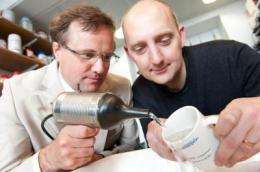
A team of scientists from the University of Southampton have developed a revolutionary ultrasonic attachment for taps, which massively enhances the ability of water to clean.
Currently, industry uses excessive water, power and additives for cleaning. For example, it can take up to 100 tonnes of water to produce 1 tonne of clean wool after shearing. Many industrial processes also generate large quantities of contaminated run-off. The water from hosing down an abattoir represents a real health risk and cannot be allowed to enter the water supply. Purifying run-off is costly – each cubic metre of water used for cleaning in the nuclear industry can cost around £10,000 to subsequently treat.
Professor Tim Leighton and Dr Peter Birkin's device works with cold water, minimal additives and consumes as much electrical power as a light bulb. Its application will be wide – licenses have already been sold to a number of industries to look at cleaning in food preparation, hospitals, manufacturing and the home. The new technology consumes less water and power than the established competitor technologies.
Talking about the need for such a technology, Professor Leighton says:
"Society runs on its ability to clean. Ineffective cleaning leads to food poisoning; failure of manufactured products such as precision watches and microchips; and poor construction – from shipbuilding to space shuttles – since dirty surfaces do not bond. The impact in healthcare is huge – hospital-acquired infections, from instruments that aren't properly cleaned, cost the NHS £1 billion per year. There's a very obvious need for technologies that improve our ability to clean while saving on our most important resources, water and energy."
In recognition of their invention, Professor Leighton and Dr Birkin were today (09 November) awarded the Royal Society Brian Mercer Award for Innovation 2011.
Using the £250,000 award from the Royal Society, the team will develop products based on an ultrasonic nozzle which can fit on the end of a tap or hose. The device uses less water and power than the equivalent pressure washer (approximately 2 litres/minute compared to 20 litres/minute and less than 200 W compared to 2kW). It is also far less damaging as the stream pressure is less that 1/100th that of a pressure washer. Another advantage is that it generates far less runoff and aerosol (tiny atmospheric particles of water that can carry contaminates into the air to then settle and contaminate other surfaces). As it is able to use cold water, energy is saved on heating water.
Power washing generates large volumes of contaminated run-off and aerosols, presenting a hazard when used e.g. cleaning sewage systems or nuclear contamination. One of the main pieces of equipment currently used for industrial cleaning, ultrasonic cleaning baths, can only clean objects small enough to fit in them and the devices to be cleaned sit in a soup of contaminated liquid. Neither power washing (high-power pressure washing) nor ultrasonic cleaning baths can easily be scaled up and neither can be used on delicate materials such as hands or salad.
The new nozzle generates both bubbles and ultrasound. Both travel down the water stream to the dirty surface and there the bubbles act as microscopic 'smart scrubbers', seeking and entering crevices to remove dirt there using shear forces in the same way that currents in a babbling brook can strip off riverbank soil . The device can be used at a high-power and a low-power setting – the latter being suitable for delicate products like hands and foodstuffs.
Licences to enable companies to bring the technology into their product lines have been negotiated with a number of companies to explore cleaning products for hospital hygiene, dentistry, food preparation, manufacturing and the power industries.
Dr Birkin says of the award:
"The Brian Mercer award represents a significant milestone for the development of this technology and its possible exploitation. There is a clear gap in the funding system with ground breaking technology produced by universities, unexploited by industry. It is also difficult to find other suitable sources to take the technology further. It is in this situation that our invention found itself.
"In these trying times for innovative research, the foresight of the Royal Society to regularly sponsor and support these initiatives, should be congratulated. It is also pleasing that a significant 'blue skies' research effort within our team, over the last 10-15 year time period, has led to an understanding of the basic physical and chemical processes that underpin this technology. The Brian Mercer award, as well as being timely, will significantly enhance the chances of this novel technology making the leap from the lab and into wider society."
Professor Leighton adds:
"Support for step changing innovation is vital if we are to have marketable technology to address the problems that will face society on the 10-50 year timescale, rather than just responding to today's problems."
The Brian Mercer Awards for Innovation were established by the Royal Society in 2001 following a bequest from the late Dr Brian Mercer, an enthusiastic inventor and entrepreneur. The awards aim to encourage these qualities in the next generation of scientists and provide a grant of £250,000 to develop an already proven concept or prototype into a near-market product.
Provided by University of Southampton


