Predators drive the evolution of poison dart frogs' skin patterns
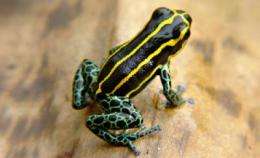
Natural selection has played a role in the development of the many skins patterns of the tiny Ranitomeya imitator poison dart frog, according to a study that will be published in an upcoming edition of American Naturalist by University of Montreal biologist Mathieu Chouteau.
The researcher's methodology was rather unusual: on three occasions over three days, at two different sites, Chouteau investigated the number of attacks that had been made on fake frogs, by counting how many times that had been pecked. Those that were attacked the least looked like local frogs, while those that came from another area had obviously been targeted.
The brightly coloured frogs that we find in tropical forests are in fact sending a clear message to predators: "don't come near me, I'm poisonous!" But why would a single species need multiple patterns when one would do? It appears that when predators do not recognize a poisonous frog as being a member of the local group, it attacks in the hope that it has chanced upon edible prey. "When predators see that their targets are of a different species, they attack. Over the long term, that explains how patterns and colours become uniform in an area," said Bernard Angers, who directed Chouteau's doctoral research.
A total of 3,600 life-size plasticine models, each less than one centimetre long, were used in the study. The menagerie was divided between two carefully identified sites in the Amazon forest. "The trickiest part was transporting my models without arousing suspicion at the airport and customs controls," Chouteau said. He chose plasticine following a review of scientific literature. "Many scientists have successfully used plasticine to create models of snakes, salamanders and poison dart frogs." The Peruvian part of the forest proved to be ideal for this study, as two radically different looking groups of frogs are found there: one, living on a plain, has yellow stripes, and the other, living on a mountain, has green patches. The two colonies are ten kilometers apart. 900 fake frogs were placed in each area in carefully targeted positions. Various combinations of colours and patterns were used.
Chouteau was particularly surprised by the "very small spatial scale at which the evolutionary process has taken place." Ten kilometers of separation sufficed for a clearly different adaptation to take place. "A second surprise was the learning abilities of the predator community, especially the speed at which the learning process takes place when a new and exotic defensive signal is introduced on a massive scale," Chouteau said.
This process could be at origin of the wide range of colour patterns that are observed not only in frogs but also many species of butterflies, bees, and other animals. Mathieu Chouteau is in fact currently undertaking post-doctoral research into the Heliconius genus of butterfly. "Considering that this kind of project requires regular field work, I have taken up residence in the small town of Tarapoto, where I am responsible for the opening of a research centre that will facilitate the study of neotropical butterfly mimicry," he said.
More information: The Role of Predators in Maintaining the Geographic Organization of Aposematic Signals, American Naturalist: www.jstor.org/stable/10.1086/662667
Journal information: American Naturalist
Provided by University of Montreal


