Monkeys with larger friend networks have more gray matter
November 4, 2011 by Lin Edwards report

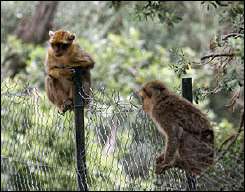
Barbary Macaques (Macaca sylvanus) at a monkeys park in Algeria

New research in the UK on rhesus macaque monkeys has found for the first time that if they live in larger groups they develop more gray matter in parts of the brain involved in processing information on social interactions.

The researchers, led by Jerome Sallet of Oxford University, said the results of the new study bear some similarities to research by other groups working with humans, that related to the extent of social interactions. These studies include recent work that suggested a link between the volume of some regions of the brain and the number of online friends people have in such as Facebook.

The new study observed 23 macaques in a number of groups of different sizes. The monkeys were kept in their groups for an average of over a year, and a minimum of two months. One monkey was alone in its cage, but in all the other groups, which had from two to seven individuals, a heirarchy developed in which an individual's rank depended on the monkey's ability to form successful social interactions, such as friendships and partnerships.

The study used (MRI) to compare the brains of the monkeys, and the results showed that in the temporal areas of the brain associated with social interaction skills, around a five percent increase in the volume of gray matter was found for each additional group member. The regions of the brain that increased in volume included the temporal pole, temporal cortex, and the inferior and rostral temporal gyri.

The researchers also compared the brains of male monkeys at various levels in the dominance-based heirarchy and found a number of brain areas, particularly the and inferior temporal sulcus, were enlarged in males of higher rank.

The research demonstrated that the social networks caused the changes in the brain (rather than enlarged influencing position in the social network, or the size of the network) because the scientists manipulated the size and makeup of the groups over a period of several months, and observed the changes in the brains of the monkeys.

Earlier research has shown that the brain shows plasticity, which means it can change in volume in different regions in response to environmental changes or acquisition of new skills or knowledge. Research had not previously shown brain plasticity in relation to social networking skills.

The paper was published in the journal Science on 4th November.

© 2011 PhysOrg.com

4.3 /5 (6 votes)  

Filter


Move the slider to adjust rank threshold, so that you can hide some of the comments.


Display comments: newest first

RobertKarlStonjek
Nov 04, 2011

Rank: not rated yet
OK, next time a rhesus wants to friend me on Facebook I'll say yes ~ his/her grey matter depends on it!!!
Rank 4.3 /5 (6 votes)
Relevant PhysicsForums posts
  • Consumption rivalry
    createdMay 25, 2012
  • Bilateral trade between all countries
    createdMay 24, 2012
  • Is the economic foundation of social media in jeopardy?
    createdMay 20, 2012
  • Psychology: Rosenthal and Hawthorne Effect
    createdMay 15, 2012
  • Is GDP and National Income the Same Thing?
    createdMay 13, 2012
  • Difference between hourly wage and real GDP per hour worked?
    createdMay 12, 2012
  • More from Physics Forums - Social Sciences

More news stories

Change in developmental timing was crucial in the evolutionary shift from dinosaurs to birds: study

At first glance, it's hard to see how a common house sparrow and a Tyrannosaurus Rex might have anything in common. After all, one is a bird that weighs less than an ounce, and the other is a dinosaur that ...

Other Sciences / Archaeology & Fossils

created 4 hours ago | popularity 5 / 5 (2) | comments 0 | with audio podcast

Social welfare cuts ultimately come with heavy price, researchers say

(Phys.org) -- Slashing government funding for Medicaid, food stamps and other programs that serve the poor – while politically popular with some lawmakers and many conservatives – may do more harm ...

Other Sciences / Social Sciences

created May 24, 2012 | popularity 4.3 / 5 (16) | comments 154

Ancient Bethlehem seal unearthed in Jerusalem

Israeli archaeologists have discovered a 2,700-year-old seal that bears the inscription "Bethlehem," the Israel Antiquities Authority announced Wednesday, in what experts believe to be the oldest artifact ...

Other Sciences / Archaeology & Fossils

created May 23, 2012 | popularity 3.5 / 5 (14) | comments 24

Dollars and sense: Why are some people morally against tax?

As the U.S. presidential election campaigns heat up, the economic debate is dominated by bailouts, austerity and, inevitably, taxation. Now a new study published in Symbolic Interaction asks why tax is such an important issue ...

Other Sciences / Social Sciences

created May 23, 2012 | popularity 3 / 5 (2) | comments 15

Oldest Jewish archaeological evidence on the Iberian Peninsula

German archaeologists of the Friedrich Schiller University Jena found one of the oldest archaeological evidence so far of Jewish Culture on the Iberian Peninsula at an excavation site in the south of Portugal, ...

Other Sciences / Archaeology & Fossils

created May 25, 2012 | popularity 4.2 / 5 (6) | comments 12


Nvidia trumpets Tegra 3 phone design wins for 2012

(Phys.org) -- Nvidia’s competitive war paint has a name, Tegra 3. On the heels of Nvidia announcements about lowering costs of its Tegra 3 processors and Nvidia-enabled tablets running Android Ice Cream ...

'Unzipped' carbon nanotubes could help energize fuel cells, batteries

Multi-walled carbon nanotubes riddled with defects and impurities on the outside could replace some of the expensive platinum catalysts used in fuel cells and metal-air batteries, according to scientists at ...

T cells 'hunt' parasites like animal predators seek prey, study shows

By pairing an intimate knowledge of immune-system function with a deep understanding of statistical physics, a cross-disciplinary team at the University of Pennsylvania has arrived at a surprising finding: T cells use a movement ...

Computer model used to pinpoint prime materials for efficient carbon capture

When power plants begin capturing their carbon emissions to reduce greenhouse gases – and to most in the electric power industry, it's a question of when, not if – it will be an expensive undertaking.

Land and sea species differ in climate change response: study

(Phys.org) -- Marine and terrestrial species will likely differ in their responses to climate warming, new research by Simon Fraser University and Australia’s University of Tasmania has found.

Scientist: Evolution debate will soon be history

(AP) -- Richard Leakey predicts skepticism over evolution will soon be history. Not that the avowed atheist has any doubts himself.