Manufacturing microscale medical devices for faster tissue engineering
In the emerging field of tissue engineering, scientists encourage cells to grow on carefully designed support scaffolds. The ultimate goal is to create living structures that might one day be used to replace lost or damaged tissue, but the manufacture of appropriately detailed scaffolds presents a significant challenge that has kept most tissue engineering applications confined to the research lab.
Now a team of researchers from the Laser Zentrum Hannover (LZH) eV Institute in Hannover, Germany, and the Joint Department of Biomedical Engineering at the University of North Carolina at Chapel Hill and North Carolina State University have modified a manufacturing technique called two-photon polymerization (2PP) to create finely detailed structures such as tissue scaffolds more quickly and efficiently than was previously possible. The new technique, which the team describes in a paper published this week in the Optical Society's (OSA) open-access journal Biomedical Optics Express, could help pave the way to more wide-spread clinical use of microscale medical devices.
Many important biological functions take place on the microscopic level and as medical research advances into this Lilliputian realm, scientists have turned to precise techniques such as 2PP to create the tiny tools necessary to manipulate cells and other miniscule structures. In current-generation 2PP technology, a laser pulse that lasts approximately one quadrillionth of a second sends a burst of energy into unset resin, causing the molecules around the pulse to fuse together into two adjoining cone shapes. By focusing on multiple points in succession, 2PP can build up complex 3D structures, cone-shaped block by cone-shaped block.
2PP can be used to manufacture devices from a wide range of base materials and does not require extreme temperatures, harsh chemicals, or cleanroom facilities, but its main drawback is long fabrication times. Like in a tiled mosaic, small 2PP building blocks can create a richly detailed design, but if you want a large structure, like a tissue scaffold that could mimic natural body parts, it can take a long time to lay all the pieces together.
"Blood vessel networks can be several centimeters in length, but walls of the smallest branches (capillaries) are only a few micrometers thick. The same applies with any tissue. Many tissues may be large, but they all have important features on the microscale," says team member Shaun Gittard of the LZH. The team notes that using conventional 2PP to manufacture the tissue scaffolds for such structures could be prohibitively slow. They address the problem by using a computer-controlled hologram to split the 2PP laser into multiple beams, creating up to 16 different focus points that can work simultaneously.
"As an example, take the time for fabricating a single layered, 1-millimeter square with 100 nanometer resolution," the authors write. "With conventional single-focus 2PP at one millimeter per second, the fabrication time would be 2 hours and 47 minutes. In contrast, with 16 foci this same area could be scanned in merely 10 minutes." Or, in other words, many foci make light work.
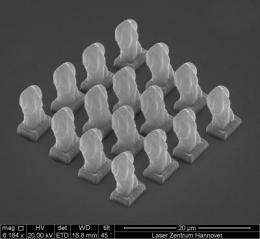
The team first tested their multiple foci system by creating 16 miniature Venus statues, each so small as to be invisible to the human eye (see figure 1). "The Venus is kind of a logo of our research group," says Gittard. "We have used it as a familiar demonstration structure for various fabrication techniques."
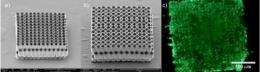
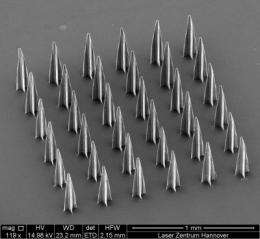
In addition to replicas of classic Greek artwork, the team also used the new technique to manufacture cylindrical tissue scaffolds (see figures 2) and an array of microneedles. Less than a half millimeter wide, rocket-shaped microneedles can be used to provide painless injections or take blood samples, notes Gittard (see figure 3). "One of the biggest promises in the future is real-time, pain-free glucose sensing and insulin delivery for treating diabetes," he says.
For now the team has only used the multiple beams to create multiple copies of the same structure. Their next goal is to use the system to produce one large, complex 3-D structure, which is a more complicated task since it requires moving the relative placement of the different foci during the fabrication process, Gittard says.
"The ability to produce large-scale devices with sub-micron features is exciting, as many cell features, such as organelles, are on this size scale," the authors write. Gittard explains that such detailed features could be used to control cell attachment and alignment, which is important since cell orientation affects function in a number of tissues, such as blood vessels, nerves, bone, and muscle.
More information: Paper: "Fabrication of microscale medical devices by two-photon polymerization with multiple foci via a spatial light modulator," Shaun D. Gittard, Alexander Nguyen, Kotaro Obata, Anastasia Koroleva, Roger J. Narayan, Boris N. Chichkov, Biomedical Optics Express, Volume 2, Issue 11, pp. 3167-3178 (2011). www.opticsinfobase.org/boe/abs … fm?uri=boe-2-11-3167
Provided by Optical Society of America


