Researchers design new handle to make lifting infant car seats safer, easier
Nov 28, 2011
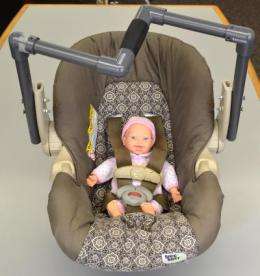
By changing the angle of the ICS handle, the NC State team made it easier on parents and safer for infants. Credit: Caleb Burrus, North Carolina State University

Engineers at North Carolina State University have developed a new handle for infant car seats (ICSs) that makes it easier for parents to lift the seat out of a car – while retaining a firmer grip on the handle – making it less likely that the seat will be dropped.

"Many products that are designed for parents don't take ergonomics into account, and the instructions are usually not very helpful," says Michael Clamann, a Ph.D. student at NC State and lead author of a paper describing the research. "We wanted to see whether, by changing the angle of the ICS handle, we could make it easier on and safer for the baby. Our idea was that it would be easier to hold on to the seat, minimizing the risk of dropping it." The idea was inspired by Clamann's experiences as a parent.

The researchers based their new handle design on existing research that details which angles reduce "ulnar deviation," or how much your wrist bends, and associated pressure in the carpal tunnel. This is important in terms of lifting tasks, because the further you bend your wrist, the weaker your grip.

The researchers tested the new design versus the traditional ICS handle with 10 different women of similar height (5th to 20th percentile in height). Participants were asked to lift the car seat out of a mock-up midsize sedan and place it into a stroller.

The team used sensors to measure muscular activity at the forearm and biceps and the wrist angle of the participants as they lifted the ICSs with different handle designs.

"Our angled handle lets people better position themselves over the car seat," Clamann says, "and allowed them to use their biceps more than their forearm muscles. That's an improvement, because our biceps are stronger than our forearms, and so are better able to bear weight. This is particularly important for smaller females lifting ICSs." The participants also told researchers that the angled handle design was easier to lift.

The team also tested to see how foot placement – in the car or on the ground – affected the participants' posture – and therefore their wrist angle. Such foot placement was previously recommended in the popular press literature regarding ICS handling.

"We found that placing your foot in the car to help lift the ICS allowed participants to use their biceps more and reduced how much they bent their wrists – giving them a firmer grip on the ICS," says Kinley Taylor, an NC State graduate student and co-author of the paper. "However," adds Clamann, "putting your foot in the car also increased the likelihood of hitting your head on the doorframe."

The researchers plan to move forward with additional efforts to see how variations on the angled handle design affect ergonomics when used in different car designs, such as minivans, and for people who are significantly taller than the participants in this study.

Explore further: Sensitive bomb detector to rove in search of danger

More information: The paper, "Comparison of infant car seat grip orientations and lift strategies," is published online by Applied Ergonomics.

add to favorites email to friend print save as pdf

Related Stories

Keep your kids properly secured while traveling

Sep 26, 2011

Child Passenger Safety Week is celebrated every year to remind parents and other caregivers of the need to keep children of all ages properly restrained in a seat that meets their weight and height requirements.

RA sufferers armed with kitchen safety tool (w/ Video)

Mar 07, 2011

For sufferers of rheumatoid arthritis (RA), cooking tasks can be both difficult and dangerous. However, a new assistive technology invented by a student from Queensland University of Technology in Brisbane, ...

Back seat less safe: Australian study

Aug 31, 2010

Adults who ride in the back of new cars are at higher risk of serious injury during an accident than those in the front seat, new research has found.

Recommended for you

Sensitive bomb detector to rove in search of danger

May 24, 2013

European researchers have developed and tested a light-weight device capable of detecting extremely minute quantities of explosives from up to 20 metres away, providing an invaluable law-enforcement tool ...

How soon could car seats enter the 3-D comfort zone?

May 23, 2013

New 3D textiles made of recyclable polyester fibres could contribute help cars be easier to recycle. But recycling technology has yet to progress in separating seat material from other car components.

NASA: Austin, calling Austin. 3-D pizzas to go

May 22, 2013

(Phys.org) —The idea of living with 3-D printed food is neither unthinkable nor new; designers and futurists have been looking to 3-D printing as food's next frontier. In 2012, there was news that the Thiel ...

User comments : 2

Adjust slider to filter visible comments by rank

Display comments: newest first

Temple
5 / 5 (1) Nov 28, 2011
This is new? These types of carseat handle have been on the market for quite a while.

Example:
http://www.infant...eats.png
Nerdyguy
1.6 / 5 (7) Nov 28, 2011
This is new? These types of carseat handle have been on the market for quite a while.

Example:
http://www.infant...eats.png


You're right. Two things came to mind when I saw the image:

1) Not a (completely) new design. Maybe the angle is slightly different.

2) The "oversize" design, while perhaps an engineering plus, appears to exacerbate a problem common among parents with small kids - never having enough space, especially in backseats.

Perhaps the large size is only applicable to the model, but if it's meant to be that large in a final version...yikes!

More news stories

Yahoo, pay-TV operators among Hulu bidders

Online video site Hulu is again up for sale, with Yahoo and pay TV operators DirecTV and Time Warner Cable among the seven bidders, according to a person with direct knowledge of the matter.

Radiation leak at Japan lab; small impact expected

An atomic research lab in northern Japan has reported a radiation leak that may have affected about 50 people, though none were hospitalized and no impact was expected outside the facility, the lab's operator ...