Preparing a homogenous haystack
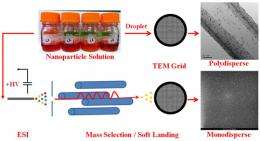
(PhysOrg.com) -- What if you could turn the whole haystack into needles? Instead of hunting for one item, you’d have 10 billion of the desired items laid out neatly in front of you. That’s what researchers at the Pacific Northwest National Laboratory did for scientists analyzing nanoparticles. Using the ion soft-landing technique developed at PNNL, the scientists prepared a homogeneous, contaminant-free sample of gold clusters, tiny particles made up of 11 gold atoms each. The team then analyzed the samples in the new aberration-corrected transmission electron microscope or TEM at EMSL.
"This is a very promising approach for TEM sample preparation," said Dr. Julia Laskin, a physical chemist at PNNL who directed the research.
Around the world, scientists use TEM to obtain detailed data on the structure of new catalysts and other materials. One example is gold, which can be highly reactive and excellent catalysts in a nanoparticle form. However,the TEM analysis can destroy the subnanometer-sized particles being examined. So, scientists must continually hunt through conventional heterogeneous samples to find more of the particles they wish to analyze. Using the ion soft-landing sample preparation technique, scientists get the job done faster as all 10 billion particles are the same.
"TEM is the workhorse technique for characterizing small particles," said Dr. Grant Johnson, a physical chemist at PNNL and the first Linus Pauling Distinguished Postdoctoral Fellow. "This is a way of making that valuable process easier."
The research team focused on 11-atom gold clusters. Gold clusters have chemical and physical properties that are highly size dependent. Removing or adding an atom can greatly change the structure and behavior of the clusters, which are of interest to scientists for their potential to create materials with novel chemical, magnetic or optical properties. Thomas Priest, a DOE Science Undergraduate Laboratory intern, synthesized the clusters, creating a reddish-orange solution. The synthesis process generates vials full of liquid, packed with gold particles of various sizes.
Johnson then electrosprayed the solution into a unique custom-built mass spectrometer at EMSL that is specially designed for ion soft landing. The electrospray turns the gold clusters in the liquid into ions in a gaseous stream. He then tuned the mass spectrometer to select the desired clusters: the 11 gold atom ions. The ions were then gently deposited with controlled energy onto a sample grid.
Dr. Chongmin Wang then picked up the sample-laden grid and took it to another laboratory containing the electron microscope. Wang was able to obtain images of the clusters, thereby determining their size, which was 0.8 nanometers, and confirming their homogeneity.
Johnson and members of Laskin's team are now studying how the structure of these small clusters changes when different numbers of gold atoms are used to form the cluster. For example, how does the structure change when 8 gold atoms are present in the cluster versus 6?
More information: GE Johnson, C Wang, T Priest, and J Laskin. 2011. "Monodisperse Au11 Clusters Prepared by Soft Landing of Mass Selected Ions." Analytical Chemistry. 83, 8069-8072. DOI: 10.1021/ac202520p
Provided by Pacific Northwest National Laboratory


