DNA testing settles 70-year mystery over possible conjoined twins buried at ancient Angel Mounds site
November 18, 2011 By Steve Chaplin
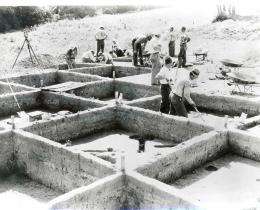
A portion of the East Village of Angel Mounds near Evansville, Ind., under excavation in 1941 by Works Progress Administration workers led by Indiana archaeologist Glenn A. Black. Black proposed that a pair of co-buried infant skeletons excavated at the time were conjoined twins. Credit: Indiana University
(PhysOrg.com) -- A mystery revealed 70 years ago when archaeologist Glenn A. Black suggested the ancient remains of two infants buried at Southern Indiana's Angel Mounds archaeological site were conjoined twins has been solved through DNA analysis at Indiana University.
When Black and a Works Progress Administration excavation crew in 1941 discovered the unique grave -- two infants buried in a single interment -- the position of the skeletons relative to one another led Black to hypothesize they were conjoined. Even though inspection showed no shared elements of conjoined twinning or fused skeletal elements, Black's field interpretation of the double burial still led him to suspect that the two were flesh-joined twins.
"The 'conjoined twins' are well known at the Glenn Black Laboratory (at IU) and also within the Department of Anthropology," said Charla Marshall, an adjunct professor of anthropology at Indiana University-Purdue University Indianapolis who received her Ph.D. from IU Bloomington this year. "They are pretty legendary, as such interesting case studies often come to be."
Legendary enough, too, for Marshall to propose a test of Black's hypothesis by using recoverable maternally inherited mitochondrial DNA, or mtDNA, to compare genotypes of the co-buried infants, which in and of itself was a unique find: Of the 310 mostly adult burial sites discovered at the Middle Mississippian Age (A.D. 1050-1400) village near Evansville, Ind., only 3 to 5 percent contained two or more nearly complete individuals.
Even if the tests showed the remains to be those of ordinary twins, the dual interment was still unique, Marshall noted. Many societies at the time viewed twin births negatively and one or both twins would be killed, while in other Eastern North American societies a twin birth was accorded high status and deaths would have warranted excessive ceremony. This burial, Black noted at the time, was otherwise unremarkable with no adornment and a location in the common burial area at Angel Mounds.
Using an automated DNA sequencing system at the Indiana Molecular Biology Institute at IU Bloomington, the team led by Marshall analyzed the mtDNA of each infant, passed down only through the maternal lines to offspring of both sexes, to determine whether the two infants belonged to the same haplogroup (common ancestors identified through similar DNA sequence variations called single-nucleotide polymorphisms).
Not only were the two infants not twins, and therefore not possibly conjoined, but the two were not even maternal siblings, test results found. One infant belonged to Haplogroup C, an mtDNA lineage believed to have arisen geographically between the Caspian Sea and Lake Baikal about 60,000 years ago, and the other belonged to Haplogroup A, which is thought to have come from Asia between 30,000 and 50,000 years ago.
"In addition to using molecular genetics analysis to shed light on this 70-year-old mystery, we also make one more case in all of the evidence against a requirement for a maternal relationship for co-burial in Midwestern societies," Marshall said.
Co-authors on the findings that appeared in the American Journal of Physical Anthropology were IU Anthropology professors Della Collins Cook and Frederika A. Kaestle, and Patricia A. Tench, an adjunct associate professor at the University of Cincinnati.
Journal reference:
American Journal of Physical Anthropology
Provided by
Indiana University
-
From lemons to lemonade: Reaction uses carbon dioxide to make carbon-based semiconductor,
32 comments
-
Thioridazine kills cancer stem cells in human while avoiding toxic side-effects of conventional cancer treatments,
3 comments
-
SpaceX private rocket blasts off for space station (Update),
42 comments
-
Climate scientists say they have solved riddle of rising sea,
31 comments
-
SpaceX capsule has 'new car' smell, astronauts say (Update),
4 comments
-
What would stain as translucent on light-coloured fabric?
21 hours ago
-
How do I identify different bacteria on culture plates?
May 26, 2012
-
Why Do Dogs do Strange things...
May 25, 2012
-
What does exophillic and endophillic mean in terms of mosquito and their control?
May 24, 2012
-
Semen stains glows under black lights (uv light)?
May 23, 2012
-
Question on Human Chromosome 2
May 23, 2012
- More from Physics Forums - Biology
More news stories
Change in developmental timing was crucial in the evolutionary shift from dinosaurs to birds: study
At first glance, it's hard to see how a common house sparrow and a Tyrannosaurus Rex might have anything in common. After all, one is a bird that weighs less than an ounce, and the other is a dinosaur that ...
Other Sciences / Archaeology & Fossils
1 hour ago |
5 / 5 (2) |
0
|
Social welfare cuts ultimately come with heavy price, researchers say
(Phys.org) -- Slashing government funding for Medicaid, food stamps and other programs that serve the poor while politically popular with some lawmakers and many conservatives may do more harm ...
Other Sciences / Social Sciences
May 24, 2012 |
4.3 / 5 (16) |
151
Ancient Bethlehem seal unearthed in Jerusalem
Israeli archaeologists have discovered a 2,700-year-old seal that bears the inscription "Bethlehem," the Israel Antiquities Authority announced Wednesday, in what experts believe to be the oldest artifact ...
Other Sciences / Archaeology & Fossils
May 23, 2012 |
3.5 / 5 (14) |
23
Oldest Jewish archaeological evidence on the Iberian Peninsula
German archaeologists of the Friedrich Schiller University Jena found one of the oldest archaeological evidence so far of Jewish Culture on the Iberian Peninsula at an excavation site in the south of Portugal, ...
Other Sciences / Archaeology & Fossils
May 25, 2012 |
4.4 / 5 (5) |
12
Dollars and sense: Why are some people morally against tax?
As the U.S. presidential election campaigns heat up, the economic debate is dominated by bailouts, austerity and, inevitably, taxation. Now a new study published in Symbolic Interaction asks why tax is such an important issue ...
Other Sciences / Social Sciences
May 23, 2012 |
3 / 5 (2) |
12
'Unzipped' carbon nanotubes could help energize fuel cells, batteries
Multi-walled carbon nanotubes riddled with defects and impurities on the outside could replace some of the expensive platinum catalysts used in fuel cells and metal-air batteries, according to scientists at ...
T cells 'hunt' parasites like animal predators seek prey, study shows
By pairing an intimate knowledge of immune-system function with a deep understanding of statistical physics, a cross-disciplinary team at the University of Pennsylvania has arrived at a surprising finding: T cells use a movement ...
Computer model used to pinpoint prime materials for efficient carbon capture
When power plants begin capturing their carbon emissions to reduce greenhouse gases and to most in the electric power industry, it's a question of when, not if it will be an expensive undertaking.
Yale study concludes public apathy over climate change unrelated to science literacy
Are members of the public divided about climate change because they don't understand the science behind it? If Americans knew more basic science and were more proficient in technical reasoning, would public consensus match ...
Same gene that stunts infants' growth also makes them grow too big: research
UCLA geneticists have identified the mutation responsible for IMAGe* syndrome, a rare disorder that stunts infants' growth. The twist? The mutation occurs on the same gene that causes Beckwith-Wiedemann syndrome, which makes ...
Scientists develop ultra-sensitive test that detects diseases in their earliest stages
Scientists have developed an ultra-sensitive test that should enable them to detect signs of a disease in its earliest stages, in research published today in the journal Nature Materials.
Nov 19, 2011
Rank: not rated yet