Cornell scientists review future of graphene
November 9, 2011 By Anne Ju

Cornell scientists review future of graphene

Enlarge

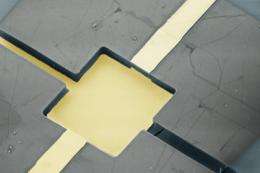
A false-color microscopy image of a 30-by-30 micron square of graphene covering a square trench to form a nanomechanical resonator. These devices, which are the thinnest possible microelectromechanical systems and are useful for sensing and signal processing, can now be batch-fabricated as a result of recent advances in graphene fabrication technology.

(PhysOrg.com) -- Graphene is sort of a scientific rock star, with countless groups studying its amazing electrical properties and tensile strength and dreaming up applications ranging from flat-panel screens to elevators in space.

The single-layer carbon sheets' stellar qualities are only just being understood in all their capacities, say scientists at Cornell -- and researchers can dream big (or rather, very small) when it comes to everything can offer.

That's what scientists in the lab of Harold Craighead, the Charles W. Lake Professor of Engineering, say in an American Vacuum Society online review article, Sept. 9, about graphene's present and future. The article made the cover of the printed journal and quickly became one of its most-downloaded pieces.

"It's becoming clear that with modern , you can imagine turning graphene into a technology," said Robert A. Barton, graduate student and lead author. "People often focus on the of graphene, and they don't really think as much of its mechanical applications."

It's precisely this area where Cornell has produced some pioneering work. In particular the Craighead group, in collaboration with others including Jiwoong Park, assistant professor of chemistry and , and Paul McEuen, the Goldwin Smith Professor of Physics, has used graphene in nanoelectromechanical systems (NEMS), analogous to an earlier generation's (MEMS).

"We've moved beyond working with little exfoliated flakes and more with grown materials that can be incorporated and connected with electronics and other mechanics," Craighead said. "So the question is, can you make these reliably, uniformly and reproducibly?"

It was only a few years ago that scientists figured out how to make arrays of hundreds of thousands of graphene devices using a process called chemical vapor deposition. This involves growing the single-layer sheets of honeycomb-latticed carbon atoms on top of copper, then manipulating the graphene to make devices.

One of the Cornell researchers' devices is like a drum head -- a piece of graphene, one atom thick, suspended over a hollow well. Although growth of graphene by on copper was invented elsewhere, Cornell researchers were the first to figure out how to make mechanical resonators from the large-area material.

"Four years ago we were able to make about one, and that took several months," Barton said. Speeding up the fabrication process has greatly increased graphene's potential in devices.

At Cornell, Barton and colleagues are working on making mass sensors out of graphene, which is atomically structured so it's sensitive to both mass and electric charge. What can result is that a bit of mass landing on a surface of suspended graphene will perturb the mechanical and electronic structure simultaneously, analogous to today's mass spectrometry but on a much smaller and more sensitive level, Barton explained.

The Cornell researchers are using optical interferometry to monitor the motion of a sheet of graphene. In this technique, the subtle device motions are read as variations in reflected light intensity, which are monitored by a fast photodiode connected to a spectrum analyzer. Another group at Cornell, led by McEuen, had earlier developed a way to "read out" carbon nanotubes, a technique that can also apply to graphene, Barton said.

The rapid progress of graphene makes its future very exciting, Craighead said.

"Graphene has gone from an oddity in a physics lab to something that can be practically incorporated into a variety of potential devices," he said. "The ability to fabricate things in these ways, to integrate them and to use them for different types of sensors, physical and chemical, is quite a step forward in a short time, and our group is one of the many that's contributed to this."

Provided by Cornell University search and more info website


Rank 5 /5 (7 votes)
Relevant PhysicsForums posts
  • microstructure of titanium
    createdMay 26, 2012
  • Steam in My Espresso Machine
    createdMay 26, 2012
  • Density question
    createdMay 24, 2012
  • Mass transport originating from a point source at a solid gas interface
    createdMay 22, 2012
  • Ammonia dispersion in Air
    createdMay 22, 2012
  • Multi Choice Help
    createdMay 21, 2012
  • More from Physics Forums - Materials & Chemical Engineering

More news stories

'Unzipped' carbon nanotubes could help energize fuel cells, batteries

Multi-walled carbon nanotubes riddled with defects and impurities on the outside could replace some of the expensive platinum catalysts used in fuel cells and metal-air batteries, according to scientists at ...

Nanotechnology / Nanomaterials

created 3 hours ago | popularity not rated yet | comments 0 | with audio podcast

Dopant gives graphene solar cells highest efficiency yet

(Phys.org) -- By taking advantage of graphene’s favorable electrical and optical properties, and then adding an organic dopant, researchers have achieved the highest power conversion efficiency yet for ...

Nanotechnology / Nanophysics

created May 21, 2012 | popularity 5 / 5 (10) | comments 14 | with audio podcast feature

In nanorod crystal growth, nanoparticles seen as artificial atoms

In the growth of crystals, do nanoparticles act as "artificial atoms" forming molecular-type building blocks that can assemble into complex structures? This is the contention of a major but controversial theory ...

Nanotechnology / Nanophysics

created May 24, 2012 | popularity 4.8 / 5 (6) | comments 0 | with audio podcast

First direct observation of oriented attachment in nanocrystal growth

Berkeley Lab researchers have reported the first direct observation of nanoparticles undergoing oriented attachment, the critical step in biomineralization and the growth of nanocrystals. A better understanding ...

Nanotechnology / Nanophysics

created May 24, 2012 | popularity 4.7 / 5 (3) | comments 0 | with audio podcast

Synthetic nano-waste does not disappear

(Phys.org) -- Tiny particles of cerium oxide do not burn or change in the heat of a waste incineration plant. They remain intact on combustion residues or in the incineration system, as a new study by Swiss ...

Nanotechnology / Bio & Medicine

created May 25, 2012 | popularity 5 / 5 (2) | comments 1 | with audio podcast


Land and sea species differ in climate change response: study

(Phys.org) -- Marine and terrestrial species will likely differ in their responses to climate warming, new research by Simon Fraser University and Australia’s University of Tasmania has found.

T cells 'hunt' parasites like animal predators seek prey, study shows

By pairing an intimate knowledge of immune-system function with a deep understanding of statistical physics, a cross-disciplinary team at the University of Pennsylvania has arrived at a surprising finding: T cells use a movement ...

Computer model used to pinpoint prime materials for efficient carbon capture

When power plants begin capturing their carbon emissions to reduce greenhouse gases – and to most in the electric power industry, it's a question of when, not if – it will be an expensive undertaking.

Change in developmental timing was crucial in the evolutionary shift from dinosaurs to birds: study

At first glance, it's hard to see how a common house sparrow and a Tyrannosaurus Rex might have anything in common. After all, one is a bird that weighs less than an ounce, and the other is a dinosaur that ...

Nvidia trumpets Tegra 3 phone design wins for 2012

(Phys.org) -- Nvidia’s competitive war paint has a name, Tegra 3. On the heels of Nvidia announcements about lowering costs of its Tegra 3 processors and Nvidia-enabled tablets running Android Ice Cream ...

Yale study concludes public apathy over climate change unrelated to science literacy

Are members of the public divided about climate change because they don't understand the science behind it? If Americans knew more basic science and were more proficient in technical reasoning, would public consensus match ...