Shaping up for cell division
November 4, 2011

Shaping up for cell division

Enlarge

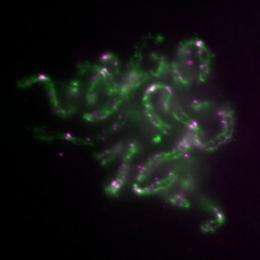
Figure 1: Mitotic chromosomes assembled in the Xenopus cell-free system. Condensin I (green) and II (magenta) display distinct localizations within the chromosomes. Credit:

The shape of chromosomes is determined by the relative levels of key protein complexes, research conducted by Keishi Shintomi and Tatsuya Hirano of the RIKEN Advanced Science Institute has shown.

As a cell prepares to divide via the process called mitosis, chromatin—the material in which DNA is packaged—condenses to form discrete rod-shaped structures called . Each chromosome contains duplicated chromatids—sister chromatids—that are aligned in parallel. After ‘mitotic chromosome condensation’ is complete, the paired chromatids segregate such that each daughter cell receives one of each pair.

“For well over a century, biologists have noticed that the shape of condensed chromosomes is highly characteristic, but varies among different organisms or among different developmental stages in a single organism,” explains Hirano. “We are interested in understanding how the shape of chromosomes is determined at a molecular level.”

Hirano’s group previously discovered that mitotic chromosome condensation requires the action of two protein complexes, known as condensins I and II. This group and others have shown that a third called cohesin is responsible for the pairing of sister chromatids within a chromosome. 

To test exactly how condensins and cohesin may contribute to shaping of chromosomes, Shintomi and Hirano turned to a cell-free system based on extracts prepared from the eggs of the frog Xenopus laevis. “The Xenopus system perfectly suited our purposes because it enables us to recapitulate many chromosomal events, including chromosome condensation, in a test tube in a cell-cycle regulated manner (Fig. 1),” says Hirano. 

To achieve their goal, the researchers then had to develop a series of sophisticated experimental protocols to precisely manipulate the levels of condensins I and II and cohesin present in the extracts.

Under the standard condition, chromosomes assembled in this cell-free system tended to be long and thin, which are general characteristics of chromosomes observed in early embryos. Strikingly, however, when the ratio of condensin I to II was reduced, they became shorter and thicker, being reminiscent of chromosomes observed in later stages of development. Further experiments revealed that cohesin works with condensin I and counteracts condensin II to properly place sister chromatids within a chromosome. Thus, their actions can be likened to a molecular ‘tug-of-war’.

“Our findings demonstrated that chromosome shape is achieved by an exquisite balance between condensin I and II and cohesin,” says Hirano. “Such a concept had been suspected for a long time, but has never been demonstrated so beautifully and convincingly until now.”

More information: Shintomi, K. & Hirano, T. The relative ratio of condensin I to II determines chromosome shapes. Genes & Development 25, 1464–1469 (2011). doi: 10.1101/gad.2060311

Provided by RIKEN search and more info website


Rank 4 /5 (1 vote)
Relevant PhysicsForums posts

More news stories

Scientist: Evolution debate will soon be history

(AP) -- Richard Leakey predicts skepticism over evolution will soon be history. Not that the avowed atheist has any doubts himself.

Biology / Evolution

created 22 hours ago | popularity 3.5 / 5 (20) | comments 85

Manufacturing genes to attack flu virus

An international research team has manufactured a new protein that can combat deadly flu epidemics.

Biology / Biotechnology

created 3 hours ago | popularity not rated yet | comments 0 | with audio podcast

More plant species responding to global warming than previously thought

(Phys.org) -- Far more wild plant species may be responding to global warming than previous large-scale estimates have suggested.

Biology / Ecology

created May 22, 2012 | popularity 4.6 / 5 (14) | comments 18 | with audio podcast

Thousands of shellfish found dead in Peru

Thousands of crustaceans were found dead off the coast of Lima following the mystery mass death of dolphins and pelicans, the Peruvian Navy said Friday.

Biology / Ecology

created May 26, 2012 | popularity 4.7 / 5 (6) | comments 7

For monogamous sparrows, it doesn't pay to stray (but they do it anyway)

It's quite common for a female song sparrow to stray from her breeding partner and mate with the male next door, but a new study shows that sleeping around can be costly.

Biology / Plants & Animals

created May 22, 2012 | popularity 5 / 5 (2) | comments 8 | with audio podcast


Land and sea species differ in climate change response: study

(Phys.org) -- Marine and terrestrial species will likely differ in their responses to climate warming, new research by Simon Fraser University and Australia’s University of Tasmania has found.

'Unzipped' carbon nanotubes could help energize fuel cells, batteries

Multi-walled carbon nanotubes riddled with defects and impurities on the outside could replace some of the expensive platinum catalysts used in fuel cells and metal-air batteries, according to scientists at ...

T cells 'hunt' parasites like animal predators seek prey, study shows

By pairing an intimate knowledge of immune-system function with a deep understanding of statistical physics, a cross-disciplinary team at the University of Pennsylvania has arrived at a surprising finding: T cells use a movement ...

Computer model used to pinpoint prime materials for efficient carbon capture

When power plants begin capturing their carbon emissions to reduce greenhouse gases – and to most in the electric power industry, it's a question of when, not if – it will be an expensive undertaking.

Change in developmental timing was crucial in the evolutionary shift from dinosaurs to birds: study

At first glance, it's hard to see how a common house sparrow and a Tyrannosaurus Rex might have anything in common. After all, one is a bird that weighs less than an ounce, and the other is a dinosaur that ...

Nvidia trumpets Tegra 3 phone design wins for 2012

(Phys.org) -- Nvidia’s competitive war paint has a name, Tegra 3. On the heels of Nvidia announcements about lowering costs of its Tegra 3 processors and Nvidia-enabled tablets running Android Ice Cream ...