Details of ancient shark attack preserved in fossil whale bone
Nov 10, 2011
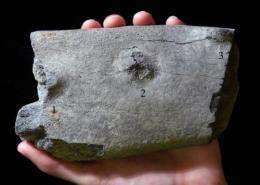
Whale bone fossil showing three tooth marks from a shark. The marks on the rib indicate the whale was once severely bitten by a strong-jawed animal. Judging by the 6 centimeter (2.4 inch) spacing between tooth marks, scientists believe the attacker was a mega toothed shark Carcharocles megalodon, or perhaps another species of large shark which was alive at that time. The whale appears to have been an ancestor of a great blue or humpback. Credit: Photo by Stephen Godfrey

A fragment of whale rib found in a North Carolina strip mine is offering scientists a rare glimpse at the interactions between prehistoric sharks and whales some 3- to 4-million years ago during the Pliocene.

Three on the rib indicate the whale was once severely bitten by a strong-jawed animal. Judging by the 6 centimeter spacing between tooth marks, scientists believe the attacker was a mega toothed shark Carcharocles megalodon, or perhaps another species of large shark which was alive at that time. The whale appears to have been an ancestor of a great blue or humpback.

"One certainly doesn't expect to find evidence of animal behavior preserved in the , but this shows just that, a failed predation," explains Stephen Godfrey, at the Calvert Marine Museum in Solomons, Md. and a Smithsonian research collaborator, who discovered the fossil. "The shark may have gone away with a mouthful, but it didn't kill the whale"

Scientists know the whale survived because "most of the fossil fragment is covered with a type of bone known as woven bone, which forms rapidly in response to localized infection," explains Don Ortner, an anthropologist at the Smithsonian's and authority on the effect of disorders on skeletal tissue. "Biomechanically woven bone is not very strong. The body eventually remodels it into compact bone, but it takes time." CT scans reveal evidence of inflammation in the bone marrow consistent with infection.
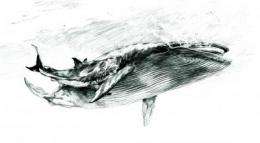
This illustration shows one plausible way, and the most likely, in which the three calluses preserved on the whale rib came about: a bite from one of the large Pliocene sharks with which these huge baleen whales had to contend. Credit: Illustration by Timothy Scheirer © CMM

The presence of the woven bone indicates the healing was incomplete and the whale died, the scientists estimate, between two and 6 weeks after the attack. The whale's death may have been unrelated to its infection and injury, Ortner says. "We don't know why it died."

Based on the curvature of the shark's jaw, as indicated by the arc of the impressions of its teeth, the scientists believe the shark was relatively small, between 4- and 8 meters long.

In the realm of paleontology, "only a handful of fossils show these kinds of interactions," Godfrey explains. "There are lots of bite marks on fossils showing where the animal died and its carcass was scavenged. This fossil is one of a very few examples that shows a trauma clearly attributed to another animal, yet also shows the victim survived the event."

Explore further: Prehistoric rock art maps cosmological belief

More information: "Bone Reactions on a Pliocene Cetacean Rib Indicate Short-Term Survival of Predation Event" was published in the International Journal of Osteoarchaeology.

Related Stories

Bone-eating 'zombie' worms can no longer hide

Oct 31, 2011

Bone-eating 'zombie' worms may be good at keeping out of sight, living off dead whales in the darkness of the sea floor, but scientists have found out how to detect them, even if there’s no trace of their ...

Second ancient whale found in Italy

Apr 02, 2007

The skeleton of a 33-foot-long prehistoric whale has been discovered in what was once an ancient seabed in Italy's Tuscany region.

Oily whale bones puzzle solved

Aug 31, 2010

The puzzle of why some oily whale bones make great habitats for weird and wonderful deep sea creatures has been solved by Natural History Museum scientists this month.

Recommended for you

Prehistoric rock art maps cosmological belief

2 hours ago

It is likely some of the most widespread and oldest art in the United States. Pieces of rock art dot the Appalachian Mountains, and research by University of Tennessee, Knoxville, anthropology professor Jan ...

User comments : 0

More news stories

Prehistoric rock art maps cosmological belief

It is likely some of the most widespread and oldest art in the United States. Pieces of rock art dot the Appalachian Mountains, and research by University of Tennessee, Knoxville, anthropology professor Jan ...

'Ugly' finding: Unattractive workers suffer more

People who are considered unattractive are more likely to be belittled and bullied in the workplace, according to a first-of-its-kind study led by a Michigan State University business scholar.

The hidden agenda of Obama's opposition

Is the US Tea Party movement a racial backlash against President Obama? A new study by Angie Maxwell from the University of Arkansas, and Wayne Parent from Louisiana State University, assesses whether racial attitudes are ...

Metamorphosis of moon's water ice explained

Using data gathered by NASA's Lunar Reconnaissance Orbiter (LRO) mission, scientists believe they have solved a mystery from one of the solar system's coldest regions—a permanently shadowed crater on the ...